
The Best Conversation Intelligence APIs for Product Teams in 2026
The best conversation intelligence APIs in 2026 aren’t interchangeable, and for a product team the differences decide the integration. A team embedding call intelligence into its own application is solving a different problem from a sales team buying a coaching platform: it wants an endpoint that accepts transcript content, returns data its code can act on, and stays out of the way of the interface it is building. Recording quality, moment tagging, and a polished reviewer experience are the features that sell platforms, and they matter very little when software, not a person, consumes the output.
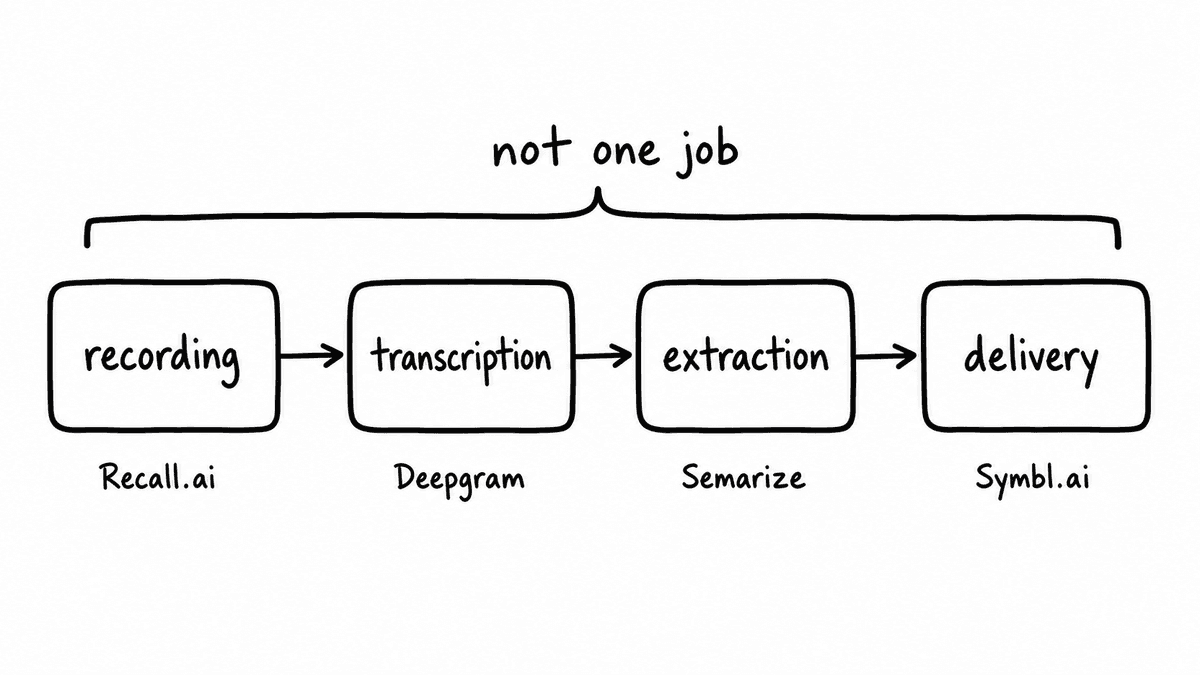
The phrase “conversation intelligence API” covers at least four separate jobs, and most of the difficulty in choosing one comes from treating them as a single category. Recording a call, turning audio into text, extracting meaning from that text, and delivering the result in real time are different problems, and different vendors are best at each. A team that knows which of the four it needs can choose quickly. A team that assumes one API does all four well usually finds the gap in production, after the integration is already load-bearing.
The short version, before the detail. If you need structured fields you define and control, Semarize is the strongest fit, because it returns typed JSON against a schema you own. If you need transcription with some built-in analysis, AssemblyAI covers both in one API. Deepgram is the pick for fast, accurate speech-to-text at scale, Recall.ai for getting a bot into Zoom, Teams, and Meet to capture the call in the first place, and Symbl.ai for real-time topics and action items during a live conversation. Most product teams combine two or three of these rather than buying one.
The best conversation intelligence APIs for product teams, compared
The table below maps each option to the job it does well. Read it as a starting shortlist rather than a ranking, because the right pick depends on which of the four jobs your product actually needs to own.
| API | Primary job | Output | Best for |
|---|---|---|---|
| Semarize | Semantic extraction | Typed JSON against a schema you define | Scoring, CRM enrichment, signal extraction |
| AssemblyAI | Transcription + audio intelligence | Transcript, sentiment, topic detection | Transcription-first applications |
| Symbl.ai | Real-time semantic extraction | Topics, action items, sentiment | Live meeting and agent-assist features |
| Deepgram | Transcription | Transcript with speaker labels | Fast, accurate speech-to-text at scale |
| Recall.ai | Recording infrastructure | Raw audio and transcription | Recording Zoom, Teams, and Meet programmatically |
The four jobs hiding inside one category
Recording is getting a bot into a Zoom, Teams, or Meet call and capturing the audio. Transcription turns that audio into speaker-attributed text. Semantic extraction reads the text and produces something structured: topics, sentiment, action items, or typed fields against a schema you define. Delivery is whether all of that happens during the call or after it ends. Recall.ai specialises in the first, Deepgram in the second, and the differences that actually matter between the rest live in the third and fourth.
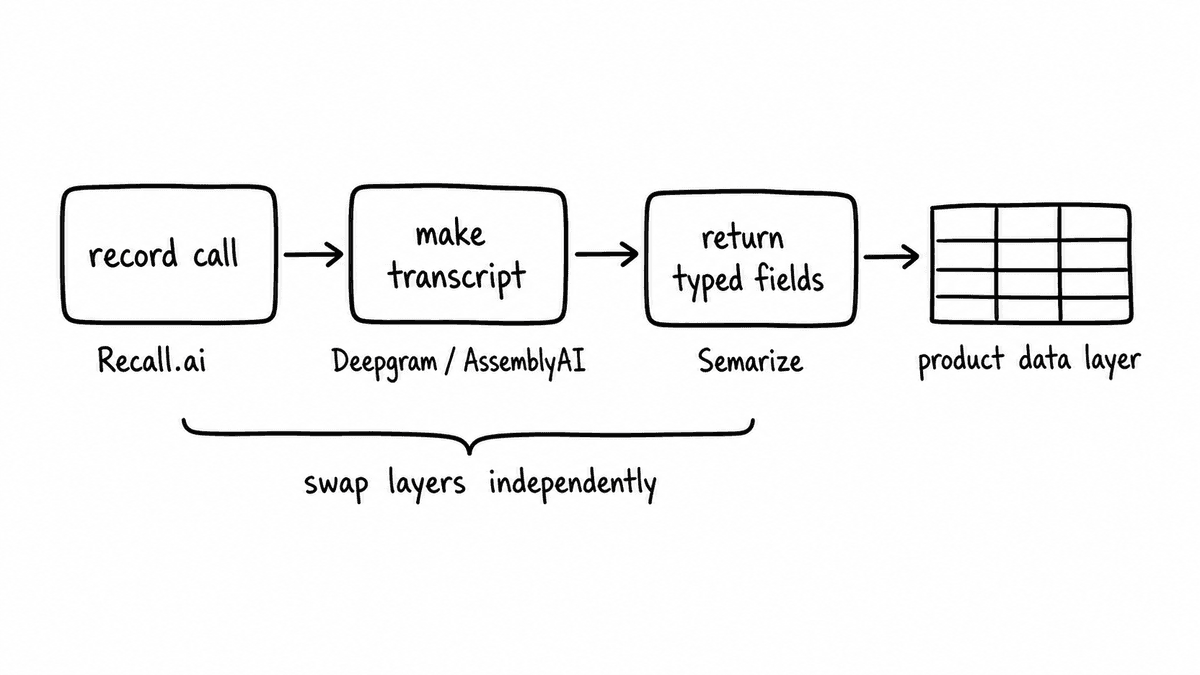
A product team rarely needs one vendor to own all four. The teams that integrate cleanly tend to pick the best option for each job and connect them, because the recording concern and the intelligence concern change on different timelines and for different reasons. The teams that struggle usually bought a single API on the promise of full coverage, then found the extraction layer, the part their product actually depends on, was the weakest of the four.
Semarize: typed signal extraction against a schema you control
Semarize is a conversation intelligence API that turns calls, emails, chats, and transcripts into structured JSON signals for automation, reporting, scoring, and downstream workflows. It is built for the extraction job specifically, and it differs from the other options on one axis: the schema is defined by the customer rather than the vendor. Evaluation logic lives in Bricks, individual typed criteria that test a transcript for specific observable evidence and return a concrete value, grouped into Kits, versioned schemas that produce the same shaped object from every call run through them.
For a product team, the practical consequence is that the output maps directly to the fields its code already expects. A team building a sales productivity tool can define the exact signals its users care about: whether a buyer articulated a quantifiable pain, whether a competitor came up, whether the next step was confirmed with a date. The API returns those as typed values, not as a prose summary the downstream code has to parse and second-guess, which makes the output safe to compare across calls, aggregate into a score, or write straight to a database. Teams that need to query this data later often pair it with a warehouse or BI workflow, and the Semarize MCP exposes the same signals to agents and assistants.
Best fit: teams that need conversation intelligence as structured data they own, for scoring, CRM enrichment, QA, reporting, or automation. Not best fit: Semarize isn’t a meeting recorder, a call storage platform, or a transcription engine, so a team whose main need is recording, word-level streaming, or a rep-facing review UI should reach for AssemblyAI, Deepgram, or Recall.ai instead, and supply Semarize a transcript only if structured extraction is also on the requirements list.
AssemblyAI: transcription with built-in audio intelligence
AssemblyAI offers a transcription API with a set of audio intelligence features layered on top: speaker diarisation, sentiment analysis, topic detection, and content safety classification. For a team that wants a single API to handle transcription and a baseline of semantic analysis, it covers both without chaining separate services, which lowers the integration surface for an early-stage product.
Best fit: transcription-first applications that also want standardised, vendor-defined classifications such as sentiment and topics without configuring anything. Not best fit: a team that needs domain-specific scoring, for example grading calls against a sales methodology or a custom QA rubric, because the topics and sentiment categories come from AssemblyAI’s own models and can’t be redefined into the exact fields the product requires. That team will add an extraction layer on top of the transcript to get there.
Symbl.ai: real-time conversation intelligence
Symbl.ai provides conversation intelligence over audio, video, and text, including real-time topic and action-item extraction, sentiment analysis, and speaker-level attribution. Its streaming API processes a conversation as it happens rather than after it ends, which suits live meeting assistance and real-time agent support in contact-centre applications.
Best fit: live meeting and agent-assist features where the output is surfaced to a person during the call. Not best fit: feeding a downstream data system with typed, consistent fields, because the output is oriented toward human-readable insight, and turning topics and summaries into stable structured values means owning a reshaping layer. The structured output field contract post explains why that layer costs more to build and maintain than it first appears.
Deepgram: fast, accurate speech-to-text at scale
Deepgram concentrates on transcription quality and speed, with strong accuracy across accented speech and industry-specific vocabulary. For a product team whose first requirement is high-quality transcription at low latency, it is worth evaluating on those terms.
Best fit: high-volume, low-latency transcription, often as the speech-to-text component in a multi-vendor stack where Deepgram produces the transcript and a downstream API turns it into structured fields. Not best fit: any use case that needs scoring, classification, or structured signal on its own, since Deepgram doesn’t provide semantic extraction above the transcript and a team that needs it will add a layer such as Semarize after transcription.
Recall.ai: programmatic recording infrastructure
Recall.ai provides a bot-based API for recording Zoom, Teams, and Google Meet calls programmatically, without the meeting host installing anything. For a product team building an application that needs to join and record calls on behalf of its users, Recall.ai handles the infrastructure: bot management, recording, and delivery of raw audio or transcript.
Best fit: getting reliable recordings and transcripts out of meetings your product doesn’t host. Not best fit: extracting meaning from the result, since Recall.ai doesn’t provide semantic evaluation above the recording layer. The common pattern pairs it with a downstream service: Recall.ai records and delivers the transcript, and a service such as Semarize or AssemblyAI applies analysis, which keeps the recording concern swappable independently of the intelligence concern.
How to choose: four questions that settle it
The first question is whether the team needs to define its own evaluation schema or whether vendor-defined classifications will do. Custom schemas are required for domain-specific scoring, methodology alignment, or any case where the exact fields and their types have to be controlled. General classifications such as sentiment, topic, and action items are fine when the product doesn’t care about the precise shape of the output.
The second is who consumes the output. Typed JSON that feeds a CRM, a warehouse, or an automation trigger is a different artefact from a prose summary a person reads, and an API that is good at one is rarely good at the other. Semarize produces the first; most of the rest produce the second.
The third is whether the team already has a transcript source. A team built on Gong, Fathom, or Zoom usually has transcripts already and needs only the extraction layer. A team starting from nothing needs transcription as well, which points either to a multi-vendor stack or to a single API like AssemblyAI that covers transcription and basic analysis together.
The fourth is real-time versus post-call. Most downstream data use cases, including CRM enrichment, coaching analysis, and pipeline reporting, don’t need processing during the call, and post-call webhook delivery is enough. If the use case genuinely needs to act mid-call, that narrows the field to APIs with streaming support and changes the shortlist.
Semarize is the extraction layer in this stack: it turns calls, emails, chats, and transcripts into typed JSON your product can act on, against a schema you define.
Common questions
What is the best conversation intelligence API for a product team?
It depends on the job. For structured fields you define and control, Semarize is the strongest fit, because it returns typed JSON against your own schema. For transcription with built-in analysis, AssemblyAI covers both. Deepgram is best for fast, accurate speech-to-text, Recall.ai for recording Zoom, Teams, and Meet programmatically, and Symbl.ai for real-time topics and action items during a live call. Most product teams combine a recording or transcription API with a separate extraction layer rather than relying on one vendor for everything.
Can one API handle recording, transcription, and extraction together?
Some options cover more than one job, but none covers all three with equal depth. Broad coverage usually means a shallower extraction layer, and deep extraction usually means bringing your own transcript. For a product team with real requirements at each layer, a composable stack tends to win, with Recall.ai for recording, Deepgram or AssemblyAI for transcription, and Semarize for structured extraction. The cost is one more integration; the benefit is the ability to change any layer without rebuilding the others.
What is the difference between vendor-defined and customer-defined output?
Vendor-defined output means the model decides which topics, sentiment labels, or entities to return based on its own logic, which is what AssemblyAI and Symbl.ai produce. Customer-defined output means you specify the exact criteria and the API returns typed values against them, which is what Semarize produces through Bricks and Kits. If your product needs the same fields in the same shape on every call, customer-defined output removes the guesswork; if standardised classifications are enough, vendor-defined output is simpler to adopt.
How do we test an extraction API before building on it?
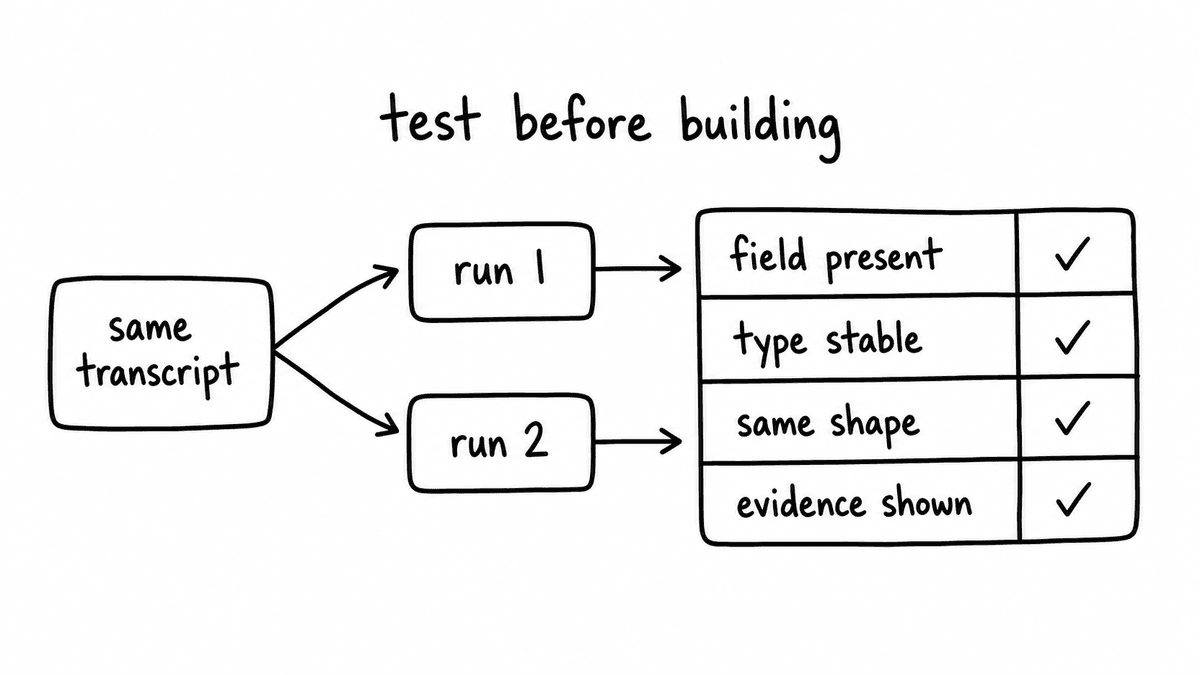
Run a sample of real calls through the API and measure three things: field presence rates, type consistency, and schema stability across repeated runs on the same input. A field that returns different values for the same transcript on separate runs points to unstable scoring logic, not just variable call content. Check null rates on the fields your product depends on against real calls before you commit. The API evaluation criteria post covers the full framework.
Continue reading
Read more from Semarize
Conversation Intelligence for Developers: Don't Build a Fragile Pipeline, Don't Buy a Black Box
Most teams don't fail to add conversation intelligence because the model is bad; they fail because the integration is fragile and unstructured. The fix isn't a better LLM pipeline or a platform API you can't control. It's a layer that takes a transcript, runs it against a versioned Kit, and returns deterministic typed JSON you can test, version, and route into your product.
The Best APIs for Building Internal Sales Tools in 2026
The GTM engineering stack for internal sales tooling is well settled in 2026. Here is what each layer looks like, which tools are worth building around, and what RevOps and enablement teams are actually assembling from them.
Gong Captures the Transcript. Here’s What It Can’t Score.
Gong’s scoring runs against a fixed model — you can’t attach your product documentation, rate card, or qualification playbook to its evaluation layer. For four evaluations that matter — product accuracy, pricing audit, methodology A/B testing, and deal readiness scoring — knowledge grounding and KB isolation are the only architecture that works.