
Gong API Alternatives for Structured Output
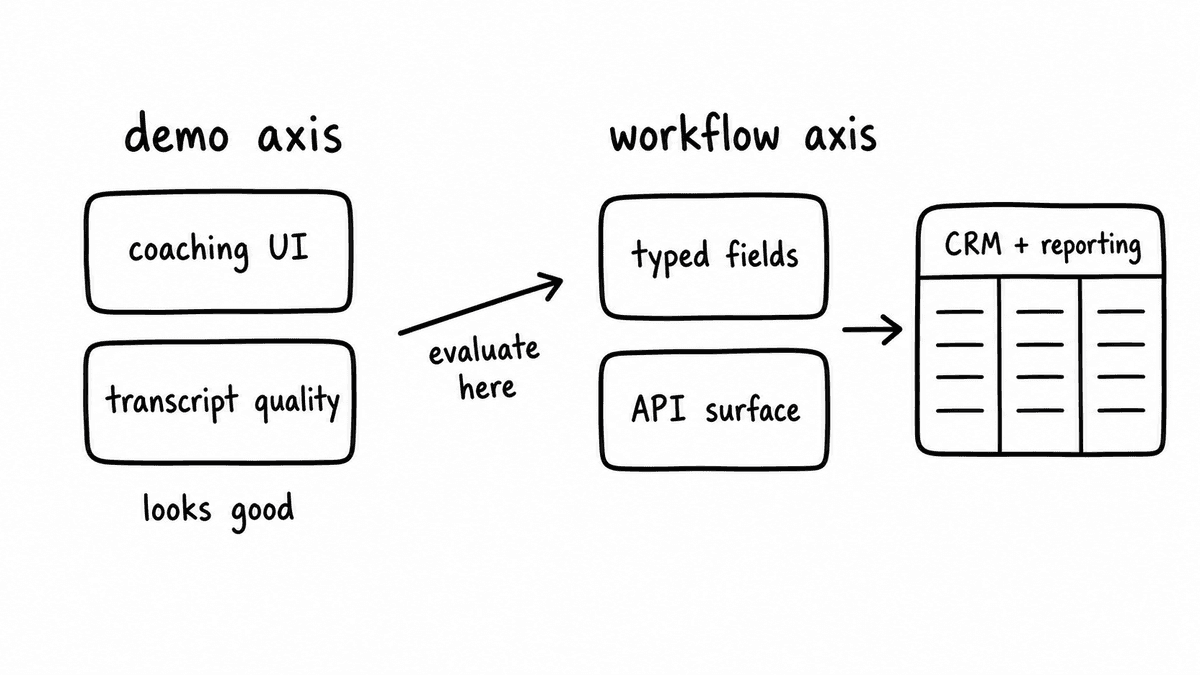
Most teams that struggle to integrate conversational intelligence data into their RevOps workflows describe it as an API problem. The API is limited, the fields are not quite right, the data requires too much reshaping before it is usable. In most cases, these are not API problems; they are requirements problems that were never solved before the vendor was chosen. The team bought the platform based on the coaching UI and the transcript quality, and only discovered what the structured output looked like for downstream systems after the contract was signed.
This pattern is specific enough to be worth naming: teams evaluate conversational intelligence platforms on the wrong axis, optimise for UI and AI quality, and then discover that their automation, CRM enrichment, and reporting workflows need something the platform was not designed to produce. Evaluating alternatives before that point requires knowing what axis to evaluate on, and defining the output requirements before the demos start.
What an API-first alternative actually means
When RevOps teams say they need a Gong API alternative, they rarely mean they need an alternative to the platform itself; most Gong users value the call coaching, the deal intelligence, and the rep-facing features, and those are genuinely good. What they mean is that they need programmatic access to structured call data that can flow directly into CRM fields, reporting models, and workflow automations without a manual extraction step in between.
Gong does expose an API. It provides access to calls, transcripts, and metadata. The constraint is not the existence of the API but the format of what it returns and the integration surface area it exposes: whether the output includes the specific typed fields that downstream systems need, whether historical backfill is available for onboarding, and whether incremental sync and webhooks are supported well enough for production pipeline use. An API-first alternative is one where the structured output for RevOps workflows is a first-class design goal rather than a secondary access path to data the platform primarily surfaces through its UI.
The two axes that determine integration success
The evaluation criteria that predict integration success in this category are structured output fields and integration surface area. Transcript quality and coaching UI do not appear on this list because they do not determine how the data behaves once it leaves the platform.
Structured output fields are the typed values that the API returns for each call: the specific fields available, their types, their stability across releases, their null rates on real call samples, and whether they are defined by the vendor or configurable by the customer. A platform that returns rich prose summaries and transcript text gives you raw material; a platform that returns typed scored fields against a schema you define gives you data your CRM and reporting systems can consume directly. The difference is whether the extraction layer is inside your pipeline or inside the platform’s model.
Integration surface area covers the mechanics of getting data reliably from the platform into your systems: authentication model, historical backfill endpoints for onboarding existing calls, incremental sync for keeping the data current without full reloads, and webhook support for real-time delivery when calls end. A platform that only supports full data exports or polling without incremental sync creates maintenance overhead and delivery gaps that compound over time. For production pipeline use, all four of these need to work reliably; discovering that one of them is missing or poorly supported after signing is expensive to work around.
The default belief that causes the failure
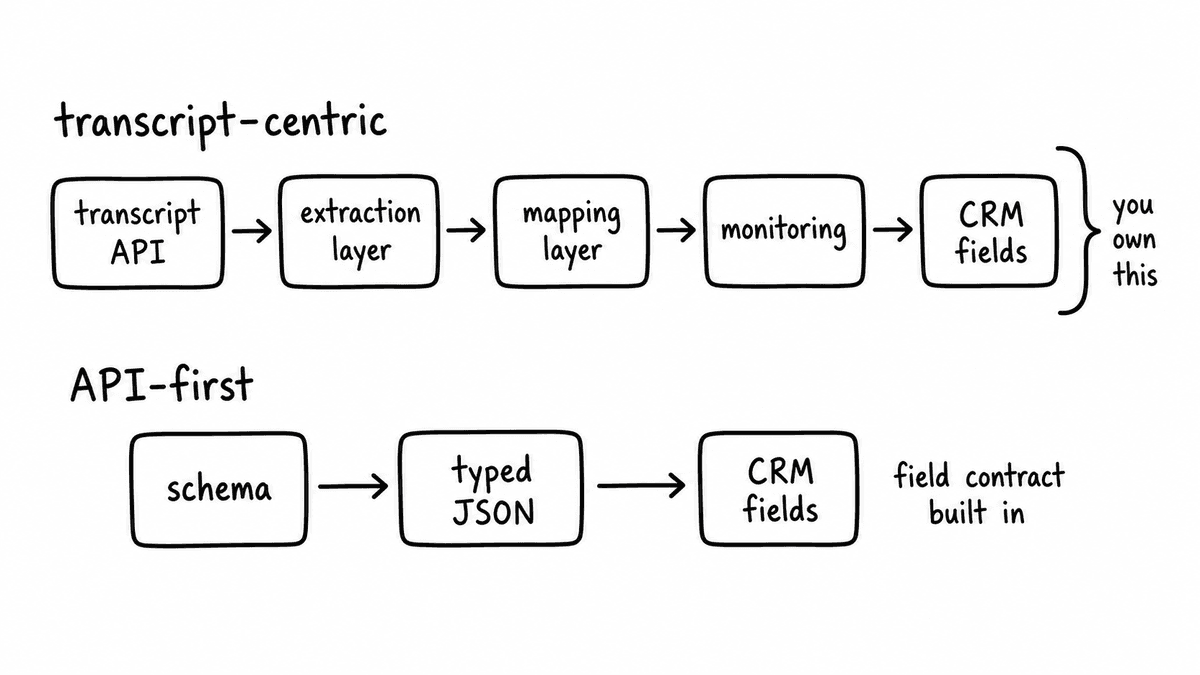
The default belief that leads to integration failures in this category is that if a vendor has an API, the data can always be reshaped into whatever format is needed downstream. This belief is wrong in a specific way: reshaping transcript-centric data into the typed fields that CRM and reporting workflows need requires a second extraction layer, and that extraction layer is itself a piece of infrastructure that needs to be built, maintained, and updated when the schema changes.
Teams that go down this path end up owning more infrastructure than they planned for: a pipeline that pulls from the platform API, an extraction layer that turns transcript text into typed values, a mapping layer that joins those values to CRM records, and a monitoring layer that catches schema drift when the platform updates its model. All of this is solvable engineering work, but it is not the simple “connect the API” integration the procurement assumption implied. Starting with a platform that produces structured output in the first place removes the middle layers entirely.
Platform lock-in is an output portability problem
Lock-in risk in conversation intelligence is not primarily about contract terms; it is about output portability. If the structured fields your RevOps workflows depend on are only accessible through a specific platform’s API, and that API has limited historical backfill or no incremental sync, migrating to a different platform means rebuilding the data pipeline from scratch and losing the historical signal data that the existing models were trained on.
The mitigation is designing for portability from the start: owning the evaluation schema rather than depending on the vendor’s model to define the fields, ensuring historical backfill is available so the data is not stranded in a vendor system, and using a structured output format like JSON that can be replicated or reprocessed if the source changes. A platform that lets you define the schema through customer-configurable evaluation criteria gives you portability that transcript-centric platforms with fixed output schemas do not.
Write the field contract before the demos
The single most effective change to the vendor evaluation process for this category is writing the field contract before any demo calls are scheduled. A field contract is the exact JSON fields your RevOps systems need from conversation data: field names, types, expected presence rates, and which systems consume each field. It takes two hours to write and it changes every subsequent conversation with a vendor from “does this look impressive?” to “can this produce the specific output my systems need?”
With the field contract in hand, vendor evaluation becomes a structured technical assessment. Can the vendor produce the fields on the contract, in the declared types, with acceptable null rates? Are those fields available via API rather than only through the UI? Is historical backfill available so the data can be populated for existing calls during onboarding? Is incremental sync supported for keeping the pipeline current? And is webhook delivery available for real-time use cases?
Vendors who cannot answer these questions specifically during an evaluation are unlikely to answer them satisfactorily after the contract is signed. The evaluation is the cheapest point to surface the gap between what a platform offers and what your RevOps workflows actually need, and the field contract is the tool that makes the gap visible.
Where Semarize fits
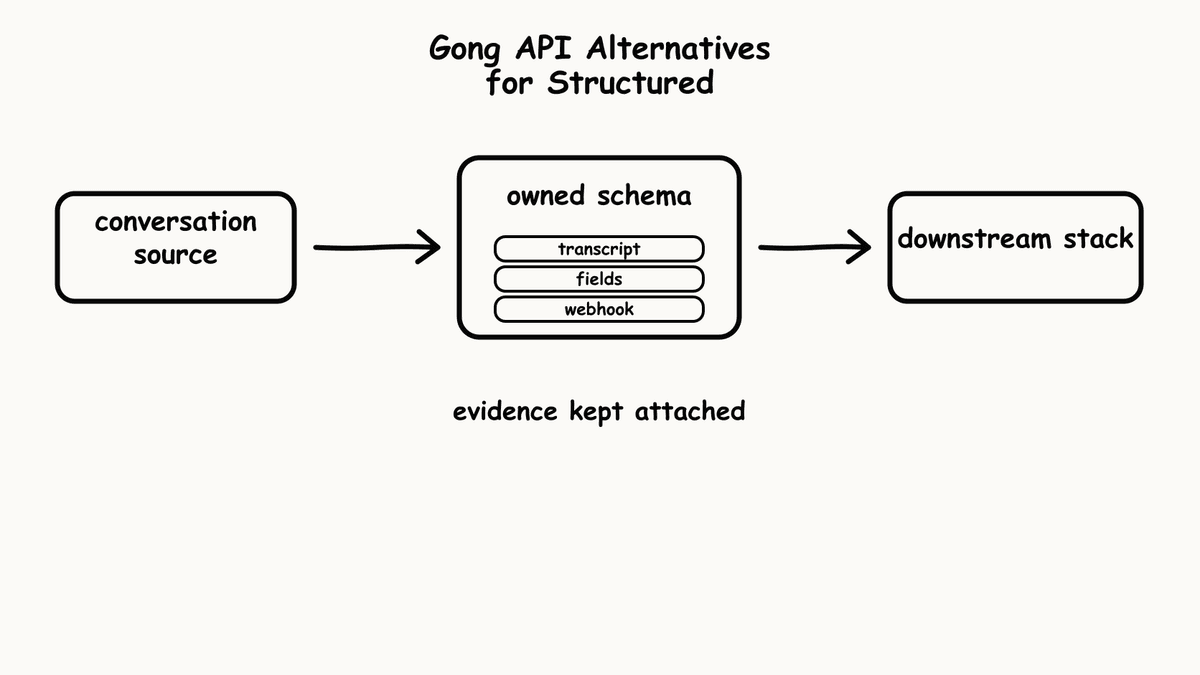
Semarize is designed for teams whose primary requirement is structured output for RevOps workflows rather than a rep-facing coaching and call review platform. The evaluation schema is defined by the customer using Bricks and Kits, the output is typed JSON that maps directly to the fields in the field contract, and the integration surface area is designed for production pipeline use: API-first delivery, webhook support, and schema versioning so downstream systems are not broken by model updates.
Semarize does not provide a coaching UI, call recording, or a rep-facing call review experience. Teams that need both a coaching platform and structured output for RevOps workflows often run Semarize alongside their existing platform, using the same transcript as the input to both. The API evaluation criteria post covers the full assessment framework for choosing between platforms in this category.
Semarize produces structured conversation output against a schema you control, so the fields your RevOps workflows depend on are defined before the pipeline starts.
Common questions
If we can’t get the exact fields we need, can we reshape the data later?
Technically yes, but the cost is higher than it appears. Reshaping transcript-centric data into typed fields requires a second extraction layer, which is infrastructure you own and maintain. When the platform updates its model or schema, that layer needs updating too. The maintenance overhead of a reshaping layer often exceeds the value of the flexibility, particularly when a platform designed to output the fields you need directly would remove the layer entirely.
What endpoints should we ask for during vendor evaluation?
Ask for four things specifically: the historical backfill endpoint (how to retrieve calls that happened before the integration was connected), the incremental sync endpoint (how to pull only calls updated since the last sync), the webhook configuration options (what events trigger delivery and what the payload schema looks like), and the schema documentation for the structured output fields. If any of these cannot be demonstrated or documented during the evaluation, treat it as a gap rather than a future roadmap item.
How do we test whether structured output fields are stable enough for workflows?
Run the same set of sample calls through the API twice with a gap between runs and compare the field values. Consistent output on the same input indicates stable scoring logic. Then run calls from different time periods and compare field presence rates; if older calls have higher null rates on key fields than recent ones, schema drift has already occurred. Finally, check the vendor’s release notes for the past six months: frequent field name changes or type changes are a reliable indicator of future schema instability.
What is the fastest way to quantify portability risk before signing?
Write the field contract (the exact JSON your downstream systems need), ask the vendor to demonstrate that their API produces those fields today in the declared types, confirm that historical backfill is available, and confirm that the schema is versioned with advance notice of changes. If any of these four conditions are not met, you have a quantifiable portability risk: either the fields you need do not exist, or you cannot recover historical data if you switch vendors, or you cannot predict when the schema will change.
Continue reading
Read more from Semarize
Gong Captures the Transcript. Here’s What It Can’t Score.
Gong’s scoring runs against a fixed model — you can’t attach your product documentation, rate card, or qualification playbook to its evaluation layer. For four evaluations that matter — product accuracy, pricing audit, methodology A/B testing, and deal readiness scoring — knowledge grounding and KB isolation are the only architecture that works.
Conversation Intelligence for Developers: Don't Build a Fragile Pipeline, Don't Buy a Black Box
Most teams don't fail to add conversation intelligence because the model is bad; they fail because the integration is fragile and unstructured. The fix isn't a better LLM pipeline or a platform API you can't control. It's a layer that takes a transcript, runs it against a versioned Kit, and returns deterministic typed JSON you can test, version, and route into your product.
CRM Enrichment From Sales Calls: The RevOps Data Ops Playbook
Most CRM enrichment stalls at 30% field coverage because the output is unstructured - reps updating from memory, summaries stored as notes. The fix is a structured extraction pipeline: transcript to consistent fields to CRM to automation triggers. This playbook covers the schema, the routing, and the implementation in Salesforce and HubSpot.