
Conversation Intelligence API Evaluation Criteria for 2026
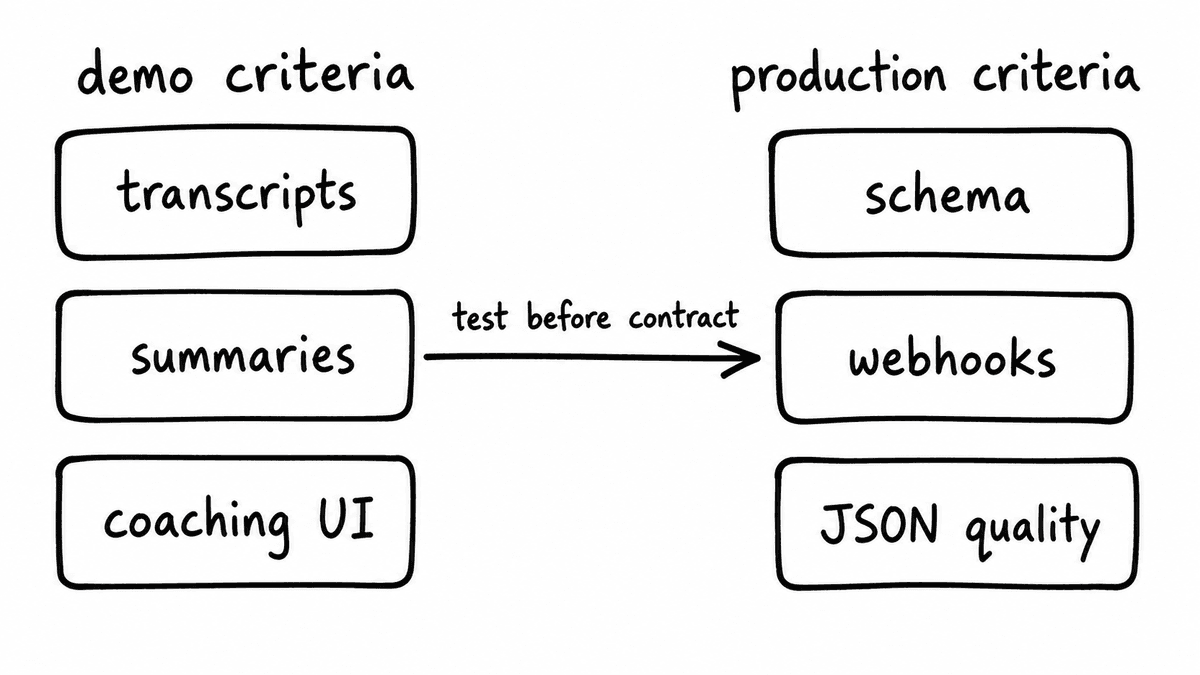
Most teams evaluating conversational intelligence in 2026 are asking the wrong questions. They spend demo cycles on transcript accuracy, coaching UI, call summaries, and how “smart” the notes feel. None of those things determine whether the vendor’s output can actually power downstream automation, CRM enrichment, or warehouse analytics. The thing that determines that is whether the API produces consistent, schema-governed JSON you can trust in production, and that is almost never tested before a contract is signed.
The result is a predictable failure mode: a team buys a conversation intelligence platform for its coaching insights, deploys it, and then discovers six months later that the structured output needed for their RevOps reporting use case is inconsistent, the schema drifts between releases, the webhook delivery is unreliable, and the fields don’t join cleanly to CRM keys. The platform looks great in demos and produces useful transcripts; it is just not the data infrastructure the downstream team needed.
The evaluation criteria that actually matter in 2026 are data engineering criteria: schema stability, delivery mechanics, JSON output quality, and integration coverage. Here is how to assess them before you commit.
What “structured signal” actually means
Structured signal from a conversational intelligence API is typed fields in a stable schema, delivered in a machine-readable format, with join keys that connect call-level data to CRM records and warehouse tables. It is not a transcript, a summary, or a set of coaching highlights. It is data that behaves like any other row in your database: it has a defined shape, the values are typed, and downstream systems can count on the schema being consistent across every call without manual normalisation.
For sales and customer success calls specifically, structured signal typically means call-level attributes that describe what happened: qualification scores for each element of your framework, a boolean for whether a specific behaviour was exhibited, a categorical value for the type of objection raised, an extracted string capturing what the buyer said about their timeline. The fields are defined by your evaluation schema, not by the vendor’s generic summarisation logic, and the values are consistent because they are scored against those criteria on every call rather than generated fresh each time with whatever the language model decides to produce.
Why coaching gets worse when the data layer is wrong
Teams typically buy conversation intelligence to improve coaching, and then find that they are coaching off the wrong signals because the data layer they are working from is unreliable or misaligned. The most common version of this is measuring rep behaviour rather than buyer understanding: scoring how long the rep talked, whether they mentioned certain keywords, whether they followed a conversation structure, all of which can be produced from a transcript without any buyer-level intelligence at all.
The problem gets worse when the underlying fields are unstable. If the vendor’s output format changes between API versions, field names drift, null rates increase without explanation, or the schema is not documented well enough to build reliable enrichment against, every downstream workflow that depends on those fields becomes brittle. The RevOps team spends engineering time maintaining mapping logic instead of extending the programme. The coaching data stops being comparable across time as the schema shifts. The forecasting model that was built on call signals starts producing outliers nobody can explain.
Evaluating the data layer before committing to a vendor is the thing that prevents all of this, and it is almost never done in standard procurement processes.
The four evaluation criteria that actually matter
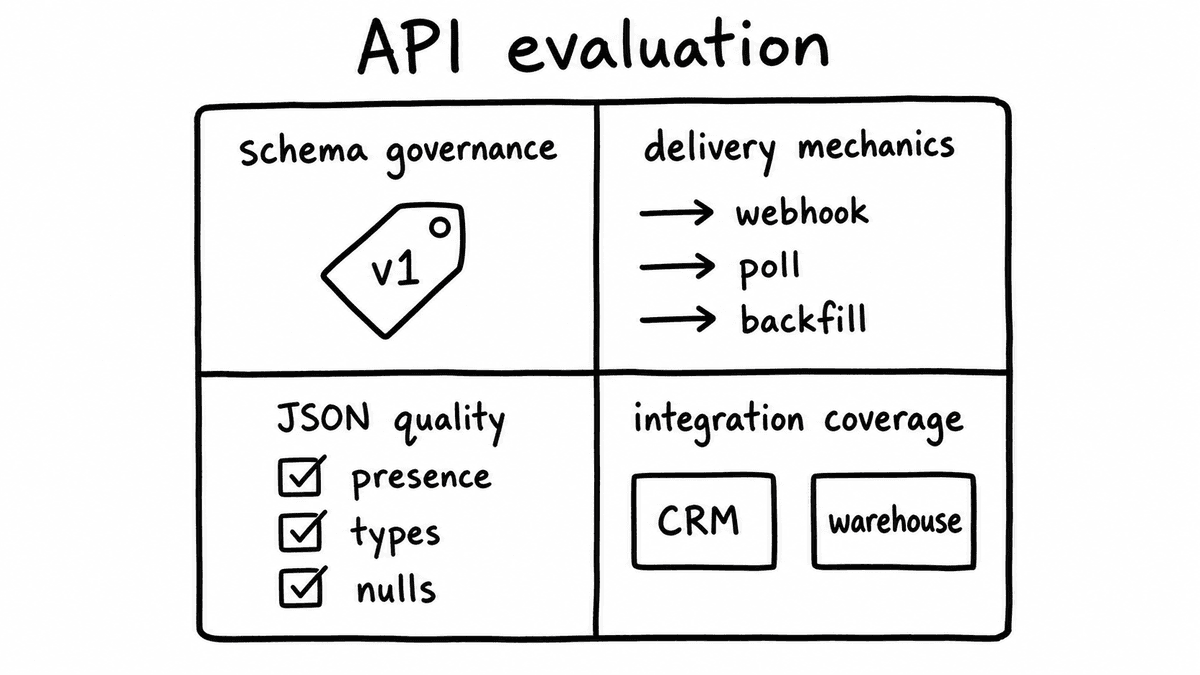
Judging a conversational intelligence API like a data engineering problem means evaluating it on four criteria: schema governance, delivery mechanics, JSON output quality, and integration coverage.
Schema governance is the foundation. The vendor should document their output schema, version it explicitly, and communicate changes before they happen. Field names should be stable across releases; if the vendor releases a new model version and the field for “discovery quality score” is now called something different or is split into sub-fields, every downstream system that reads that field breaks. Ask specifically how the vendor handles schema evolution and what their deprecation policy looks like. A vendor that cannot answer this clearly is not ready for production data use.
Delivery mechanics covers how the data gets to your systems. The options are real-time webhooks, incremental polling, and historical backfill, and a production-grade integration needs all three: webhooks for real-time delivery after calls end, polling for resilience when webhook delivery fails, and backfill for onboarding historical calls and rebuilding data after schema changes. A vendor that only supports one of these delivery modes will create gaps in your data at the points where the limitation is hit, and those gaps tend to surface in reporting at the worst possible time.
JSON output quality is the metric most teams never measure before signing. Field presence rates measure how often each field has a non-null value across real calls; a field that is null on forty percent of calls is not usable for reliable reporting. Type consistency measures whether the field values are always the declared type, or whether a score field sometimes returns a string. Schema drift measures whether the field structure changes silently between batches. Join-key coverage measures whether the call-level records include reliable identifiers that link back to CRM opportunities and contacts. All of these can be tested with a real sample of calls before purchase.
Integration coverage is straightforward: does the vendor support the destination systems your team uses, either natively or through an automation layer, and is the integration path documented well enough to build from? Integration coverage matters less if the API is clean and your team has engineering capacity to build direct integrations; it matters more for teams relying on no-code automation tools or native CRM connectors.
How to run an API bake-off before shortlisting vendors
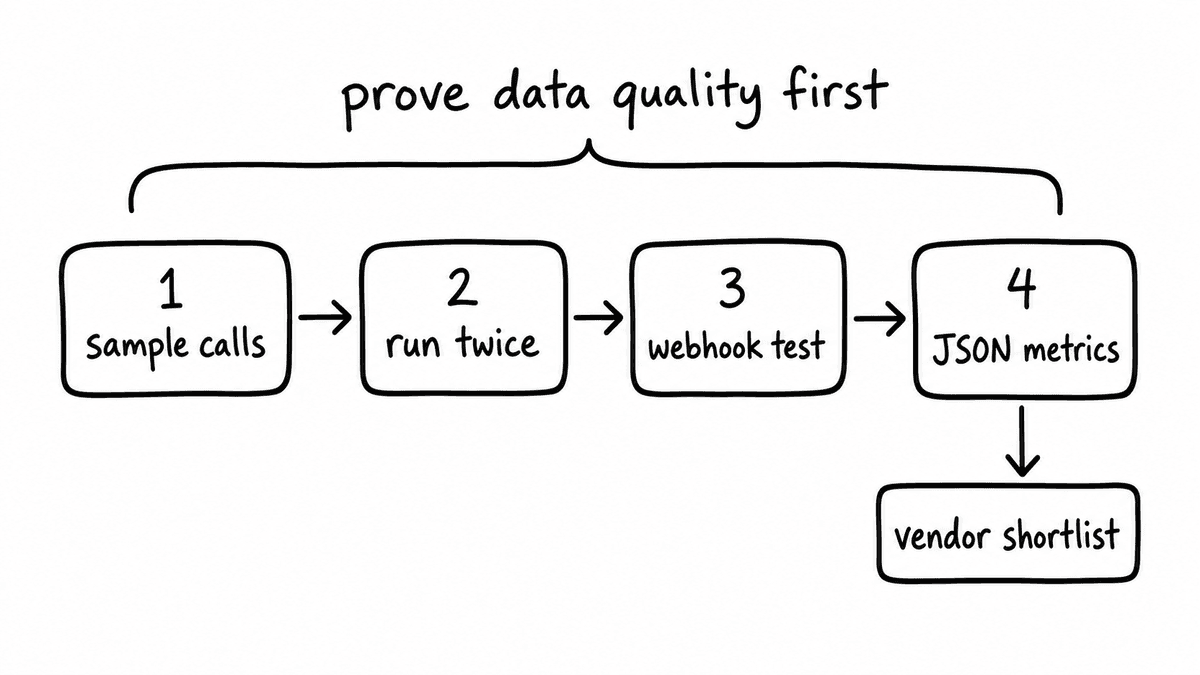
The behavioural shift that changes the quality of vendor selection in this category is running an API evaluation before committing to a shortlist, not after. Most teams run demos first and technical evaluation last, which means the commercial conversation has started before the data quality is confirmed. Reversing the order is straightforward and typically possible with any vendor offering a trial or sandbox environment.
The bake-off process has four steps. First, backfill a real sample of calls, ideally fifty to a hundred from across your team, representing the call types you intend to score. Second, validate schema stability by running the same calls through the API twice with a gap between runs and comparing the field values; a reliable schema produces consistent outputs on the same input. Third, test webhook ingestion into a staging environment for your CRM or warehouse, measuring delivery latency, payload completeness, and failure rate. Fourth, measure JSON output quality directly: field presence rates, type consistency, null patterns by call type, and whether the join keys map cleanly to your CRM opportunity IDs or contact records.
The results of this process will tell you more about vendor suitability than any amount of demo time, and they will surface the data quality issues that would otherwise appear six months into a contract when replacing the vendor is significantly more expensive. The vendors who are confident in their structured output will support this evaluation process; the ones who resist it are usually doing so because the output quality does not survive close inspection.
Where API-first conversation intelligence fits
API-first conversation intelligence platforms are built around the assumption that the primary consumer of the output is a downstream system, and that the quality bar for the output is therefore a data engineering bar rather than a readability bar. The evaluation schema is defined by the customer, not generated by the vendor; the output is typed JSON, not prose; the delivery is via webhook or API, not email or in-app notification; and the schema is versioned and stable rather than evolving with each model update.
The Semarize conversational intelligence API is built in this model: Bricks define the typed evaluation criteria, Kits version them into stable schemas, and the API returns consistent JSON on every call against that schema. For teams building conversation data into a warehouse or populating CRM fields from call content, the data engineering criteria above are what the platform is designed to meet.
For teams whose primary use case is rep-facing coaching, call review, and manager summary dashboards, a more traditional note-taker or conversation intelligence platform may be a better fit: the use case is human consumption of output, not machine consumption, and the evaluation criteria shift accordingly toward UI quality, transcription accuracy, and coaching feature depth. The key is being clear about which use case you are actually buying for before you start the evaluation, so the criteria you apply match the job you need done.
Semarize is built for teams evaluating conversation intelligence as data infrastructure: stable Bricks and Kits, structured JSON, and API-first delivery into the systems that need the signal.
Common questions
How do we tell if a conversational intelligence vendor’s schema is stable enough for production?
Ask the vendor directly: how do they version their output schema, how do they communicate changes before they happen, and what is their deprecation timeline for changed fields? Then test it yourself by running the same sample calls through the API twice and comparing outputs. Inconsistent results on the same input are a signal of unstable scoring logic rather than schema drift, but both are disqualifying for production enrichment use cases. Stable production schemas should also be formally documented, not described in release notes or discovered through API inspection.
What should we test in webhook ingestion versus polling?
For webhooks, test delivery latency (how quickly after a call ends does the payload arrive), payload completeness (are all the expected fields present in every delivery), and retry behaviour (does the vendor retry on delivery failure and for how long). For polling, test whether the endpoint returns consistent results across overlapping time windows, whether deleted or updated records are handled correctly, and whether the pagination is reliable at high volume. Production integrations need both, because webhook failures need to be recoverable via poll.
What JSON quality metrics matter most for CRM enrichment and warehouse analytics?
Field presence rate (how often each field has a non-null value), type consistency (are values always the declared type), null pattern distribution (are nulls random or correlated with call length, type, or speaker count), schema drift rate (how often fields change silently), and join-key coverage (do call records include identifiers that reliably join to CRM opportunity and contact records). Measure all of these on a real sample before committing; they are the metrics that determine whether the output is actually useful in downstream systems.
How do we avoid coaching off rep behaviour when the goal is buyer understanding?
Define your evaluation schema around buyer-side signals rather than rep-side activity. Instead of scoring talk-time ratio or keyword frequency, score whether the buyer articulated a quantifiable pain, whether they described a specific business case, and whether they engaged with the proposed next steps. These fields require semantic understanding of what the buyer said and cannot be produced from activity metrics alone. A vendor whose scoring is built around rep activity will make this distinction harder to maintain; one with customer-defined schemas lets you build the buyer-side evaluation directly into the Bricks.
Do we need both real-time ingestion and historical backfill for reliable reporting?
Yes. Historical backfill is needed at two points: onboarding (to populate your reporting layer with data from calls before you connected the integration) and after schema changes (to rescore historical calls against an updated evaluation schema so comparisons remain valid). Real-time ingestion is needed for operational use cases like CRM field updates and alerts that trigger on call outcomes. A vendor that only offers one of these two delivery modes will create gaps in one of these scenarios.
Continue reading
Read more from Semarize
Conversation Intelligence for Developers: Don't Build a Fragile Pipeline, Don't Buy a Black Box
Most teams don't fail to add conversation intelligence because the model is bad; they fail because the integration is fragile and unstructured. The fix isn't a better LLM pipeline or a platform API you can't control. It's a layer that takes a transcript, runs it against a versioned Kit, and returns deterministic typed JSON you can test, version, and route into your product.
Gong Captures the Transcript. Here’s What It Can’t Score.
Gong’s scoring runs against a fixed model — you can’t attach your product documentation, rate card, or qualification playbook to its evaluation layer. For four evaluations that matter — product accuracy, pricing audit, methodology A/B testing, and deal readiness scoring — knowledge grounding and KB isolation are the only architecture that works.
Bricks and Kits: the mechanism for stable conversation evaluation
Freeform prompts produce inconsistent evaluation results - scores drift, output shapes change, and you can't tell whether coaching improved anything or whether the rubric moved. Bricks define a locked evaluation schema: one question, one output type. Kits group them into reusable evaluation workflows. The result is schema-stable conversation analysis you control.