
What BI Teams Need From Conversation Data
BI teams are usually the last people to get asked what they need from conversation data, and the first people to discover that whatever the conversation intelligence platform exports is not quite right for what they are trying to build. The export lands in a warehouse table or a spreadsheet, the analyst opens it, and the fields are inconsistent, the identifiers do not join cleanly to the CRM, and the values that should be typed are strings. The platform looks excellent in the UI. The data is structurally unusable.
This is not a niche problem. It is the default outcome when conversation intelligence platforms are designed around rep-facing dashboards and coaching UI rather than around the data infrastructure needs of the teams who want to build analytics on top of them. Understanding what BI teams actually need, and why current exports almost never deliver it, is the starting point for anyone trying to incorporate conversation data into a warehouse, a reporting model, or a GTM analytics layer.
What BI teams are trying to do with conversation data
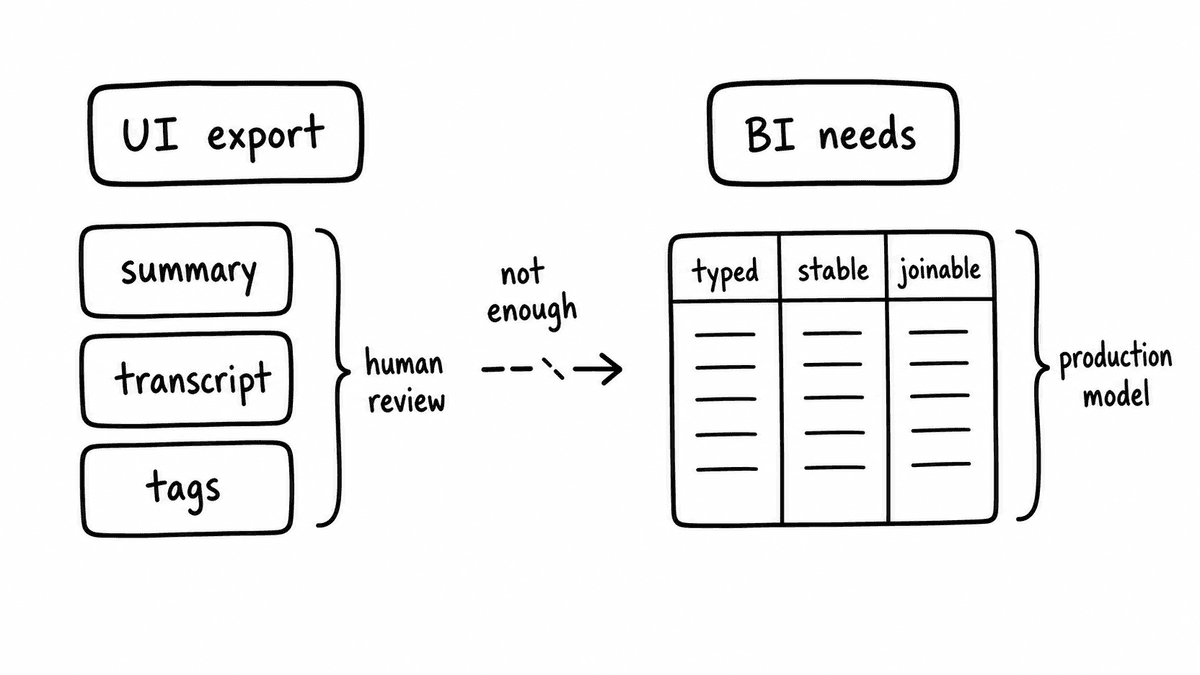
The jobs BI and data teams want to do with conversation data are the same jobs they do with any other data source in the stack: join it to other tables, aggregate it across time, filter it by dimension, and build reporting and models on top of it. For a sales analytics use case, that means joining call-level signals to opportunity records in Salesforce, aggregating qualification scores by rep and territory, filtering by call type and stage, and building pipeline health models that incorporate what was actually said in conversations rather than just what reps entered into CRM fields.
To do any of this reliably, the conversation data needs to behave like any other structured table in the warehouse. That means typed columns with consistent values, stable field names that do not change between export batches, primary and foreign keys that join cleanly to the other tables the analyst is working with, and schema documentation that is accurate and current. These requirements are not exotic; they are the baseline for any data source that is meant to support production analytics.
What UI exports actually deliver
The standard export from a conversation intelligence platform produces something designed for human review: CSV or JSON with call metadata, transcript text, summary prose, and possibly a set of AI-generated tags or topics. The fields that look most useful for analytics, the ones representing whether specific things happened on the call, are usually embedded in prose summaries or available only in the UI, not in the export. The export is a document in spreadsheet format, and it behaves accordingly.
The specific problems that make UI exports unreliable for analytics are predictable and consistent across most platforms. Field names change between releases when the vendor updates their AI model or restructures their data model. Values that should be booleans or scores come back as free-text strings because the underlying extraction was prose-based. Foreign keys that should join to CRM records are absent, inconsistent, or formatted differently from the keys in the CRM. Null rates are high and unpredictable, particularly for fields that depend on AI extraction. And the schema is documented after the fact, if at all, in changelog notes that the analyst has to discover when their queries break.
The result is that incorporating conversation data into a warehouse requires ongoing maintenance work: normalisation scripts, null handling, key mapping, and schema monitoring to catch the inevitable silent changes. For most BI teams, this overhead makes conversation data impractical to maintain as a production data source, so it ends up as a one-off analysis that is too expensive to keep current.
The four things that make conversation data actually usable
Getting from “technically exportable” to “production-ready for warehouse analytics” requires four things: typed fields, stable schema, joinable keys, and consistent delivery.
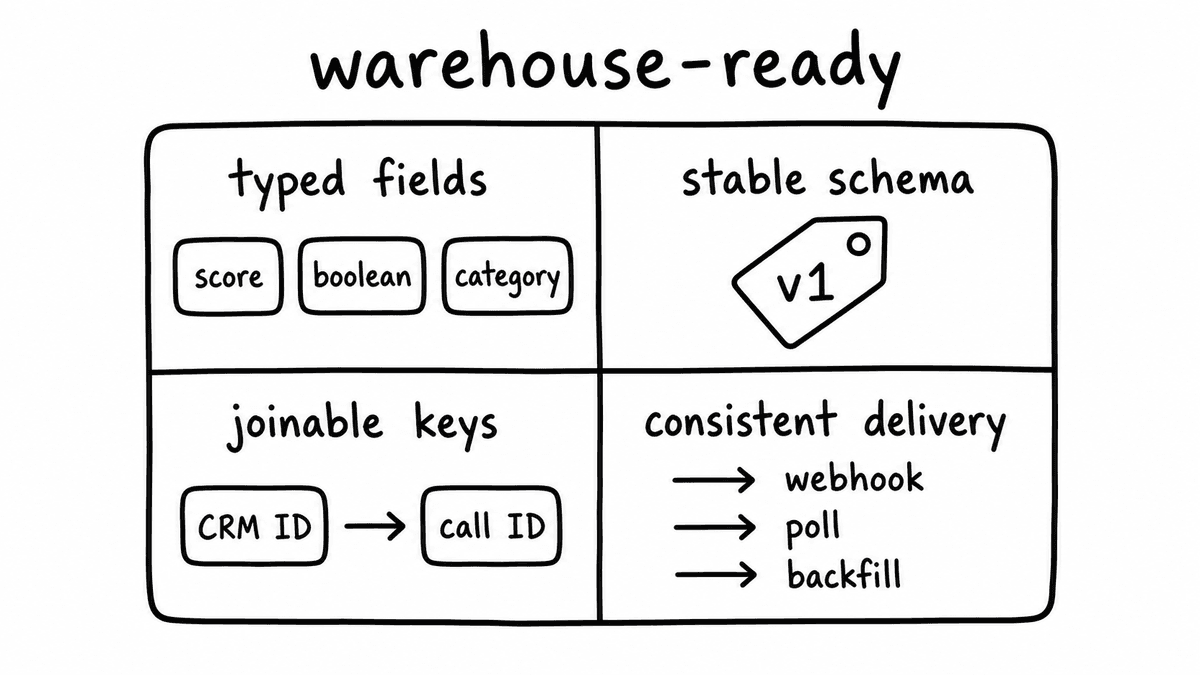
Typed fields mean that a score field always returns a number, a boolean field always returns true or false, and a categorical field always returns one of the declared categories rather than whatever prose the AI decided to generate. Type consistency is the difference between a field that an analyst can filter and aggregate directly and one that requires a parsing step before every use. Without typed fields, conversation data cannot be queried reliably, and every report that touches the data requires manual verification to confirm the field values are in the expected format.
Stable schema means that the field names, types, and presence rates do not change silently between data batches. Schema drift is the most common cause of broken pipelines in conversation data integrations: a vendor updates their model, a field is renamed or split, and the downstream query that was joining on that field name either fails silently or starts returning nulls. Stable schema requires explicit versioning and advance notice of changes, not just a changelog entry after the fact.
Joinable keys mean that each call record includes identifiers that link reliably to the other tables the analyst needs to join against. For sales analytics, this typically means a CRM opportunity ID and a contact or account ID that match the formats used in the CRM export. Without clean join keys, conversation data becomes an island: interesting in isolation but impossible to incorporate into the pipeline health, rep performance, or customer success models that require joining across multiple data sources.
Consistent delivery means the data arrives on a predictable schedule, with known latency, via a delivery mechanism the warehouse pipeline can depend on. Webhook-driven delivery for real-time use cases, incremental API polling for scheduled loads, and historical backfill for onboarding: these are standard data infrastructure requirements that conversation intelligence platforms often support incompletely or not at all.
Why this requires a different approach to conversation intelligence
The platforms that produce excellent coaching dashboards are often not the same ones that produce excellent warehouse-ready data, because the design decisions that produce a great UI are different from the design decisions that produce reliable structured output. A coaching platform optimises for human readability: the summary should be clear, the insights should be engaging, the UI should surface the most interesting moments from a call. A data infrastructure layer optimises for machine readability: the schema should be stable, the types should be consistent, the delivery should be reliable, and the output should require no human interpretation to use.
API-first conversation intelligence is built around the second set of constraints. Semarize produces typed JSON from every call against a schema defined by the customer in Kits, versioned so that schema changes are explicit rather than implicit, with delivery via webhook or API. The output is a data record with typed fields, not a document with embedded insights. For BI teams building on top of it, the integration looks like any other structured data source: fields with known types, stable names, and join keys that connect to the CRM records the rest of the model is built on.
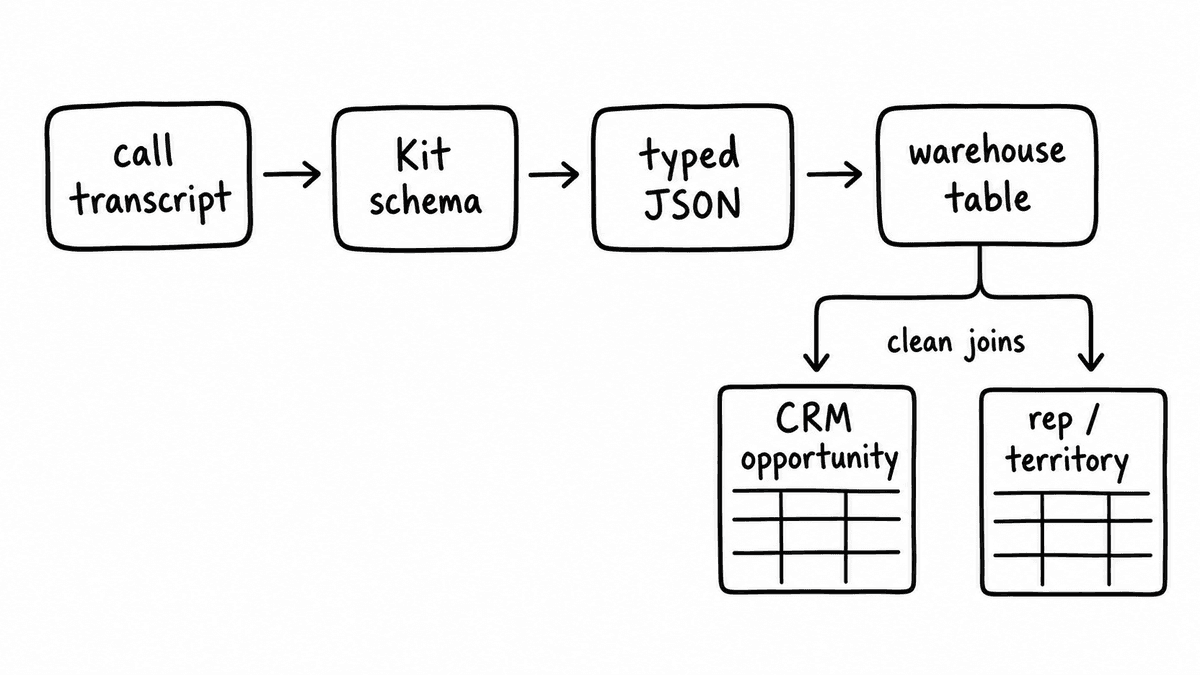
The conversation data warehouse post covers the specific technical patterns for getting typed call fields into BigQuery, Snowflake, and Databricks. The point here is that the decision about which conversation intelligence platform to use should factor in warehouse-readiness as a first-class criterion, not an afterthought discovered when the first export breaks the pipeline.
What to ask before connecting a conversation platform to your warehouse
The questions that surface data infrastructure fit before committing to a platform are straightforward but rarely asked in standard procurement processes. Does the API return typed fields or prose? Is the output schema versioned and documented? What are the foreign keys on call records, and do they match the identifiers in your CRM export? What is the typical null rate for scored fields, and does it vary by call type or length? How does the vendor handle schema changes: advance notice, deprecation period, or silent update?
Asking these questions in a demo cycle takes ten minutes and saves six months of maintenance work. The vendors who have built for data infrastructure use cases will answer them directly. The ones who have not will redirect to the coaching UI.
Semarize turns conversation content into typed, versioned JSON that BI teams can join, query, and model in the warehouse without treating call summaries as data infrastructure.
Common questions
Why do conversation intelligence exports often have high null rates?
High null rates in conversation intelligence exports usually reflect one of two issues: the field is based on AI extraction that was not present in every call (for example, a field for “competitor mention” will be null on calls where no competitor was mentioned), or the extraction model has inconsistent coverage, returning values for some call types and nulls for others without a documented reason. The first is expected and manageable with good schema documentation. The second is a data quality problem that BI teams discover when the field they were counting on for a model turns out to be unreliable.
How should conversation data join to CRM records in a warehouse?
The most reliable join is on CRM opportunity ID, which should be present on every call record where the call was associated with an open deal. Contact ID and account ID provide secondary join paths for customer success and post-sale analytics. The challenge with most conversation platforms is that these identifiers are either absent from the export, present as a different format than the CRM uses, or require a manual mapping step to reconcile. An API-first platform that treats CRM key coverage as a schema requirement will have these join paths documented and consistent.
What is the difference between a conversation intelligence export and a structured conversation signal API?
A conversation intelligence export is a snapshot of whatever the platform stores for each call: transcript text, summary prose, metadata, and possibly some AI-generated tags. The schema is controlled by the vendor and changes with the product. A structured conversation signal API produces typed JSON against a schema the customer defines, evaluated against each call, versioned and stable. The first is designed for human consumption; the second is designed to be the input to warehouse tables, CRM fields, and downstream analytical models.
Can conversation data be made reliable for time-series analysis?
Yes, but only if the evaluation schema is held constant over the analysis period. Scoring the same field with a different model version or different criteria at different points in time produces numbers that are not comparable, which breaks time-series trends and before-after analyses. Kit versioning in Semarize addresses this by fixing the evaluation logic at a specific version, so scores from calls six months ago and calls this week are produced against the same criteria and can be compared directly.
Continue reading
Read more from Semarize
Conversation Data Warehouse: Consistent Call Fields for BI
BI teams can't query transcripts. They can't join AI summaries to CRM objects. To make conversation data useful for analytics, it needs to arrive as consistent typed fields - booleans, scores, text fields, lists - with join keys that connect calls to opportunities, accounts, and contacts. This is the pipeline, the schema, and the governance model that makes sales call analytics possible in your warehouse.
Capacity Planning Lags Because Sales Data Misses the Act of Selling
Sales capacity models built on CRM events are structurally late. Stage labels and activity counts record what happened to deals, not what was happening inside them. The missing ingredient isn't more pipeline data - it's structured signals from selling conversations that show whether buyers actually understood, committed, and progressed.
CRM Enrichment From Sales Calls: The RevOps Data Ops Playbook
Most CRM enrichment stalls at 30% field coverage because the output is unstructured - reps updating from memory, summaries stored as notes. The fix is a structured extraction pipeline: transcript to consistent fields to CRM to automation triggers. This playbook covers the schema, the routing, and the implementation in Salesforce and HubSpot.