
Capacity Planning Lags Because Sales Data Misses the Act of Selling
Every capacity plan is built on assumptions about how the pipeline will perform. Those assumptions are fed by CRM data - stage distribution, deal age, historical close rates, rep activity counts. The model crunches these inputs and produces a headcount recommendation.
The model is usually fine. The data feeding it is what's late. Capacity planning doesn't lag because the math is wrong - it lags because the underlying sales data is missing the act of selling. This is the same measurement gap behind overhiring. What the CRM records is what happened to deals. What it can't record is what was happening inside them.
Event data versus selling data
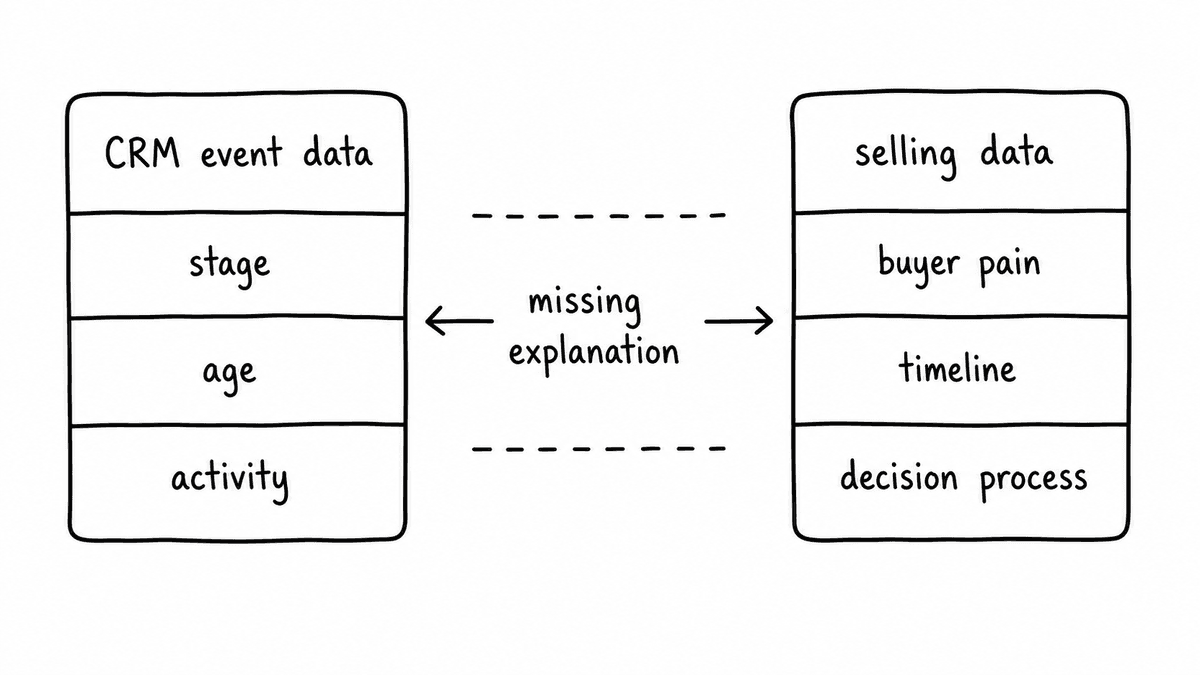
A deal in “Negotiation” stage at week eight tells you the rep advanced it to that stage and hasn't moved it. It doesn't tell you whether the buyer has a genuine compelling event, whether pricing was understood and accepted in the last conversation, or whether procurement has been introduced. Those facts exist in the call transcript. They don't exist in the stage label.
Stage changes are events attached to opportunities. They record the moment a rep made a judgment call about where a deal stood. The accuracy of that judgment is embedded in the conversation that prompted it - but the conversation doesn't make it into the CRM. What makes it in is an outcome: “moved to Negotiation,” “activity logged.”
This is what's missing from most capacity models: not pipeline volume, but explanation. The data exists to tell you how many deals are at each stage. It doesn't exist to tell you whether buyers at those stages actually understood the product, committed to a timeline, or named a decision process. Those signals - the ones that predict whether deals advance - live in selling conversations that never get structured.
The lag is structural, not correctable with process
Teams that recognise this problem typically respond with tighter CRM hygiene: mandatory field updates, stage gate checklists, weekly pipeline reviews. Coverage rates improve temporarily. The lag persists.
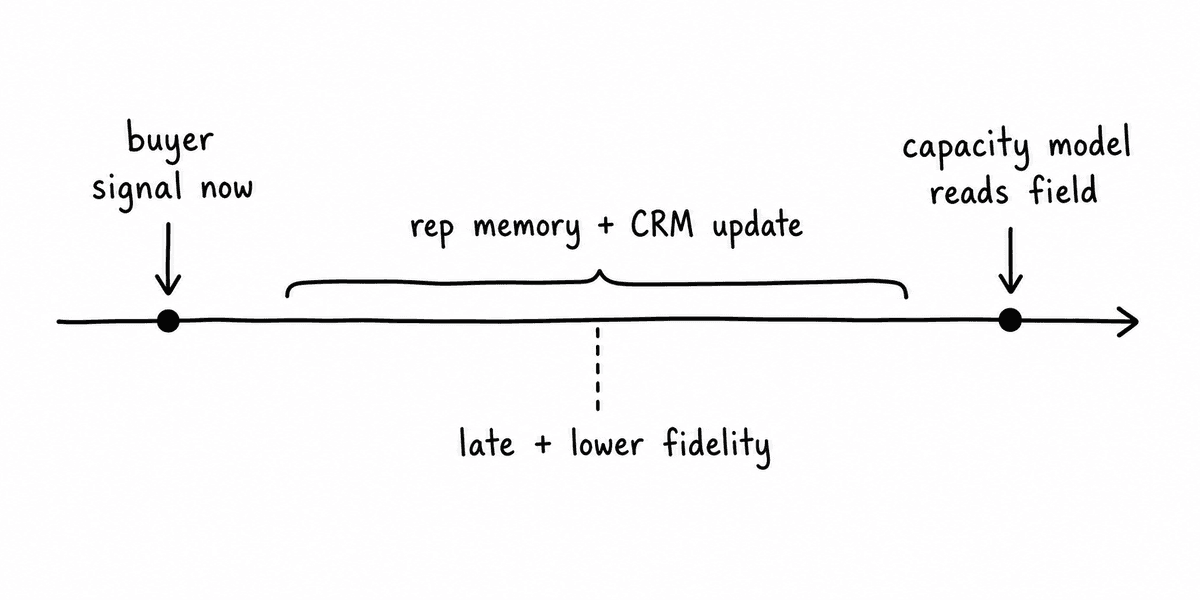
It persists because the lag is built into how the data is created. A rep's CRM update happens after the conversation, from memory, shaped by optimism about deals they're close to and fatigue about deals they're not. That update is always slower than the conversation that prompted it and less accurate than a direct extraction from what was said. Process pressure changes the volume of updates. It doesn't change the latency or the fidelity.
Better forecasting math has the same problem. If the inputs are event-driven and structurally late, a more sophisticated model produces more sophisticated predictions from stale data. The bottleneck is the data, not the model applied to it.
What conversation-derived signals add to the picture
The signals that best predict whether a deal will advance are buyer signals: whether the buyer articulated a specific pain with measurable consequences, whether they confirmed a decision timeline, whether they named a next step and committed to it. These signals exist in the transcript of every sales call as it happens - they just aren't being extracted.
When those signals are extracted automatically and structured as consistent fields via structured Bricks, they can feed capacity inputs alongside CRM events. A deal where the buyer confirmed a timeline and named a decision owner looks different from a deal at the same stage where the buyer has been consistently non-committal - and that difference can be visible to the model rather than invisible to it.
Capacity models fed by both event data and conversation-derived signals are working from a fuller picture. The stage label tells you what the rep decided. The buyer signal tells you whether the decision was grounded. The RevOps and pipeline qualification use case covers how to set up the structured extraction that produces these signals at scale, and the data science use case covers how those fields land in Snowflake or BigQuery for capacity modelling.
Signal freshness as a planning input
The standard capacity review cadence - monthly or quarterly - is tied to forecast cycles. That cadence made sense when the only inputs available were forecast data and CRM snapshots. When buyer signals are updated automatically after every call, the inputs to capacity assumptions can update on a different rhythm.
The behavioural shift is to treat “when did the signal last update?” as a data quality question. A deal where buyer signals haven't updated in three weeks - no timeline confirmation, no next step agreed, no articulated pain on record - should carry less weight than a deal where the buyer confirmed a decision process yesterday. That freshness logic is only possible when the signal source is structured conversation data, not rep-updated fields.
Operationally, this means building the signal freshness loop before changing the capacity review cadence. Extract structured buyer signals from calls using a capacity-planning Kit. Route them to the fields your capacity model reads. Set staleness thresholds for deal weight. Once that pipeline exists, the cadence question becomes a model design decision rather than a process debate.
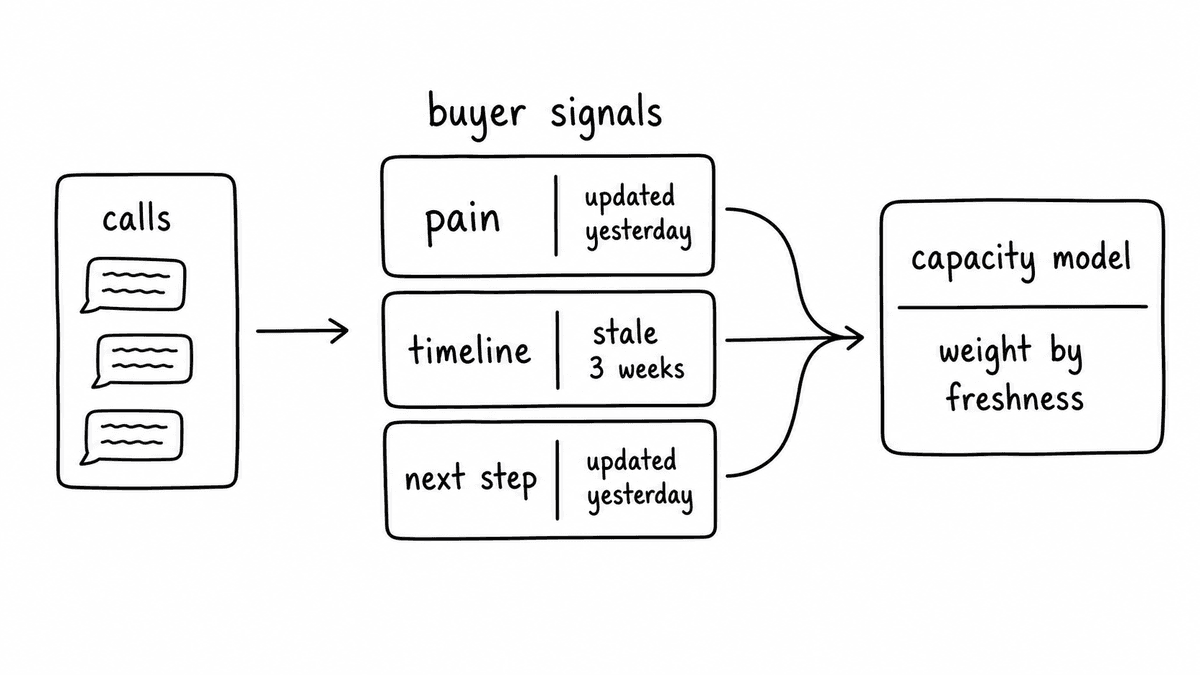
Semarize extracts structured buyer signals from every call and returns them as typed fields your forecasting and capacity tools can use.
Common questions
What exactly counts as “conversation-derived signals” for deal progression?
The most predictive signals are buyer-side, not rep-side: whether the buyer articulated a specific pain with measurable consequences, whether they confirmed a timeline, whether they named a next step with a specific owner and date, and whether they raised pricing objections that went unresolved. These are extractable directly from call transcripts as structured yes/no fields or scored values. They complement CRM stage data by explaining whether the buyer's state matches the stage the rep assigned - which is often where the gap is.
Should we replace CRM stage updates or add to them?
Add to them - CRM events still matter for tracking deal flow. The problem isn't that stage data exists, it's that stage data alone is used as the primary truth source for capacity assumptions. Conversation-derived signals go alongside CRM events: the stage label tells you what the rep decided about deal progression; the buyer signal tells you whether that decision had evidence behind it. Both inputs make the model more accurate. Neither replaces the other.
How often should capacity assumptions update if signals are changing weekly?
The signal freshness loop and the capacity review cadence are separate questions. Signals should update every time a call produces new evidence - that's automatic once extraction is running. Capacity assumptions don't need to update that frequently; what changes is the quality of inputs available when the review does happen. A weekly signal update feeding a monthly capacity review is already a significant improvement over a monthly CRM snapshot feeding the same review.
What does RevOps need to operationalize this without adding reporting burden?
The key is that extraction has to run automatically - not as a task for reps or managers. When structured buyer signals arrive as fields from an API after each call, they can populate CRM objects and capacity model inputs without anyone touching a form. The RevOps work is the pipeline design (what fields, which objects, how staleness is calculated) rather than ongoing data management. That setup cost is one-time; the maintenance is the same as any other CRM automation.
How do you measure buyer understanding without turning reps into note-takers?
You don't - that's the point. Buyer understanding signals are extracted from call transcripts automatically, not entered by reps. The rep runs the call the same way they always have. The extraction layer reads the transcript after the call ends and returns structured fields: did the buyer confirm a timeline (yes/no), what pain did they articulate (text), was a next step agreed (yes/no with date). None of that requires rep input. The rep's job is to run conversations that produce those signals, not to document them afterward.
Continue reading
Read more from Semarize
Overhiring Is a Measurement Failure, Not a Hiring Strategy
Sales teams don't overhire because of poor judgment. They overhire because CRM-driven capacity models are built on stage labels and activity counts - data that can't reveal whether buyers are actually progressing. By the time deal reality becomes visible, headcount decisions have already been made.
Sales is human. Sales data is not.
CRM data captures events - stage changes, activity counts, timestamps. It doesn't capture the human act of selling. The evidence that explains why deals move or stall lives in conversations, not in fields a rep updated.
Conversation Intelligence Produces Signals, Not Workflows
CI vendors sell outcomes - better forecasts, improved coaching, higher win rates. The outcome claims are accurate for teams that wire CI signals into their downstream workflows. For teams that don't, the dashboards fill up and the outcomes don't move. The gap between running CI and seeing results is always an implementation gap, not a vendor gap.