
Conversation Data Warehouse: Consistent Call Fields for BI
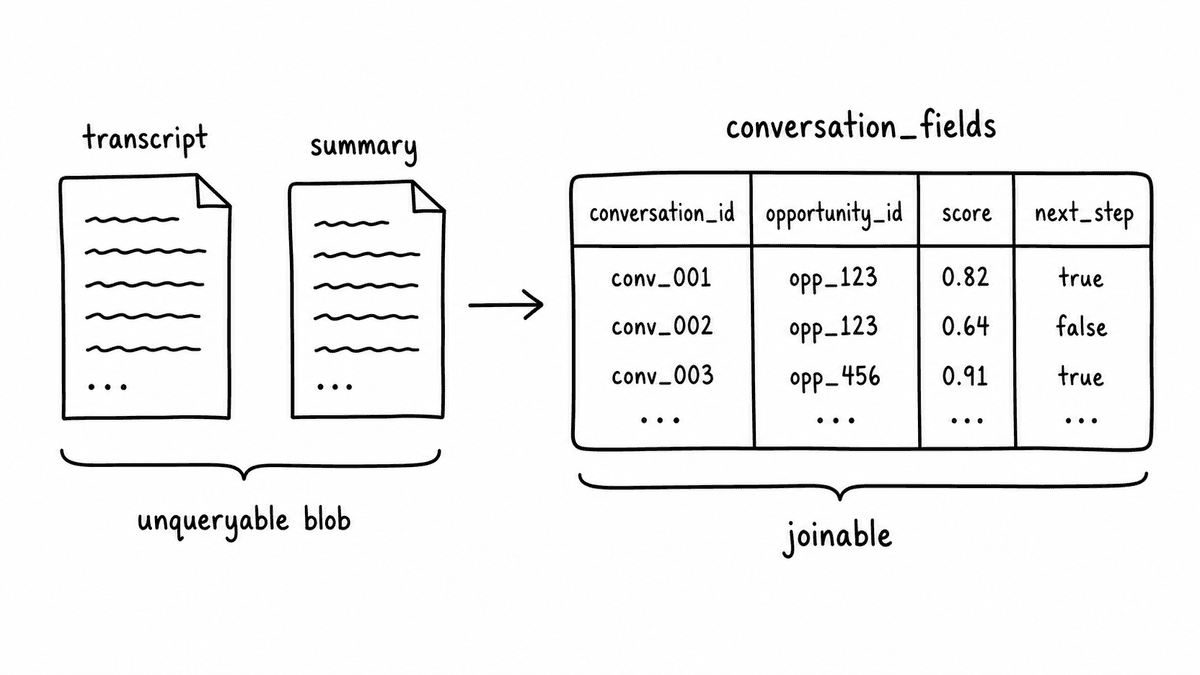
Most BI teams that want to analyse sales call outcomes run into the same wall: the conversation data isn't in the warehouse. It's in a conversation intelligence platform - accessible through a UI, exportable as transcript text, maybe summarised by an AI layer. None of that is queryable in BigQuery, Snowflake, or Databricks. None of it joins to your CRM objects. It exists as a separate, unstructured blob that your analytics models can't reach.
This is what most teams actually have when they say they have conversation intelligence: insight for human consumption, not data for system consumption. The transcripts are there. The highlight reels are there. The thing that's missing is a stable schema with typed fields and join keys- the form the data needs to be in before a BI layer can do anything with it. The gap isn't a conversation intelligence problem. It's a data warehouse problem.
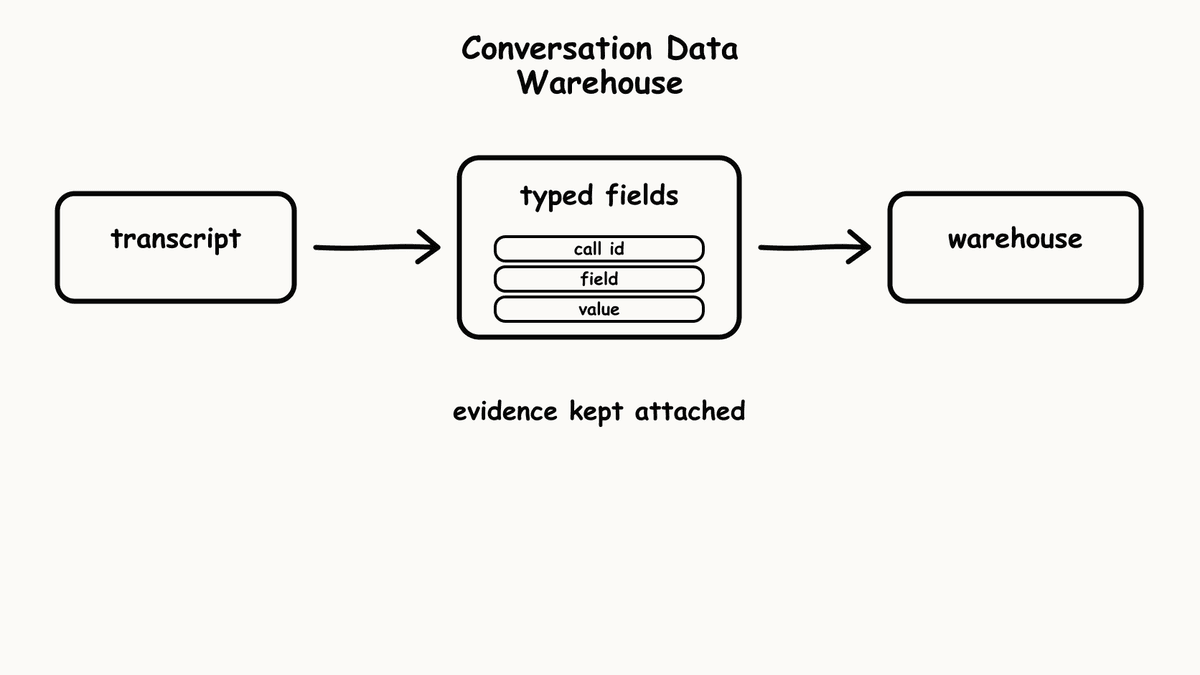
What structured conversation data actually means
A structured conversation field is a value with a defined type that arrives in the same format on every run. discovery_depth_score: 68 (numeric score), next_step_confirmed: true (boolean), competitor_mentioned: "CompetitorName" (text), deal_stage_evidence: ["budget confirmed", "timeline stated"](list). These aren't AI summaries or highlight reels. They're fields with fixed names, defined types, and values that the BI layer can group, filter, aggregate, and join without additional transformation.
What a BI team needs from conversation data is the same thing they need from any upstream source: a consistent schema that doesn't change silently, typed outputs that map cleanly to warehouse columns, and join keys that connect conversation records to the CRM objects they relate to. The critical join keys are a conversation_id, an opportunity_id from your CRM, and a contact_id where available. Without those, the conversation table is an island. With them, you can join discovery depth to win rate, CS call signals to churn outcomes, and rep rubric scores to quota attainment.
A transcript can't do any of that. Neither can a paragraph of AI commentary. The output format is the prerequisite - everything else in warehouse analytics depends on it. See the API documentation for the full response schema and join key conventions.
Why tool-native data doesn't solve the problem
Most conversation intelligence platforms are built for human consumption. Their output is dashboards, highlight clips, and summary views - designed for a manager to read, not for a BI tool to query. When teams try to extract analytics from these tools, they typically get manual exports, brittle spreadsheets, or an API that returns unstructured text. None of it has a consistent schema. None of it joins cleanly to CRM objects.
Even when AI scoring exists, it often measures the wrong thing. Scorecards built around rep behaviour - talk ratio, framework adherence, question count - produce fields that don't correlate well with deal outcomes. The BI team loads them into the warehouse, runs the correlation models, and finds weak or inconsistent signal. That's not a data quality problem in the usual sense - it's a measurement problem. Fields that measure what the rep did don't predict what the buyer decided. Fields that measure buyer-understanding signals do: whether the buyer articulated a specific pain, confirmed a timeline, named a decision process. Those are the fields worth building warehouse analytics on.
The pipeline from transcript to warehouse
The data flow that produces warehouse-ready conversation fields has four stages: transcript ingestion, structured extraction via the evaluation API, JSON output validation, and warehouse load. Transcript ingestion can come from any recording source - Zoom, Teams, or a direct upload. The extraction stage is where the schema gets applied: the evaluation API takes the transcript and returns a structured JSON object with the typed fields defined in your evaluation Kit. That JSON is validated against the schema (field types, required fields, null handling) before being loaded. Then it lands in the warehouse with the join keys attached.
The practical pipeline: call recording → transcript → extraction API with Kit → structured JSON → schema validation → warehouse table. Each stage has a defined contract. The warehouse table schema is stable because the extraction schema is locked - model updates don't silently change field names or output types. The table schema reflects the Kit definition, and the Kit definition is versioned. Changes are explicit releases, not silent edits.
What you can build once the data is there
Once consistent conversation fields are in the warehouse with CRM join keys, the analytics that were previously out of reach become standard queries. Discovery depth score correlated with win rate, by rep and by segment. CS escalation signals correlated with churn, broken out by account tier and product line. Deal risk scores tracked across deal stages to identify where in the funnel deals most commonly deteriorate. Rep benchmarking on specific rubric dimensions across cohorts and over time, with before-and-after views tied to training programmes.
These aren't novel questions - revenue teams have been trying to answer them for years. They weren't answerable because the conversation data wasn't in a form the analytics layer could use. The data volume was there, the recording infrastructure was there, but the extraction layer producing typed, joinable fields wasn't. Putting conversation fields in the warehouse doesn't change the questions. It changes whether they're answerable.
Schema governance as a data product concern
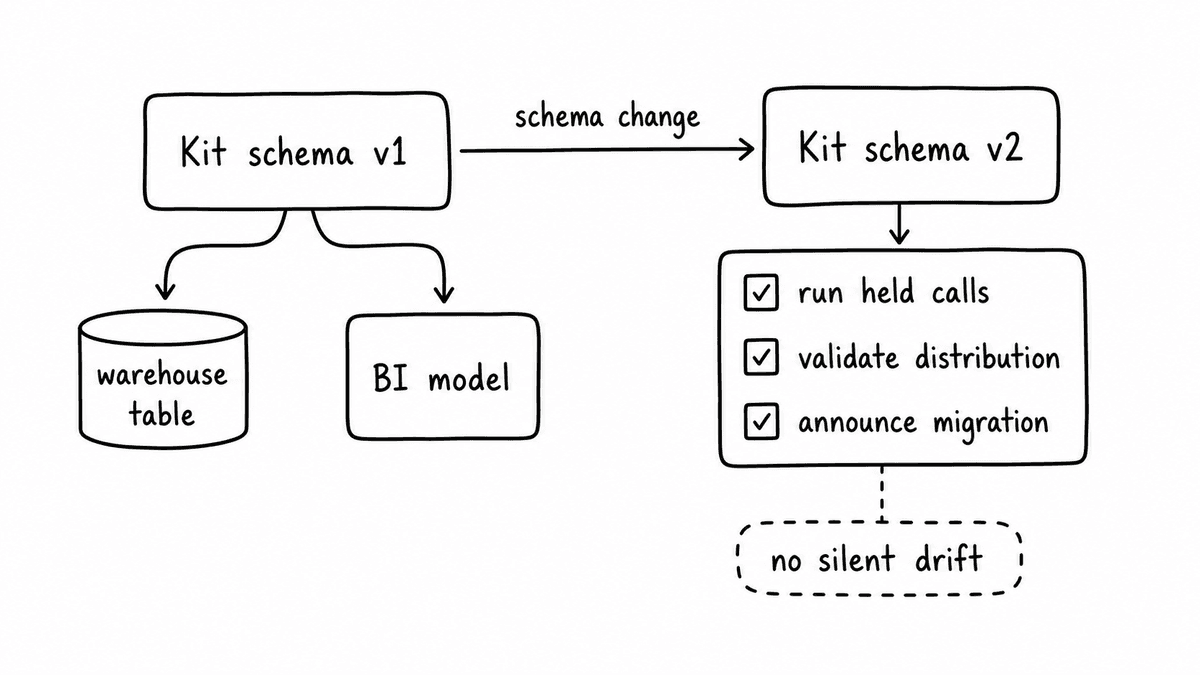
Once warehouse analytics depend on conversation fields, schema stability becomes a first-class engineering concern. If the extraction logic changes silently - a field gets renamed, an output type shifts, a new field appears without a corresponding warehouse column - downstream models break in ways that are hard to trace. The failure mode isn't obvious: models still run, they just produce wrong results based on stale field definitions.
Treat the extraction schema as a versioned data product. Changes are releases: bump the version, run the new schema in parallel against a held call set, validate that output distributions match expectations before cutover. Communicate changes to downstream consumers in advance - BI models, dashboards, alerting rules - the same way you'd communicate a warehouse table migration. The conversation data is just another upstream source. It needs the same governance practices as any other table your models depend on.
How Semarize produces warehouse-ready conversation data
Semarize is designed as a data layer first. You define the extraction schema in a Kit- a collection of Bricks, each asking one question and returning one typed output. A discovery depth Brick returns a score. A next step Brick returns a boolean with a supporting quote. A competitor mention Brick returns a text field. The Kit is the schema definition; each Brick is a column in the output. The same Kit runs against every call and returns the same JSON structure - consistent field names, consistent types, consistent null handling. Because the schema is locked and versioned, warehouse table definitions don't break when the underlying model updates.
Knowledge grounding means the fields carry meaning calibrated to your business, not to model inference. Attach your qualification criteria and the discovery depth Brick checks against your specific definition of what qualified pain looks like. Attach your sales methodology and rubric fields check against your actual standards rather than a generic industry baseline. Critically, each Brick accesses only the knowledge relevant to its specific question - attention isn't diluted across the full knowledge base, which keeps extractions precise and field values interpretable when they land in the warehouse. The RevOps use case covers the full signal architecture, including how typed fields route to CRM objects and forecast models alongside warehouse storage.
Semarize returns structured JSON with a stable, versioned field schema from every call. Define the extraction contract, load it to your warehouse, and build analytics from actual conversation data.
Common questions
What does a typed conversation fields table look like in a warehouse?
One row per call, with columns for the extraction outputs: numeric scores (discovery_depth_score), booleans (next_step_confirmed, pricing_concern_raised), text fields (competitor_name, pain_statement), and lists (stakeholders_mentioned, deal_risks). Plus join key columns: conversation_id, opportunity_id, contact_id, call_date. The table schema is defined by the evaluation Kit - each Brick in the Kit produces one column with a defined type. Add a Brick, add a column. The schema is explicit and change-controlled.
How do we generate join keys between conversations and CRM objects?
Join keys require that the conversation record and the CRM object share a common identifier. The most reliable approach is to include the CRM deal or opportunity ID in the call metadata when the recording is triggered - either from the rep's calendar invite, from the CRM activity record, or from an integration that associates the call with the deal at the start. That ID flows through the extraction pipeline and lands in the warehouse table as a foreign key. If that metadata isn't available at recording time, it can often be resolved post-hoc by matching call timestamps to CRM activity logs.
Do we still need transcripts in the warehouse if we have structured fields?
Keep them, but don't rely on them for analytics. Transcripts are useful as evidence lookups - when a field score is unexpected, you want to be able to pull the relevant transcript segment and see what the evaluation was responding to. They're not useful for modeling or dashboarding because they have no consistent schema. Store transcripts in a separate table linked by conversation_id, and treat them as a debugging and audit layer rather than an analytics input. The structured fields are what your models and dashboards should read.
How do we prevent schema drift when extraction logic changes?
Treat extraction schema changes as versioned releases, not silent edits. Before changing a field name, type, or adding a new required field, create a new Kit version. Run it in parallel with the old version against a held call set and validate that output distributions match expectations before cutover. Communicate changes to anything downstream - BI models, dashboards, alerting - in advance. The same migration pattern you'd use for any other warehouse table schema applies here. The extraction contract is a data product with consumers who depend on its stability.
What analytics should we build first once the data is in the warehouse?
Start with signal validation before building models. Take a sample of closed won and closed lost deals and check whether the conversation field distributions differ between the two groups. Do lost deals show lower discovery depth scores, earlier unresolved pricing concern flags, lower champion engagement? If the signals have predictive validity, build the win rate correlation model first - it produces the clearest evidence that conversation data belongs in your analytics stack. Then layer in rep benchmarking and cohort trend analysis once the signal quality is confirmed for your specific sales motion.
Continue reading
Read more from Semarize
CRM Enrichment From Sales Calls: The RevOps Data Ops Playbook
Most CRM enrichment stalls at 30% field coverage because the output is unstructured - reps updating from memory, summaries stored as notes. The fix is a structured extraction pipeline: transcript to consistent fields to CRM to automation triggers. This playbook covers the schema, the routing, and the implementation in Salesforce and HubSpot.
Capacity Planning Lags Because Sales Data Misses the Act of Selling
Sales capacity models built on CRM events are structurally late. Stage labels and activity counts record what happened to deals, not what was happening inside them. The missing ingredient isn't more pipeline data - it's structured signals from selling conversations that show whether buyers actually understood, committed, and progressed.
Conversation Intelligence for Developers: Don't Build a Fragile Pipeline, Don't Buy a Black Box
Most teams don't fail to add conversation intelligence because the model is bad; they fail because the integration is fragile and unstructured. The fix isn't a better LLM pipeline or a platform API you can't control. It's a layer that takes a transcript, runs it against a versioned Kit, and returns deterministic typed JSON you can test, version, and route into your product.