
Symbl.ai Alternatives for Structured RevOps Data
Teams searching for Symbl.ai alternatives have usually already decided to run revenue operations on top of call data, and the question driving the search is what happens to the output after the call ends. Symbl.ai analyses conversations well. The friction is that its output, topics, action items, and summaries, is built for a person to read, and a CRM property, a scoring threshold, or a warehouse table needs typed fields instead. That gap, rather than analysis quality, is what sends teams looking.
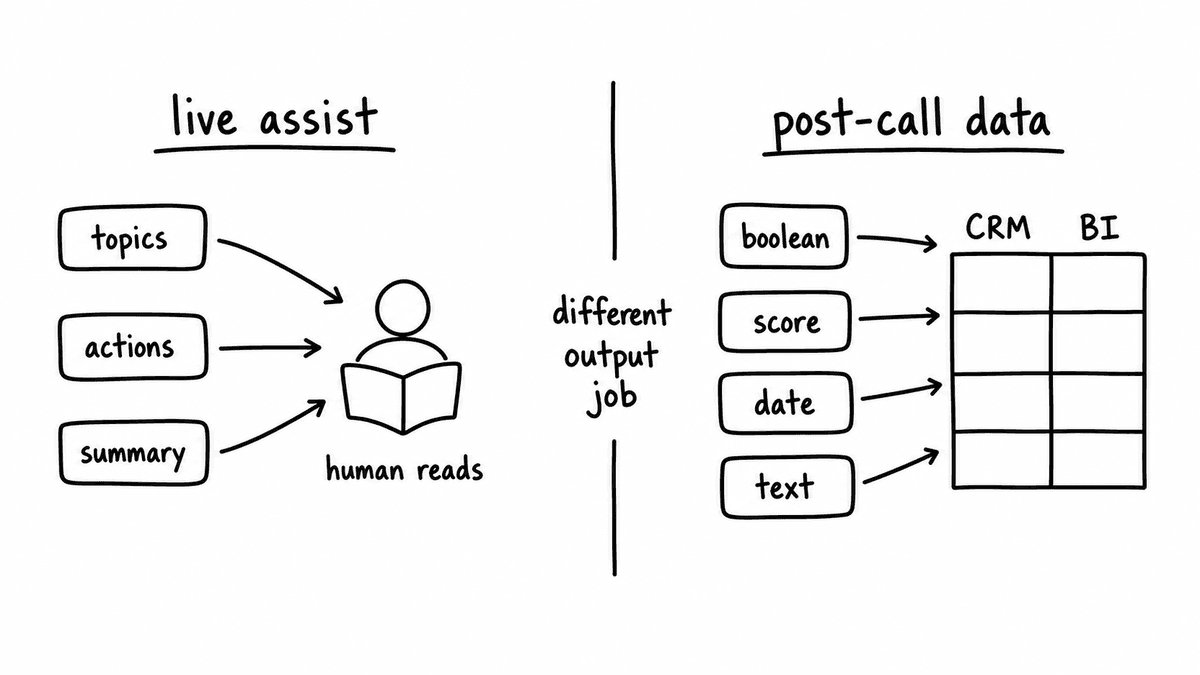
The short answer: stay with Symbl.ai if your core need is real-time meeting intelligence or agent assist, where the output is surfaced to a person during the call. Look at an alternative when you need deterministic, typed output you can route, score, and audit without a person in the loop. For that, Semarize is the closest fit, because it returns structured JSON against a schema you define rather than prose you have to reshape. AssemblyAI and Deepgram are the alternatives worth considering when the real requirement turns out to be transcription rather than evaluation.
Who Symbl.ai is for
Symbl.ai provides conversation intelligence over audio, video, and text through an API that handles both real-time and asynchronous processing. Its core features include topic detection, action item and question extraction, sentiment analysis, conversation trackers for keyword and phrase monitoring, and AI-generated meeting summaries. The streaming API processes live calls as they happen, which suits applications that need to respond during a conversation rather than after it ends.
That makes it a strong fit for teams building meeting-assistance tools, contact-centre agent support, or any feature that surfaces output to a person in near-real-time. The API is well documented and accepts a range of input formats, which keeps the integration barrier low for a team adding conversation intelligence to an existing product. A team whose product lives inside the live call, prompting an agent or summarising a meeting as it closes, is using Symbl.ai for exactly what it was designed to do.
Why teams look for Symbl.ai alternatives
Topics, action items, and summaries are built for human consumption, and they aren’t directly consumable by a downstream data system. A topic-detection result is a list of extracted phrases; a summary is a paragraph of prose. Neither maps reliably to a typed CRM property, a yes/no flag in a QA dashboard, or a scored value in a reporting model without an intermediate step that reads the prose and decides what the structured value should be. That step is an extraction layer, and once it exists, your team owns and maintains it.
For teams enriching CRM opportunity records with specific fields from every call, scoring calls against MEDDIC or a custom QA rubric, or building reporting models that aggregate call-level signals across a rep’s book, the output format is the constraint. The scoring logic needs to be defined by the team, and the result needs to be typed rather than narrative. Symbl.ai’s trackers allow some customisation around keyword and phrase monitoring, but they don’t provide a way to define typed evaluation criteria with a governed output schema. A second constraint is schema stability: a pipeline that depends on the same fields across call batches needs the output structure to stay fixed, because a field that appears, disappears, or changes type without warning breaks everything downstream of it.
Where Semarize fits
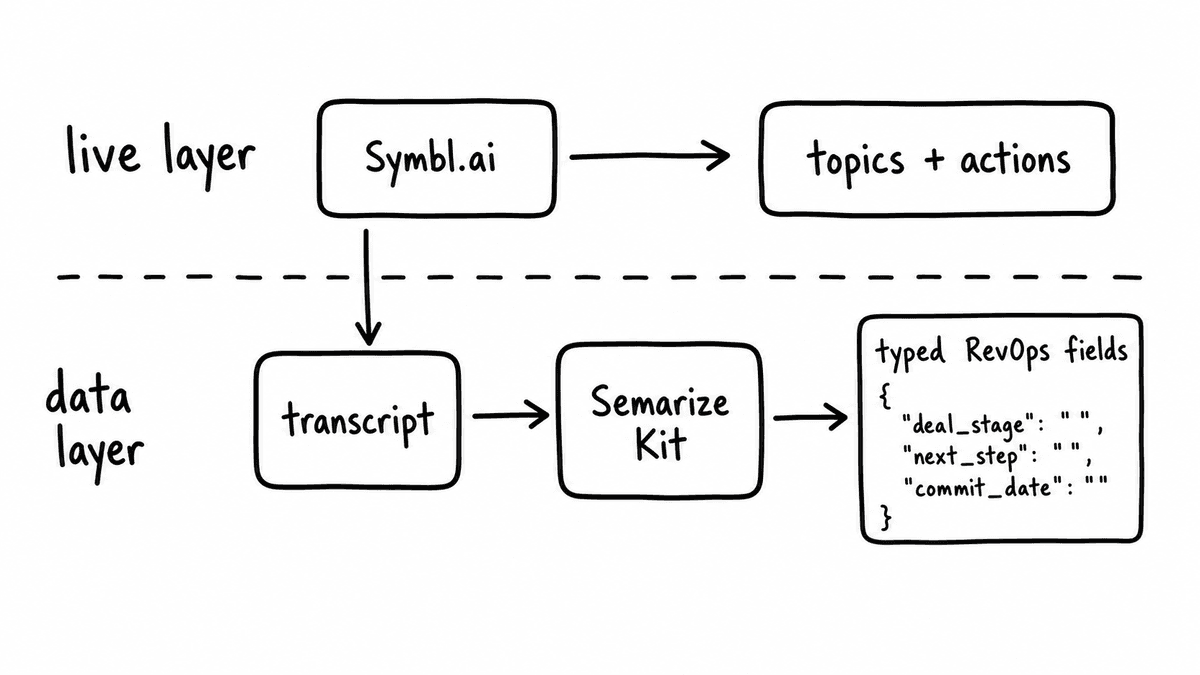
Semarize is a conversation intelligence API that turns calls, emails, chats, and transcripts into structured JSON signals for automation, reporting, scoring, and downstream workflows. The difference from Symbl.ai is one of buying model and architecture rather than analysis quality. Symbl.ai is a real-time intelligence platform you consume during the call; Semarize is data infrastructure you own, where the schema is defined by the customer through Bricks, individual typed criteria that test a transcript for specific evidence and return a concrete value, grouped into versioned Kits that produce the same shaped object from every call.
In practice that means Semarize doesn’t generate topics or summaries from its own model logic. It evaluates the transcript against the criteria the customer defined and returns exactly the fields those criteria specify. A RevOps team that needs to know whether a buyer articulated a quantifiable business problem, whether a competitor was named, and whether a next step was confirmed with a date gets those three typed fields back, ready to write to the CRM or query in a report. The data, the schema, and the workflow stay owned by the team rather than living inside a vendor’s dashboard.
Where Semarize is not a fit
Semarize isn’t a meeting recorder, a call storage platform, or a coaching dashboard, and it doesn’t transcribe audio or analyse a call in real time. A team that needs to process conversation content as it happens, for example to surface information to a contact-centre agent mid-call, will find Symbl.ai’s streaming capabilities better matched to that job. Semarize processes transcript content after the call ends and returns structured output by webhook or API, which fits post-call workflows and not live assistance. Teams that mainly need transcription, or general-purpose audio intelligence without defining their own criteria, will often start better with AssemblyAI or Deepgram.
Symbl.ai alternatives compared
| Option | Output type | Schema you define | Best fit |
|---|---|---|---|
| Semarize | Typed JSON | Yes, via Bricks and Kits | CRM enrichment, scoring, RevOps workflows |
| AssemblyAI | Transcript + audio intelligence | Vendor-defined categories | Transcription plus general audio analysis |
| Deepgram | Transcript | No | Fast, accurate transcription at scale |
| Symbl.ai | Topics, action items, summaries | Partial, via trackers | Real-time meeting intelligence, agent assist |
Use cases Semarize handles differently
The clearest way to see the difference is to write the output first. Before comparing any vendor, list the exact fields your pipeline needs and give each one a type: a yes/no for whether pain was articulated with a consequence, a text field for the named competitor, a category for the deal stage the buyer implied, a date for the agreed next step. With that schema written down, the evaluation becomes concrete rather than a demo impression.
Run a sample of your own real calls through each option and measure four things: how often each required field comes back populated, whether the value matches the type you specified every time, whether the same transcript produces the same fields on repeated runs, and whether the output shows the evidence behind each value so a wrong field can be traced. Semarize is built to pass that test by design, which is what makes it suitable for CRM enrichment, automated MEDDIC scoring, and QA coverage at scale. The CRM enrichment playbook covers the field-mapping patterns for Salesforce and HubSpot, and the RevOps use case shows where the structured output lands in the workflow.
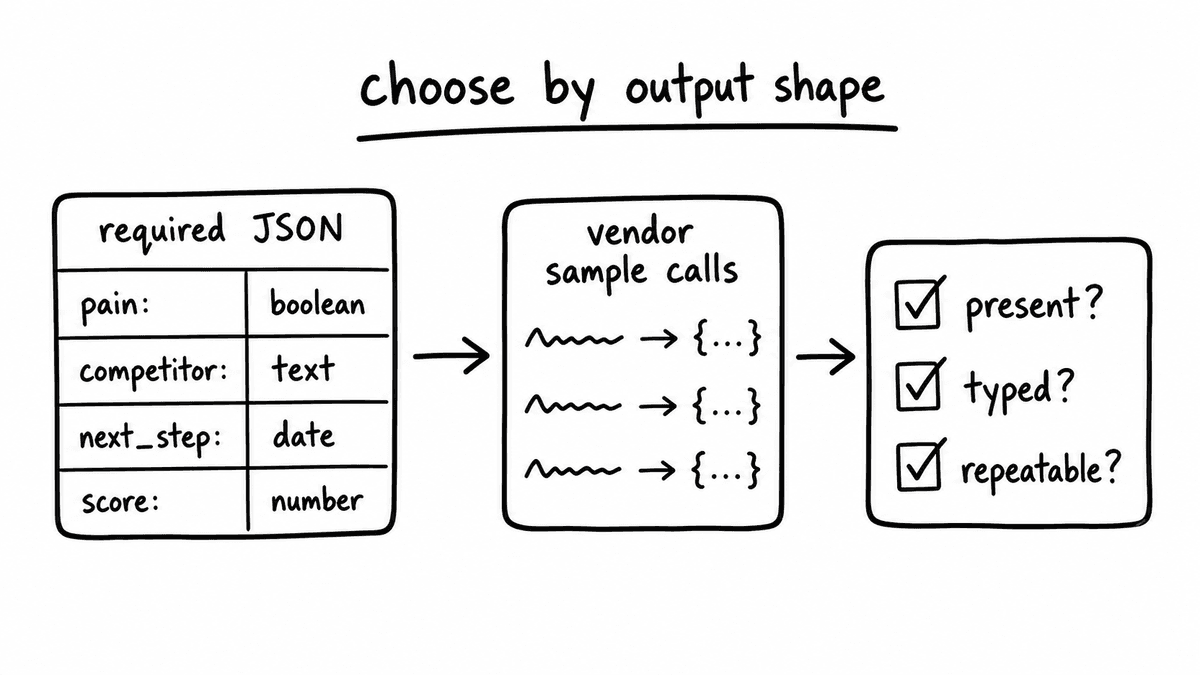
Semarize turns call transcripts into typed JSON against a schema you define, so the output is ready to route, score, and audit without a reshaping layer in between.
Common questions
Is Semarize a replacement for Symbl.ai?
Not a like-for-like one, because the two solve different problems. Symbl.ai is built for real-time meeting intelligence and agent assist during a live call; Semarize is built for structured, typed output from conversation content after the call ends. A team that needs in-call features should keep Symbl.ai for that. A team that needs deterministic fields for CRM enrichment, scoring, or reporting should evaluate Semarize on output stability. Some teams run both, with Symbl.ai handling the live layer and Semarize the post-call data layer.
What does “deterministic” mean for call intelligence output?
It means the same transcript produces the same structured fields every time it is evaluated against the same schema. A probabilistic system can return a slightly different summary or topic list on repeated runs, which is fine for a human reader and a problem for an automation that expects a stable value. Determinism is what lets you build a CRM update, a scoring threshold, or a pipeline query on top of the output and trust it behaves the same way next week as it does today.
How do we test schema reliability before signing a contract?
Run your own real calls, not the vendor’s demo calls, through the API and measure field presence rate, type consistency, repeatability across runs, and whether the evidence behind each value is visible. Start from the JSON your CRM and scoring pipeline actually need, then check how many of those fields come back populated and correctly typed on every call. A vendor that can’t hold the schema steady across a real sample won’t hold it steady in production.
Can Semarize evaluate transcripts produced by Symbl.ai?
Yes. Semarize accepts transcript text regardless of source, so a team using Symbl.ai for recording or transcription can pass that text to Semarize for structured evaluation against its Kit schema. The two run as separate layers in one pipeline: Symbl.ai handling recording and transcription, Semarize handling the typed evaluation that feeds CRM enrichment, scoring, and reporting.
Continue reading
Read more from Semarize
Gong API Alternatives for Structured Output
Most teams that struggle integrating Gong data into RevOps workflows describe it as an API problem. It is almost always a requirements problem. Before evaluating alternatives, write the exact JSON fields your downstream systems need and test vendors against that contract.
Conversation Intelligence for Developers: Don't Build a Fragile Pipeline, Don't Buy a Black Box
Most teams don't fail to add conversation intelligence because the model is bad; they fail because the integration is fragile and unstructured. The fix isn't a better LLM pipeline or a platform API you can't control. It's a layer that takes a transcript, runs it against a versioned Kit, and returns deterministic typed JSON you can test, version, and route into your product.
Gong Captures the Transcript. Here’s What It Can’t Score.
Gong’s scoring runs against a fixed model — you can’t attach your product documentation, rate card, or qualification playbook to its evaluation layer. For four evaluations that matter — product accuracy, pricing audit, methodology A/B testing, and deal readiness scoring — knowledge grounding and KB isolation are the only architecture that works.