
From Raw Transcripts to Durable RevOps Signals: Pipeline Health, Rep Performance, and Buyer Engagement
The forecasting problem in RevOps is usually a signal problem in disguise. Raw call transcripts aren’t pipeline health indicators but archives of what was said, and they can’t be queried, compared, or connected to downstream forecasting and capacity planning workflows without being converted into something structured first. When the conversion step is missing, teams score calls and view dashboards and then forecast from the same CRM stage data they always used, because the conversation data never made it into the systems that drive the forecast.
The schema-first approach fixes this. It starts from the RevOps questions that need answering, works backwards to define the structured signals that would answer them, and then builds the extraction pipeline to produce those signals reliably. The output is a set of durable, queryable fields that can be written to a data warehouse and connected to forecasting and capacity planning workflows.
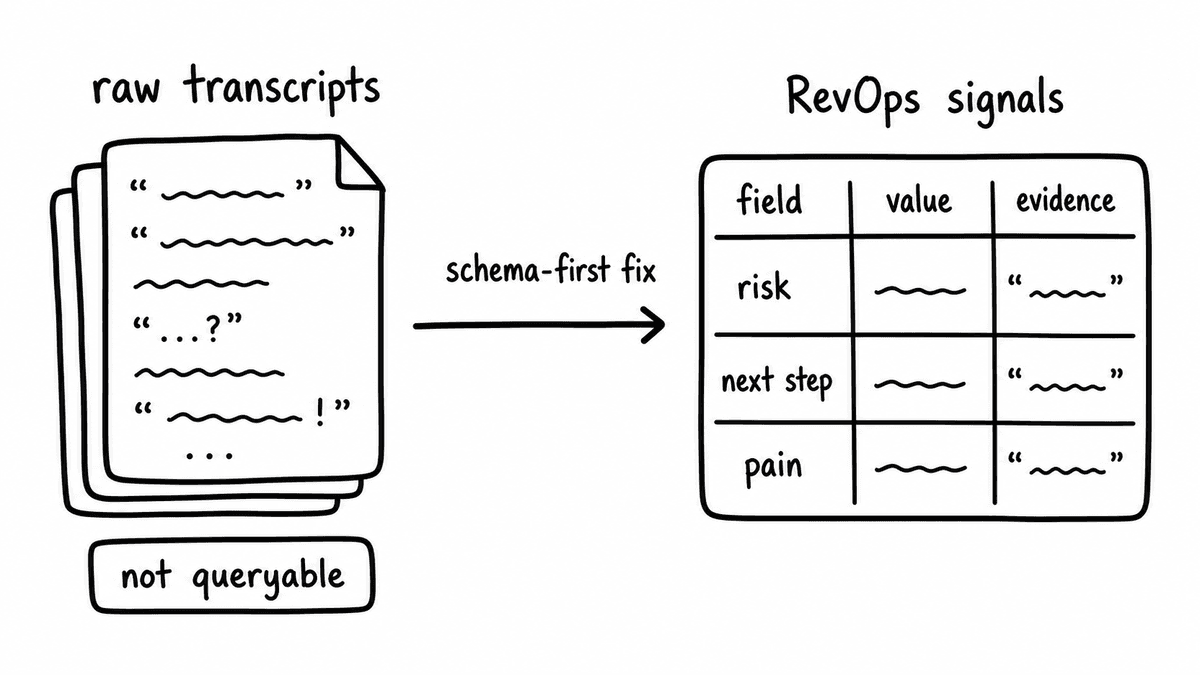
Transcripts are not signals
Transcripts are evidence: they record what was said, by whom, in what order. They can tell you that a competitor was mentioned, but they can’t tell your forecasting model whether competitor mentions are predictive of deal loss without a structured field that captures competitor presence consistently across every deal. A structured field that says "Competitor: [name]" on 400 opportunities in the warehouse can be analysed. Four hundred transcript files in a folder can’t.
The difference between a transcript archive and a RevOps signal layer is the extraction step. Extraction converts transcript evidence into typed fields with stable definitions that remain consistent across time, across reps, and across model versions. A field defined as "buyer described business consequence" means the same thing on a call scored six months ago as it does on a call scored today, because the Brick criterion hasn’t changed. That consistency is what makes the field usable in a forecasting model that compares this quarter to last quarter.
Start from RevOps questions, not from features
The schema design question is: what do we need to know about deals to predict progression, identify stalling, and flag risk? Working backwards from that question produces a set of extraction targets that are directly connected to the forecasting and capacity planning workflows the schema is supposed to feed.
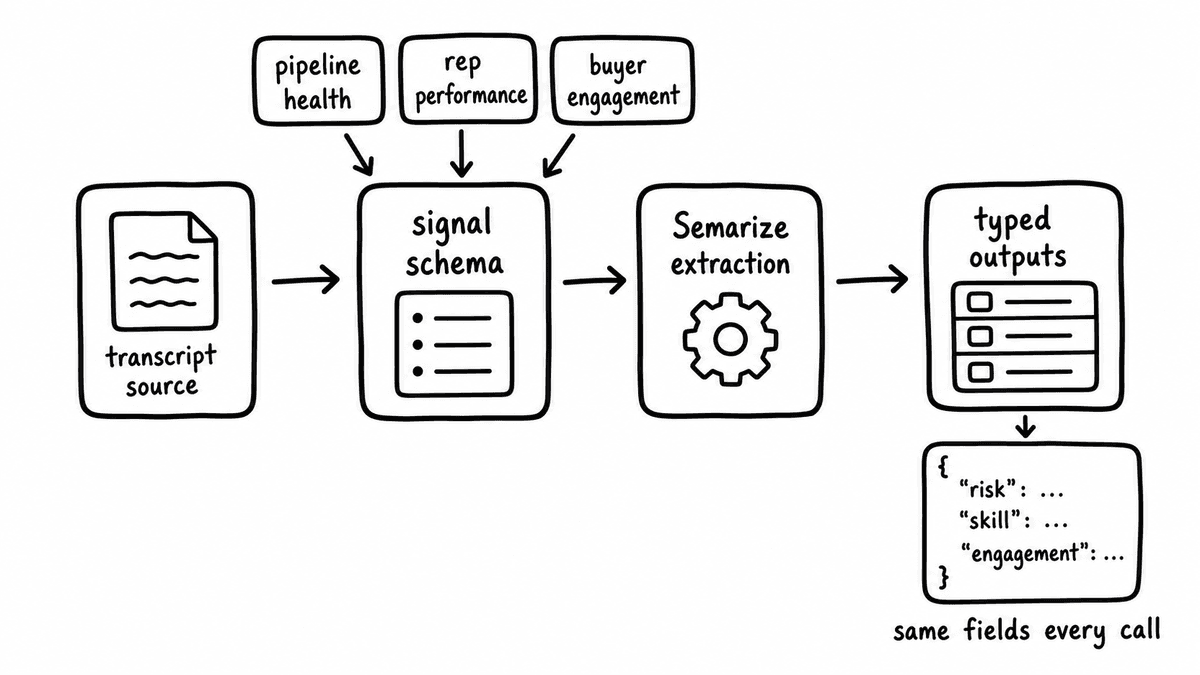
Pipeline health indicators that tend to be predictive include: whether the economic buyer has been engaged in the last two calls, whether a business consequence was stated by the buyer at any point in the deal, whether a decision timeline is present, and whether a specific next step was committed to with a date on the most recent call. Each of these has a clear answer in transcript evidence and a typed output that maps to a warehouse field.
Rep performance metrics that are grounded in buyer outcomes rather than activity counts include: the percentage of a rep’s discovery calls where the buyer described a consequence, the percentage where the economic buyer was engaged, and the percentage where a committed next step was extracted. These fields measure whether the rep is producing deals with genuine qualification evidence, not whether the rep logged the right number of activities.
Buyer engagement scores built on interaction signals from the transcript, such as whether the buyer asked specific questions about implementation, whether they introduced internal stakeholders voluntarily, and whether they referenced the vendor’s specific features rather than the category, provide leading indicators that can supplement the lagging stage-progression data in the CRM.
Treat the output as a data product
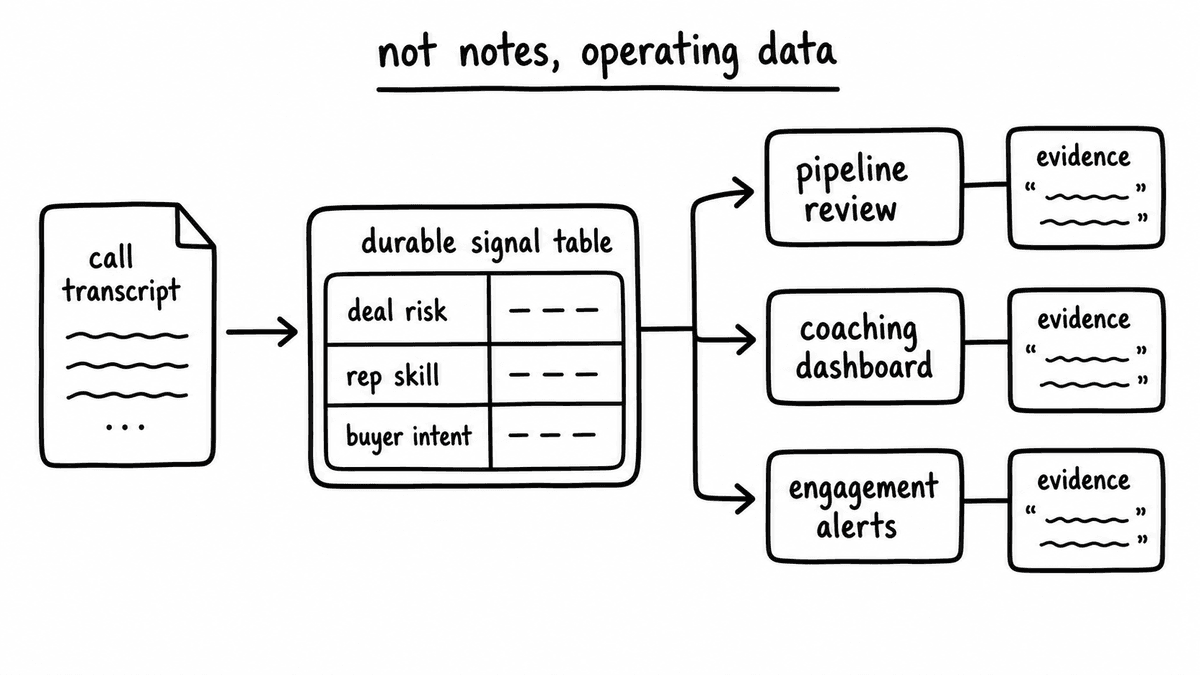
The structured signal layer is a data product, not a one-time export. That means it has a schema, a versioning policy, a validation layer, and a defined destination. Kit versioning in Semarize locks the field names, output types, and valid values at a specific version so the schema does not change silently when the evaluation logic is updated. Every call processed against the same Kit version produces fields that are comparable to every other call processed against that version, which is the prerequisite for time-series analysis and cohort comparisons.
The destination for the signals should be both the CRM and the data warehouse. The CRM gets the deal-level fields that affect pipeline reviews and workflow triggers in real time. The warehouse gets the full signal table, including the Kit version as a column, so analysts can filter by version when comparing scores across time periods where the schema may have changed. The conversation data warehouse post covers the schema patterns for BigQuery, Snowflake, and Databricks.
Connecting signals to forecasting and capacity planning
Once the structured signal layer is queryable in the warehouse, it can be connected to forecasting and capacity planning workflows as an additional input layer. Pipeline health scores derived from call evidence can improve forecast models that currently rely only on CRM stage and amount. Deals where the economic buyer was never engaged in any call can be weighted down in the forecast even if they are at a late stage. Deals where three consecutive calls produced no committed next step can be flagged as risk, independent of stage.
For capacity planning, buyer engagement signals across a rep’s book of business provide a real-time view of which accounts are warming and which are cooling, rather than relying on activity counts that don’t distinguish between productive meetings and meetings that produced no commitment. The capacity planning post covers how conversation signals close the gap in the data that capacity planning currently works without.
Common questions
What is the difference between scoring calls and creating RevOps signals?
Scoring calls produces a per-call output that reflects the conversation. Creating RevOps signals produces queryable, comparable fields that can be aggregated across deals, reps, and time periods and connected to forecasting models. Call scores that live in a dashboard aren’t RevOps signals; typed fields written to a warehouse table with a stable schema and a Kit version identifier are. The distinction matters because only the second form can be used as an input to capacity planning, pipeline health analysis, or a forecasting model.
Where should the signals live: CRM, warehouse, or both?
Both, with different purposes. The CRM receives the deal-level fields that affect pipeline management and workflow triggers in real time: whether the economic buyer was engaged, whether a next step was committed. The warehouse receives the full signal table for analysis: historical comparisons, rep performance cohorts, correlation analysis between specific signals and deal outcomes. Writing to both doesn’t require two extraction runs, only two routing steps from the same JSON output.
What is the minimum viable signal layer to start forecasting?
Five fields that map to the most common deal quality questions are enough to start: economic buyer engaged in the last two calls, business consequence stated by buyer, decision timeline identified, competitor mentioned, and committed next step extracted. These five fields, queryable in the warehouse and written to CRM opportunity records, provide enough signal to identify deals that are at risk independent of their CRM stage and to validate whether the existing forecast process is weighting those deals correctly.
Continue reading
Read more from Semarize
CRM Enrichment From Sales Calls: The RevOps Data Ops Playbook
Most CRM enrichment stalls at 30% field coverage because the output is unstructured - reps updating from memory, summaries stored as notes. The fix is a structured extraction pipeline: transcript to consistent fields to CRM to automation triggers. This playbook covers the schema, the routing, and the implementation in Salesforce and HubSpot.
Conversation Data Warehouse: Consistent Call Fields for BI
BI teams can't query transcripts. They can't join AI summaries to CRM objects. To make conversation data useful for analytics, it needs to arrive as consistent typed fields - booleans, scores, text fields, lists - with join keys that connect calls to opportunities, accounts, and contacts. This is the pipeline, the schema, and the governance model that makes sales call analytics possible in your warehouse.
Bricks and Kits: the mechanism for stable conversation evaluation
Freeform prompts produce inconsistent evaluation results - scores drift, output shapes change, and you can't tell whether coaching improved anything or whether the rubric moved. Bricks define a locked evaluation schema: one question, one output type. Kits group them into reusable evaluation workflows. The result is schema-stable conversation analysis you control.