
GTM Engineering in 2026: Revenue Data Engineering Explained
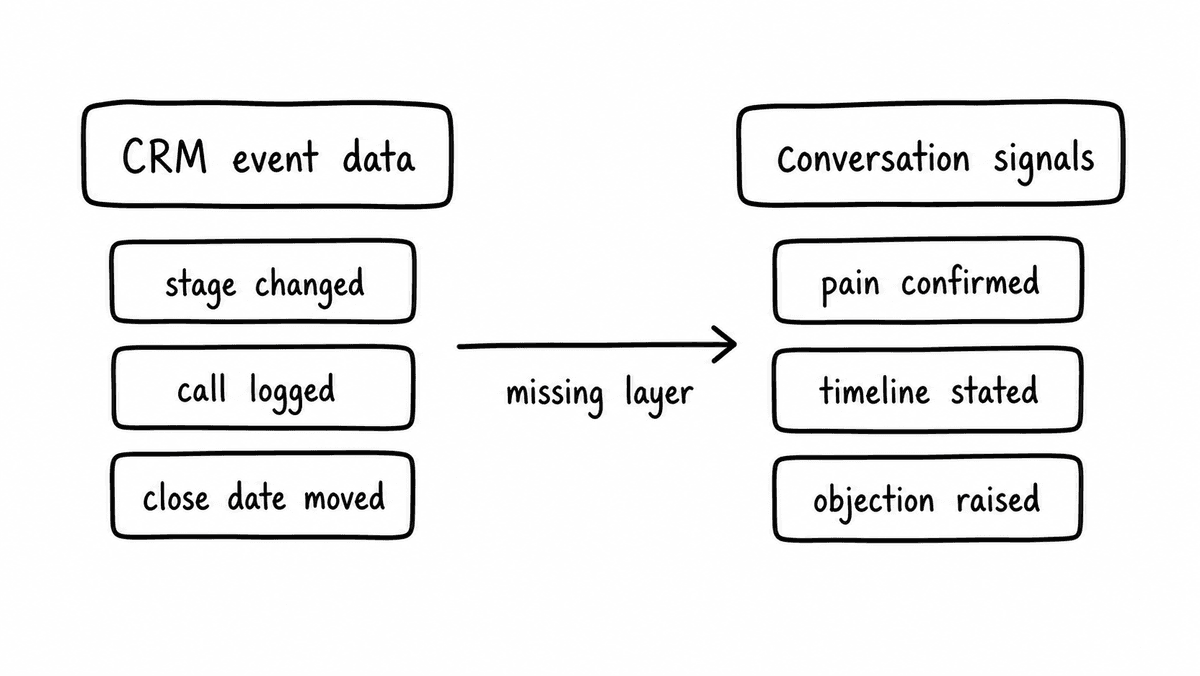
Over the last few years, serious time and money has been spent building GTM pipelines that do quite perform as well as they should, and the reason is almost never the automation layer or the AI model. The problem is further upstream, and a function of a lack of progress in the way that we track and analyse sales, and it's all event data driven: stage changes, activity logs, close date updates. Designed to track what happened to a deal, not what is happening inside one, the event data distinction is one of the core tensions in GTM engineering in 2026.
Despite this, the workflow layer has genuinely matured - teams can wire a Salesforce field update to a Slack alert, trigger a coaching workflow when a deal stalls, and build forecast models that update on a schedule, but all of that depends on the quality of the signals feeding into it, and most teams have not addressed the part of the stack where the highest-quality signals actually live: the conversation. Getting that right is what revenue data engineering is actually for.
What revenue data engineering actually involves
Revenue data engineering is the practice of building the pipelines, schemas, and extraction logic that make sales and marketing signals queryable, automatable, and comparable over time. In most organisations it has meant building on top of CRM data, and CRM data is a reasonable starting point because it is structured, already present, and connected to the tools that need it. But CRM data alone is insufficient for what AI-augmented GTM workflows require.
- A forecasting model that incorporates deal quality signals needs to know whether the buyer confirmed a timeline and articulated a specific pain, not just whether the deal is in a particular stage.
- A coaching automation needs to know whether the rep used the discovery framework on that specific call, not just that a call happened and lasted 45 minutes.
- A QA process needs a score per call against a consistent rubric, not a count of how many calls a rep completed this week. These are fundamentally different kinds of data from what CRM was built to capture, and building a proper revenue data layer means building the pipeline that produces them.
Most GTM engineering stacks have not done that yet, and the inconsistent results they are seeing trace back to that gap.
Why CRM data falls short
CRM data is retrospective by design: a stage label records a decision the rep made after a conversation, not the content of the conversation itself, an activity log records that a call happened, and a close date reflects what the rep last heard from the buyer, updated whenever they remember to update it. As the underlying sales data problem makes pretty clear, most sales data is attached to opportunities rather than to the act of selling, and that distinction matters enormously when you are building AI workflows that need to make predictions or trigger actions based on deal state.
The lag compounds across every system that depends on it: a buyer raises a serious objection on a Monday call and the stage does not move until Friday, if it moves at all, and the forecasting model, the capacity planning model, the automation that was supposed to fire a coaching alert are all working from a picture that is days behind what is actually happening in the pipeline. As I described in capacity planning built on CRM-native fields, the decisions that require the most accuracy tend to be made against data that updates least reliably - Adding more sophisticated AI to the top of this stack does not fix the lag; it produces more sophisticated analysis of data that is still wrong.
Where the real signals live
Every sales call is a data event - The buyer either confirms a timeline or doesn't, the rep either asks the key discovery questions or skips them, specific objections are raised and either handled clearly or deflected, next steps are agreed with a named owner and a date, or it were left as a vague follow-up. All of that is in the transcript, and it is far more useful for understanding deal progress and rep performance than any CRM field, because it reflects what actually happened in the room rather than an abstraction of it made hours later.
The problem is extraction, and the challenge isn't accessing the transcript: Zoom and Teams can both deliver them via webhook, and the API integration is straightforward. The real challenge is that raw transcript text is unstructured, and unstructured data cannot feed the typed fields that automation workflows and reporting systems depend on. A sentence about timelines in a transcript does not become a boolean in a Salesforce field without an extraction layer in between and building that layer in a way that is consistent, versioned, and reliable enough to base automations on is the real work of revenue data engineering in 2026, and most teams have not built it.
What it means for a signal to be structured
Structured conversation signals are a typed field with a consistent definition, produced by the same evaluation logic on every call that goes through the pipeline. Booleans for "buyer confirmed timeline" are either true or false, grounded in a specific quote from the transcript, and produced by the same rubric whether the call was 20 minutes or 90. Scores for "discovery completeness" are an integer on a defined scale rather than a prose summary that varies in length and emphasis depending on how the model interpreted the call.
This distinction matters at scale: when one person reads a call and tells you whether discovery was good, you get a judgement, but when the same rubric is applied to 500 calls, you get data you can aggregate, compare by rep, chart over time, and use to measure whether a training programme changed anything on live calls. Kits are the versioned evaluation schemas that make this work: a set of typed Bricks that define exactly what to extract, in what format, against what definition. Because the Kit is versioned, the output from call 1 is directly comparable to the output from call 500, and the output from this quarter is comparable to last quarter's even if average call length changed or the team grew.
The alternative to a versioned schema is a prompt you tweak periodically and assume produces consistent results. At small scale, a prompt works well enough. But the moment you need to compare scores across time, aggregate across reps, or build an automation that fires reliably on a typed condition, the consistency of the output stops being an implementation detail and becomes the whole point.
What the extraction pipeline looks like in practice
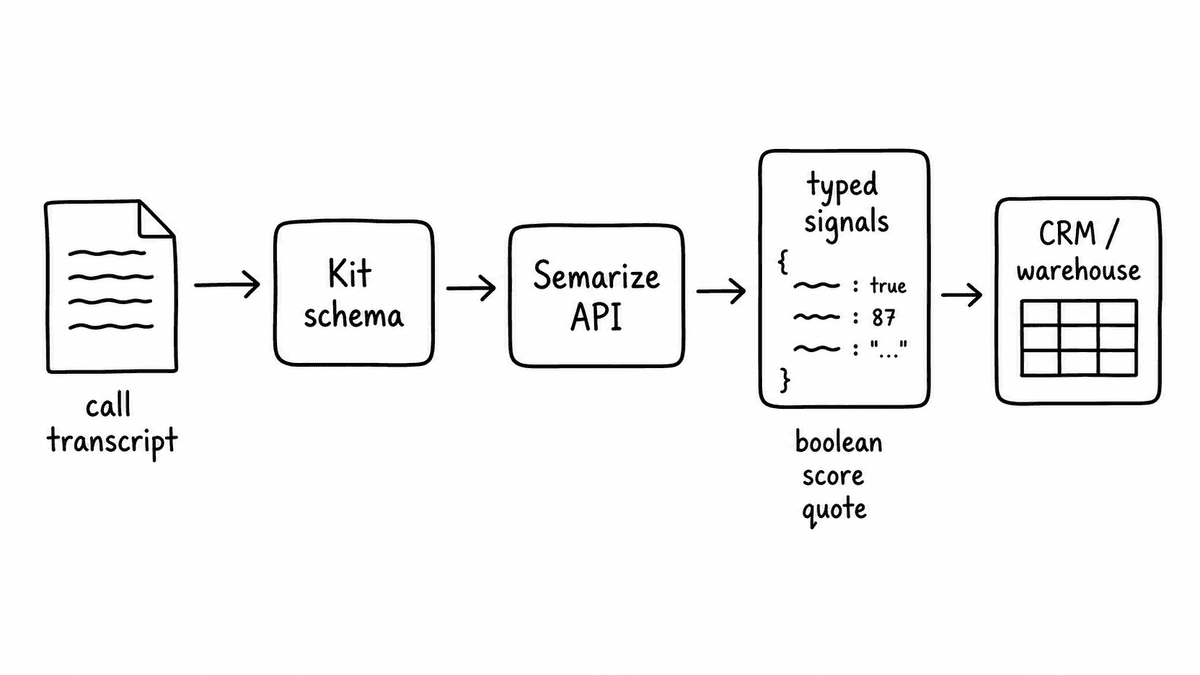
The pipeline has three steps: a call ends and Zoom or Teams delivers the transcript via webhook to the automation layer receiving it, typically n8n or Make. The automation passes the transcript to the Semarize API with a Kit code, and the scored JSON comes back: typed fields, a confidence level for each, and the transcript quote that grounded the output. The automation writes those fields to the relevant CRM record and routes any triggered workflows. The whole sequence runs without rep involvement and completes within a few minutes of the call ending.
The outputs compound across the stack: Salesforce opportunity fields for MEDDIC elements get populated automatically after every discovery call. A deal risk flag fires if the buyer has not confirmed a timeline by the third call. A coaching alert routes to the manager if the discovery score falls below the team benchmark. A CRM enrichment feed keeps opportunity records current with what was actually said on the last call. None of these require complex AI workflows: they require typed input data that means the same thing every time, and the extraction layer is what produces it.
Input quality is the ceiling
Teams building GTM engineering stacks in 2026 have generally solved the workflow layer. n8n and Make are mature platforms, CRM APIs are well documented, and the tooling for building interfaces on top of structured data has improved dramatically. The constraint has moved: the teams seeing inconsistent results from their AI-augmented workflows have a data problem rather than a tooling problem, and the data problem is almost always in the conversation layer: what comes out of calls is unstructured and inconsistent, and so the outputs of every workflow built on top of it are unstructured and inconsistent too.
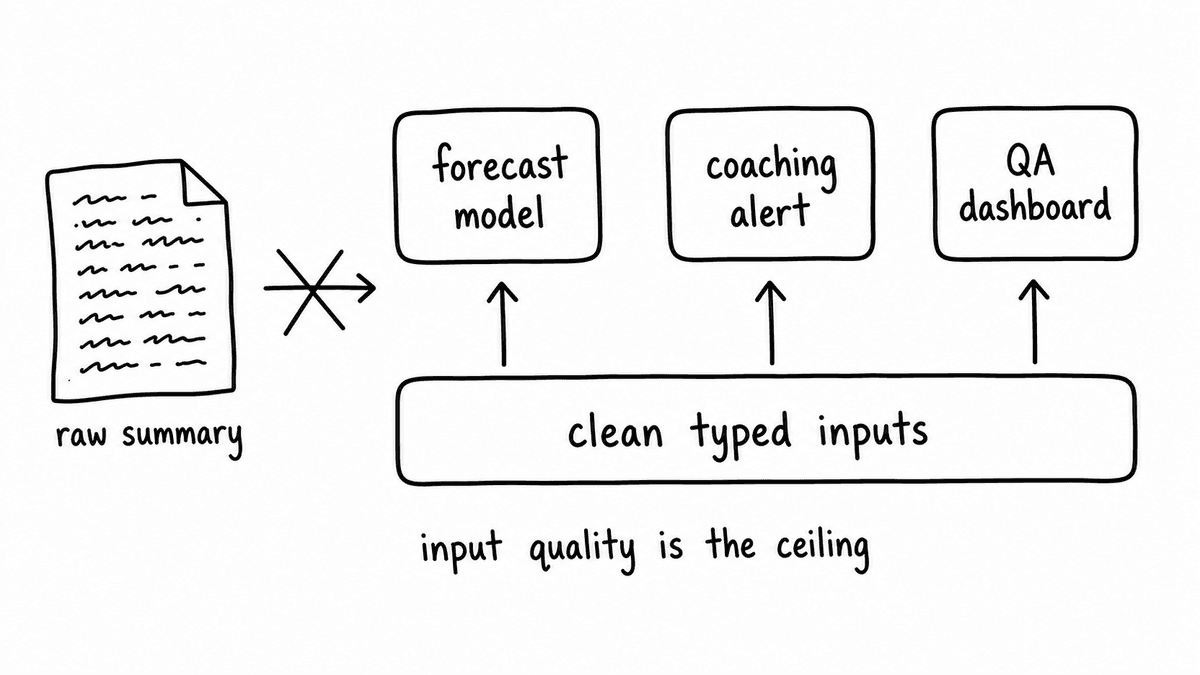
AI call scoring without proper grounding is a good illustration of how this plays out. Scoring workflows that perform well in a demo often fail in production because the evaluation criteria were never made explicit and the outputs were never made consistent. Teams rebuild the model, adjust the prompt, and swap the AI provider, but the problem was always in the input. The model is only as good as what goes into it, and if what goes in is a mix of rep-filled CRM fields and variable prose summaries, the output varies regardless of how sophisticated the model is.
The teams that get durable results instrument the conversation layer first. They define evaluation schemas before building automations, treat extraction as a dependency rather than an afterthought, and give the AI workflows downstream of the extraction layer clean, typed, versioned fields to work with. That is what revenue data engineering looks like when it is working, and it is why RevOps teams that invest in the data layer first tend to see compounding returns from each new workflow they add on top.
Common questions
What is GTM engineering?
GTM engineering is the practice of treating go-to-market as an engineered system: building the automations, data pipelines, and measurement infrastructure that make sales and marketing motion faster, more consistent, and measurable. In 2026 it typically involves connecting CRM, conversation data, automation platforms, and AI scoring layers into pipelines that run without manual intervention. The discipline has matured significantly on the workflow side, but most teams are still working through the data quality problem that sits underneath it.
What is revenue data engineering?
Revenue data engineering is the discipline within GTM engineering focused on the data layer: defining which signals matter, building pipelines that produce them reliably, and making them available to the AI workflows and reporting systems that depend on them. In 2026 the core challenge is conversation data. It is the richest source of revenue signals in most organisations, but also the hardest to make structured, consistent, and queryable, and most stacks have not built the extraction layer that closes that gap.
Why can't you use CRM data alone for AI-powered GTM workflows?
CRM data records what happened to a deal administratively: stage labels, logged activities, close date changes. It does not record what happened inside the conversations where deals actually progress, and that is the data AI-augmented workflows need most. A model predicting deal risk needs to know whether the buyer confirmed a timeline and articulated a specific pain, not just the current stage. CRM data also lags: a buyer signals reservation on Monday and the stage does not update until later in the week, if at all, which means every downstream system depending on it is always behind.
How do you get structured signals out of sales calls automatically?
A call ends and the transcript arrives via webhook from Zoom or Teams. An automation layer passes it to the Semarize API with a Kit code, which defines exactly what to extract and in what typed format. The API returns a JSON object with scored fields and the transcript evidence that grounded each output. The automation writes those fields to CRM and routes any triggered workflows. The pipeline runs end to end without any manual step between the call ending and the CRM record being updated.
What is the difference between a structured conversation signal and a call summary?
A call summary is prose: readable, variable in length and emphasis, and impossible to aggregate or compare across calls. A structured conversation signal is a typed field: a boolean, an integer on a defined scale, or a specific extracted string, produced by the same rubric on every call that goes through the pipeline. The difference is the difference between data you can read and data you can query, automate against, and track over time. Summaries are useful for individual call review. Structured signals are what revenue data engineering runs on. Semarize is the extraction layer that turns conversation transcripts into typed, versioned signals your GTM workflows can depend on.Start building ->
Continue reading
Read more from Semarize
Sales is human. Sales data is not.
CRM data captures events - stage changes, activity counts, timestamps. It doesn't capture the human act of selling. The evidence that explains why deals move or stall lives in conversations, not in fields a rep updated.
Capacity Planning Lags Because Sales Data Misses the Act of Selling
Sales capacity models built on CRM events are structurally late. Stage labels and activity counts record what happened to deals, not what was happening inside them. The missing ingredient isn't more pipeline data - it's structured signals from selling conversations that show whether buyers actually understood, committed, and progressed.
Conversation Intelligence for Developers: Don't Build a Fragile Pipeline, Don't Buy a Black Box
Most teams don't fail to add conversation intelligence because the model is bad; they fail because the integration is fragile and unstructured. The fix isn't a better LLM pipeline or a platform API you can't control. It's a layer that takes a transcript, runs it against a versioned Kit, and returns deterministic typed JSON you can test, version, and route into your product.