
Conversation Intelligence Produces Signals, Not Workflows
Conversation intelligence vendors tend to describe their products in terms of outcomes: better forecasts, improved coaching, higher win rates. Those claims are technically supportable - teams that implement CI well do see those outcomes. The problem is that the causal chain requires work the vendor can't do for you, and most implementations never close the gap between “CI is running” and “outcomes improved.”
Most RevOps teams don't have a conversation intelligence problem. They have a vendor-claim translation problem: they buy CI expecting the tool to fix forecasting, coaching, and pipeline visibility, and find that what they actually got was a data layer. That data layer is genuinely useful - but only if something consumes it. If the downstream wiring isn't built, the signals sit in dashboards and the outcomes don't move.
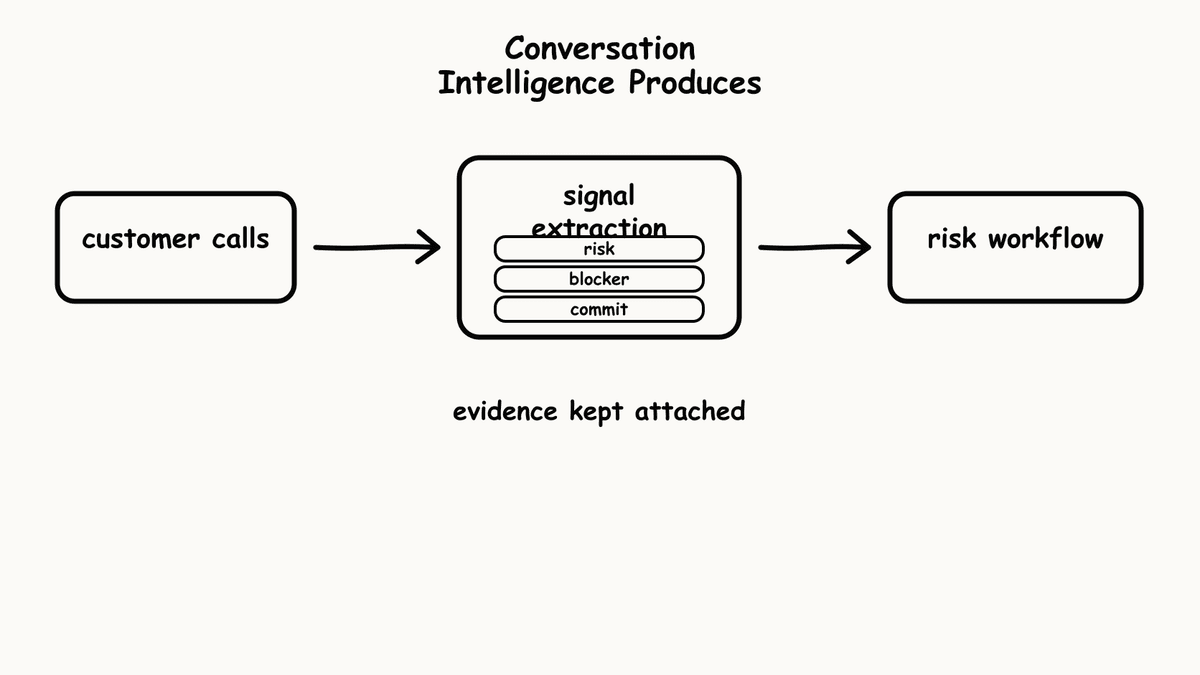
What CI actually produces
Conversation intelligence produces two things: transcription and structured semantic signals. The structured signals are where the value lives - scorecards, deal signals, process adherence flags, buyer understanding indicators. These are the fields that can enrich CRM objects, feed forecast models, and trigger coaching workflows. They are upstream inputs to better outcomes, not the outcomes themselves.
What CI does not produce is a redesigned decision system. If your forecast model is still primarily driven by stage and rep confidence, adding conversation signals doesn't change the model - it gives you more data sitting next to it. If your coaching process is still based on manager intuition and periodic call reviews, CI scoring doesn't change the process - it gives you better inputs that nobody is pulling from. The signals exist. The workflow that acts on them doesn't.
The failure modes that show up in practice
The most common failure is measuring the wrong thing. Teams buy CI to improve coaching, then coach off rep behaviour metrics - talk ratio, question count, framework adherence - because those are the signals the tool surfaces most visibly. Those metrics tell you what the rep did. They don't tell you whether the buyer understood anything as a result. Coaching that optimises for rep behaviour produces reps who perform better on the scorecard without necessarily running better conversations.
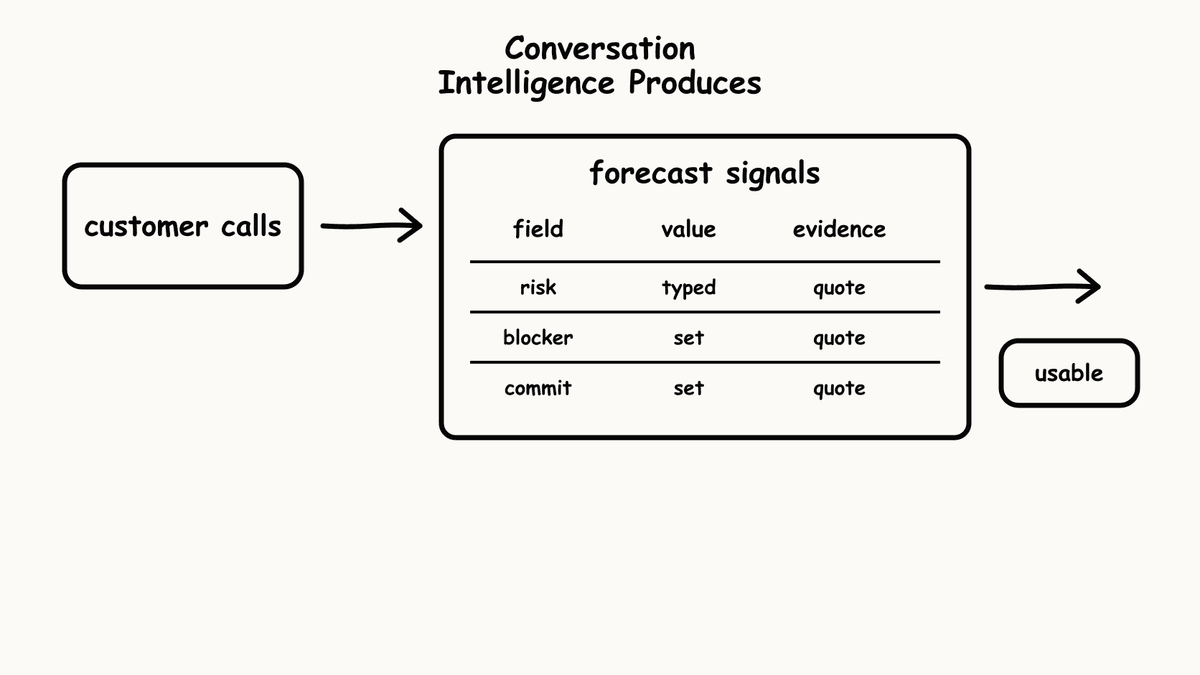
The second failure is treating the scorecard as the outcome rather than the input. A CI dashboard full of scores and highlights creates the feeling of measurement without the substance of it. Scores that aren't connected to a coaching action, a CRM field update, or a forecast model input aren't producing outcomes - they're producing reporting. The behavioural change problem in CI is specifically this gap: the signal exists but never reaches the moment where a rep decides what to do differently.
What properly wired CI signals enable
When conversation signals are connected to your downstream workflows, three things become possible that weren't before. Forecast risk detection: deals where buyers haven't confirmed a timeline or named a next step get flagged automatically, regardless of what stage the rep has them in. The signal comes from the conversation, not from manager judgment in a pipeline review.
Evidence-based coaching: when a rep's discovery depth scores are consistently low, you pull the specific calls where buyer pain wasn't articulated and coach from transcript evidence. The feedback is specific and grounded, not a general performance observation derived from win/loss patterns. And CRM enrichment without rep input: deal evidence fields - competitor mentioned, timeline confirmed, stakeholder identified - populate automatically from the conversation, closing the coverage gap that rep updates never could. The CRM enrichment playbook covers the full extraction and routing pipeline.
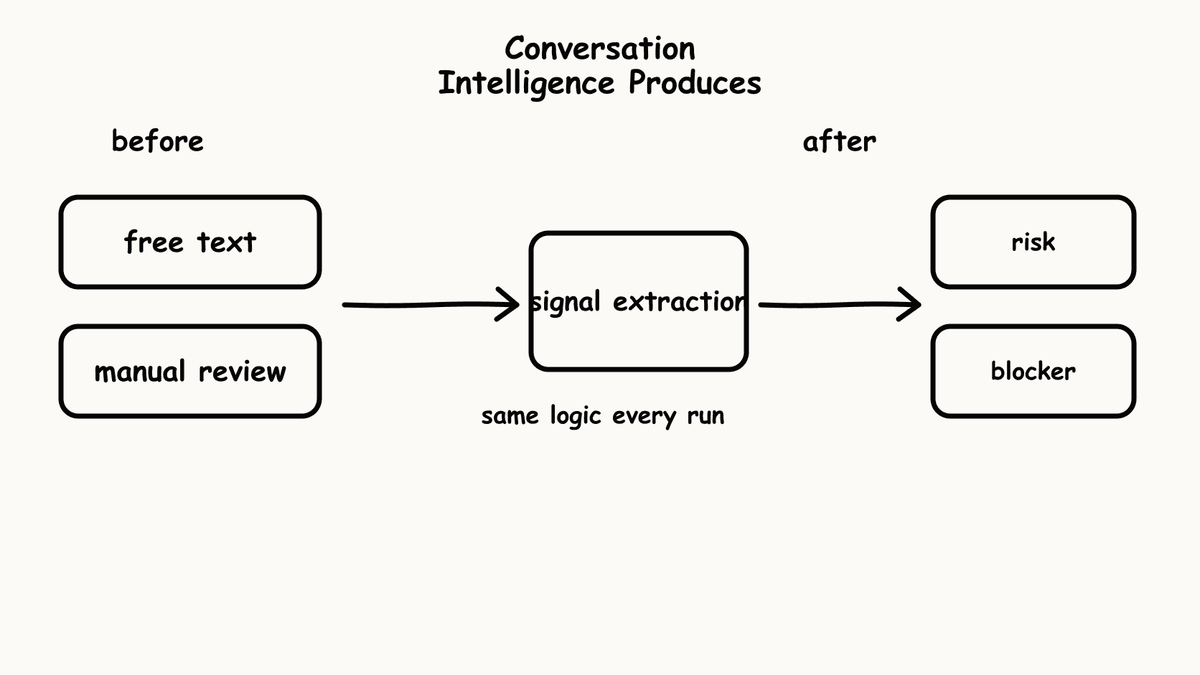
All three of these depend on the same prerequisite: structured, consistent signals that route into the systems making decisions. Dashboards don't produce outcomes. Signals wired into CRM fields, forecast models, and coaching workflows via Make or n8n do.
How to evaluate CI with the right questions
During diligence, the question that matters isn't “what outcomes does this improve?” - every vendor will answer that with case studies. The question is: what specific buyer-understanding signals does this produce, and how do those signals map to the workflows that drive your decisions? Those are two different questions that most CI demos skip entirely.
Ask for the actual output format. Ask how the extraction schema is defined and versioned. Ask what happens to the output fields - do they route to CRM automatically, or do they require manual review? Ask how you'd build a forecast risk trigger on top of the signals, and whether the API supports that without a custom integration project. If the vendor can't demonstrate the wiring, the signal quality is moot - it won't reach the places that need it.
How Semarize approaches the signal-to-workflow problem
Semarize is designed as a data layer first. You define the extraction schema - which buyer-understanding signals matter for your use case, what output type each field returns, what evidence standard is required - and the APIreturns structured JSON your downstream systems can consume directly. The schema is versioned and stable, so CRM integrations, forecast models, and coaching workflows don't break when the underlying model updates.
Knowledge grounding means the signals are calibrated to your business context, not to model inference. Your qualification criteria, your pricing, your sales methodology - these attach to the evaluation Kit and the extraction checks against them. The result is signals that mean something specific in your pipeline, not generic indicators that require a human to interpret before they become actionable. The RevOps use case covers the full signal-to-workflow architecture, including forecast risk detection, CRM enrichment, and coaching measurement.
Semarize produces structured buyer-understanding signals from every call. Define what you need downstream, and build from that.
Common questions
If CI gives us transcripts and scores, why doesn't it automatically improve forecasting?
Because transcripts and scores are inputs, not decisions. A forecast improves when the model making it incorporates new signals - buyer timeline confirmation, stakeholder identification, deal risk indicators - not when those signals exist in a separate dashboard. For CI to improve forecasting, the extraction outputs need to populate the fields your forecast model reads, either directly via CRM enrichment or through a forecast risk layer that sits above the conversation data. The tool produces the signals. Your RevOps architecture is what makes them count.
What should we measure instead of rep activity when evaluating CI signal quality?
Buyer-understanding signals: whether the buyer articulated a specific, quantifiable pain; whether they confirmed a timeline; whether they agreed to a next step with a named owner and date; whether they introduced additional stakeholders or decision criteria. These are buyer-side facts that exist in the transcript and predict deal outcomes more reliably than rep activity metrics. If your CI evaluation only shows rep behaviour scores - talk ratio, questions asked, framework adherence - you're measuring inputs without measuring whether those inputs produced buyer understanding.
How do we evaluate an AI scorecard without trusting the demo?
Run five of your own calls through it - specifically calls where you know something specific went wrong or right. Check whether the scores reflect what actually happened: did the pricing concern that derailed the deal get flagged, did the strong discovery that advanced the deal get scored accurately? Then run the same calls twice and compare outputs. If scores shift between runs without any change to the call, the evaluation isn't stable. Consistent, grounded signals should produce the same result on the same call regardless of when the evaluation runs.
What does “downstream wiring” actually look like in a RevOps workflow?
It means CI signal fields flowing into the systems that make decisions, without a human review step in between. In practice: extraction outputs populating Salesforce or HubSpot fields automatically after each call; a forecast risk score updating a deal risk field that feeds your forecast model; a coaching flag triggering a task in your rep workflow tool when a specific buyer signal is absent. The wiring is a set of integrations and field mappings, not a dashboard. If the only thing reading your CI outputs is a human reviewing a report, the wiring isn't built.
Can CI embedded inside a broader revenue platform still fail to improve outcomes?
Yes - and for exactly the same reasons. The platform embedding doesn't change the underlying logic: signals need to be accurate, grounded in your business context, and wired into the decisions that matter. A CI layer embedded in a revenue platform that surfaces rep behaviour metrics to a coaching dashboard has the same failure mode as a standalone CI tool doing the same thing. The question to ask of any embedded CI implementation is the same: what specific buyer-understanding signals does it produce, and what downstream decision does each signal feed?
Continue reading
Read more from Semarize
Why Conversation Intelligence Doesn't Drive Behavioural Change (and What Does)
Eighteen months into a CI implementation, many teams find that call scores have improved but win rates haven't moved. The data is there. The dashboards are running. The coaching is happening. What's missing is the step where insight becomes a different behaviour in the next conversation - and CI alone doesn't close that gap.
CRM Enrichment From Sales Calls: The RevOps Data Ops Playbook
Most CRM enrichment stalls at 30% field coverage because the output is unstructured - reps updating from memory, summaries stored as notes. The fix is a structured extraction pipeline: transcript to consistent fields to CRM to automation triggers. This playbook covers the schema, the routing, and the implementation in Salesforce and HubSpot.
Conversation Data Warehouse: Consistent Call Fields for BI
BI teams can't query transcripts. They can't join AI summaries to CRM objects. To make conversation data useful for analytics, it needs to arrive as consistent typed fields - booleans, scores, text fields, lists - with join keys that connect calls to opportunities, accounts, and contacts. This is the pipeline, the schema, and the governance model that makes sales call analytics possible in your warehouse.