
Stop Running Win/Loss Surveys. Start Capturing Deal Signals From Calls.
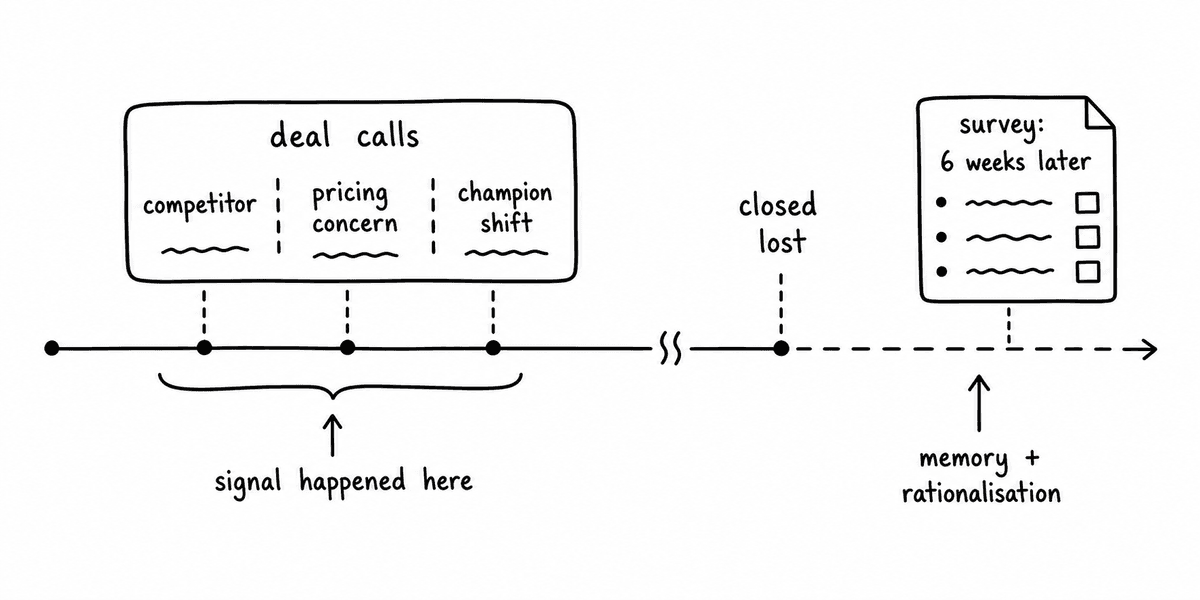
Win/loss programmes built on post-deal surveys share a structural problem: the survey happens after the outcome is known. At that point, you're collecting memory and rationalisation, not the decision inputs that actually drove the result. Response rates average around 12%, and the responses skew toward recently churned customers who have strong opinions and enough dissatisfaction to reply. Deals that closed get underrepresented because satisfied buyers have less motivation to reflect on why.
The signal timing problem is what matters most. If you learn six weeks after a deal closes that the buyer didn't understand your pricing model, that information is useful for the next similar deal - but it's too late for the deal you lost, and too late to coach the rep while the conversation is still fresh. The signals existed during the deal. They just weren't being captured.
What in-call win/loss signals look like
Every sales call contains the signals that eventually determine win or loss - the same real-time pattern behind extracting MEDDICC qualification from transcripts. Competitor mentions happen during discovery when buyers compare options. Pricing concerns emerge when the number is stated and the buyer's response reveals whether they understand the model. Champion engagement changes - a buyer who was leaning forward starts deferring, or introduces a new stakeholder who wasn't previously in the picture - show up in the transcript before they show up in deal stage changes.
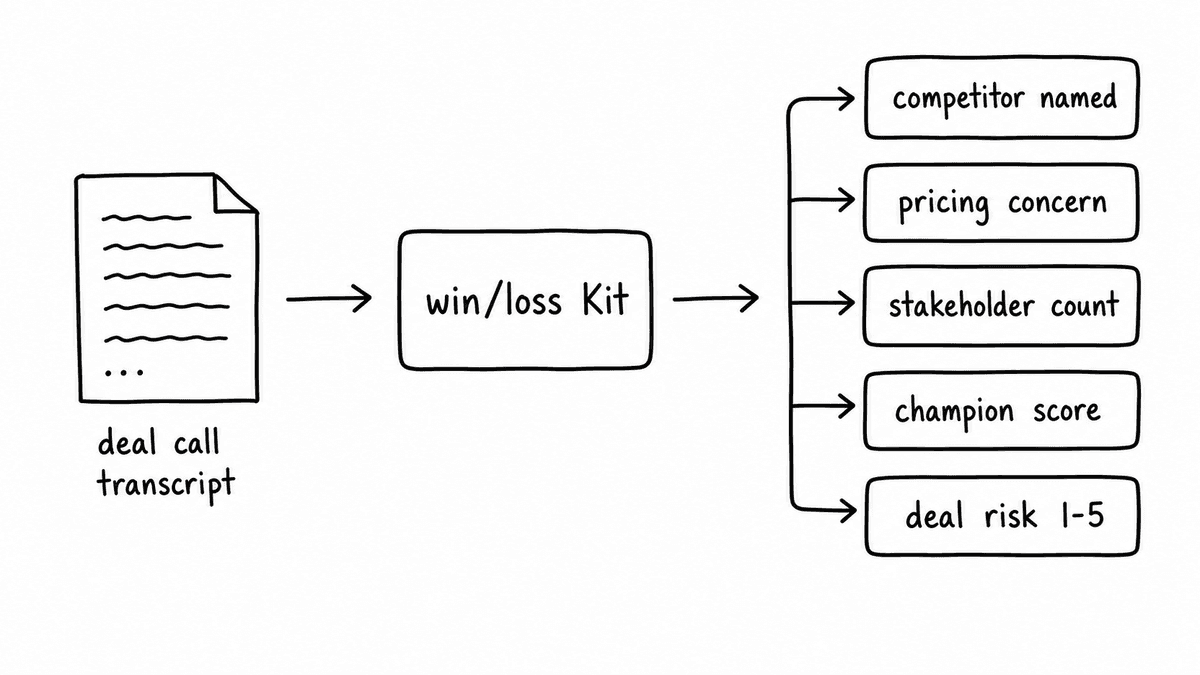
A win/loss signal extraction schema covers the specific fields that matter: competitor named (text), pricing concern expressed (yes/no with supporting quote), number of distinct stakeholders mentioned (count), champion engagement level (score), deal risk indicator (1-5), next step confirmed with date (yes/no). Each one is a Brick in a win/loss Kit. These fields exist in every recorded call. Extracting them automatically makes win/loss a real-time capability rather than a retrospective exercise.
The deal risk score deserves specific attention. It's not a single data point - it's an aggregate of adverse signal presence across a call: unresolved pricing concerns, competitor mentions without a rep response, stakeholder disengagement, absence of a confirmed next step. Tracked across every call in a deal, risk scores show you when the deal started to deteriorate - which is typically well before the stage label changes and long before any survey would be triggered.
Why surveys don't fix attribution
Post-deal surveys collect buyer opinion about why they made a decision. That opinion is shaped by hindsight, relationship dynamics, and the buyer's motivation for giving feedback. Buyers who chose you attribute the win to the relationship or the product. Buyers who didn't choose you attribute the loss to price or timing, because those are the simplest explanations and they avoid criticising the rep directly.
The actual decision inputs - whether they understood your differentiation, whether the pricing model landed, whether the right people were in the room at the right time - are in the call. The survey can't surface them accurately because the buyer is reconstructing the decision from memory rather than reporting what happened as it happened. More questions or better survey design doesn't solve this. The timing problem is structural.
Teams often respond to weak win/loss data by adding more enablement content - better battlecards, more pricing FAQs, updated competitive positioning. That's not wrong, but it doesn't correct the attribution problem because it still doesn't measure buyer understanding during deals. You end up optimising for what you can measure, not what actually drove the outcome.
Building always-on win/loss signal capture
The operational shift is to treat win/loss as a conversation intelligence problem rather than a feedback collection problem. Every deal call is processed through an evaluation schema that extracts the signals relevant to outcome prediction - competitors named, pricing response, stakeholder dynamics, deal risk - and stores them as structured fields. Grounding the schema in your competitor list and pricing is what makes those fields specific to your deals rather than generic mentions.
When a deal closes (won or lost), you have a record of how those signals evolved across the deal lifecycle. Which calls saw competitor mentions? When did pricing concerns appear? Did deal risk scores trend up or down in the two weeks before close? That evidence base is more accurate than post-deal survey responses and available before the outcome is known, which means it can drive real-time deal coaching and risk flagging rather than just retrospective analysis.
The CRM enrichment playbook covers how to structure deal risk scoring and route signals into your RevOps and coaching workflows.
Validating that signals predict outcomes
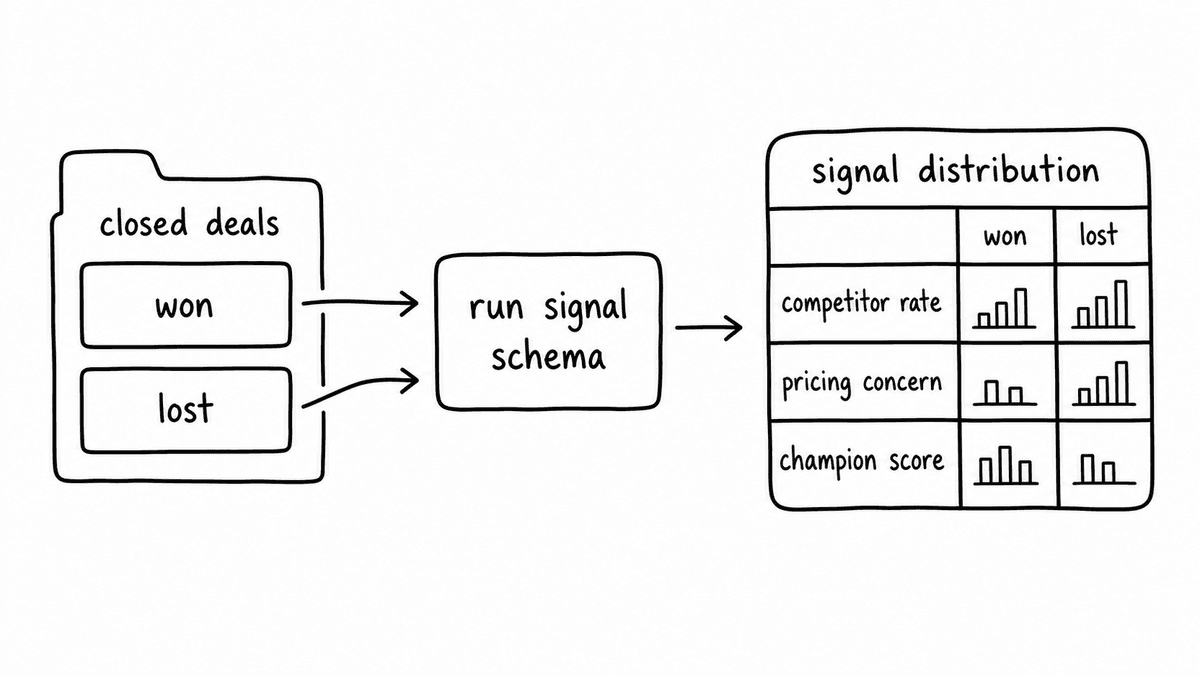
Before using extracted signals for attribution, validate that they correlate with outcomes in your deal history. Take a sample of closed won and closed lost deals and run the extraction schema against the call recordings. Check whether the signal distributions differ: do lost deals show higher competitor mention rates, earlier pricing concern flags, lower champion engagement scores? If they do, the signals have predictive validity in your context.
This calibration step matters because the predictive weight of specific signals varies by segment, deal size, and sales motion. Enterprise deals may show more stakeholder complexity signals; mid-market deals may show pricing sensitivity signals more reliably. Once you know which signals correlate most strongly with outcomes in each segment, you can weight the deal risk score accordingly rather than treating all adverse signals equally.
How Semarize supports real-time win/loss analysis
Semarize extracts win/loss signals from call transcripts as typed, structured fields - not summaries or narrative highlights that require human interpretation. Each field in the extraction schema is defined once in a Kit: what question is being asked, what output type is expected, what evidence standard must be met. The same Kit runs against every deal call automatically, producing a consistent signal record across the full deal lifecycle.
The structured outputs mean deal risk scores and signal data land directly in your CRM and RevOps tooling via the API - no manual review step, no analyst translating highlights into fields. When a rep is preparing for a deal review, the signal record is already populated: competitors mentioned in call three, pricing concern unresolved in call four, champion engagement declining across the last two calls. That evidence base is what pipeline reviews and coaching conversations should be built from.
Surveys will still tell you what buyers think they decided. Call signal extraction tells you what was actually happening when they were deciding. The two data sources answer different questions - and for the questions that most affect deal outcomes, the call data is the more reliable input.
Semarize extracts deal signals from every call in real time and returns them as structured data your pipeline and coaching systems can act on.
Common questions
How is call-recording win/loss different from standard call coaching scorecards?
Coaching scorecards evaluate rep behaviour - talk ratio, framework adherence, question quality. Win/loss signal extraction captures deal-outcome signals: competitors named, pricing concerns expressed, stakeholder dynamics, champion engagement changes, deal risk scores. The output is used for attribution and forecasting, not for rep performance reviews. Both use the same transcript, but they ask fundamentally different questions of it. A rep can score well on a coaching rubric and still produce calls with high deal risk - the two schemas are measuring different things.
What if buyers don't mention competitors or pricing explicitly on every call?
Not every call will produce every signal - that's expected and not a problem. A competitor mention field that returns null on most early-stage calls and starts appearing in later-stage calls is itself a meaningful signal pattern. The value comes from tracking signal presence and absence across the deal lifecycle. An absent pricing concern in calls one through three followed by a pricing concern in call four tells you something about when risk emerged. The schema captures the pattern, not just individual data points.
How do we validate that extracted signals actually predict win/loss outcomes?
Run the extraction schema against a sample of historical closed deals - both won and lost - and check whether signal distributions differ between the two groups. If lost deals consistently show higher competitor mention rates, earlier unresolved pricing concerns, and lower champion engagement scores than won deals, the signals have predictive validity in your context. Do this before using the signals for live deal scoring; the calibration tells you which signals matter most in your specific sales motion.
What does a deal risk score (1-5) actually represent in practice?
A deal risk score aggregates the presence and intensity of adverse signals in a call: unresolved pricing concerns, competitor mentions without a rep response, stakeholder disengagement, absence of a confirmed next step. A score of 1 means the call showed strong positive signals across those dimensions. A score of 5 means multiple risk indicators appeared without resolution. The scale is calibrated against your win/loss history - deals that closed had characteristic signal profiles, and deals that slipped or lost did too.
Do we still run surveys at all, or replace them entirely?
Surveys still have value for qualitative relationship feedback and net promoter data - things that don't appear clearly in transcripts. The shift is to stop relying on surveys as the primary source of win/loss attribution data. Call signals should feed the attribution model; surveys can supplement with buyer perspective after the fact. When a survey response conflicts with the in-call signal record, that discrepancy is worth investigating - it often reveals something about how buyers rationalise decisions versus what actually drove them.
Continue reading
Read more from Semarize
MEDDICC Scoring From Discovery Calls
Most MEDDICC data is stale before it reaches CRM. Reps update fields from memory after the call, introducing timing gaps and sampling bias that make qualification scores unreliable. Extracting MEDDICC signals directly from transcripts fixes the data freshness problem that better training never will.
CRM Enrichment From Sales Calls: The RevOps Data Ops Playbook
Most CRM enrichment stalls at 30% field coverage because the output is unstructured - reps updating from memory, summaries stored as notes. The fix is a structured extraction pipeline: transcript to consistent fields to CRM to automation triggers. This playbook covers the schema, the routing, and the implementation in Salesforce and HubSpot.
Conversation Intelligence Produces Signals, Not Workflows
CI vendors sell outcomes - better forecasts, improved coaching, higher win rates. The outcome claims are accurate for teams that wire CI signals into their downstream workflows. For teams that don't, the dashboards fill up and the outcomes don't move. The gap between running CI and seeing results is always an implementation gap, not a vendor gap.