
How Conversation Intelligence Scores MEDDIC and Feeds Pipeline Forecasting
Understanding how conversation intelligence scores MEDDIC and feeds forecasting starts with an uncomfortable admission: most pipeline forecasts run on qualification data that nobody in the room actually trusts. The MEDDIC fields on an opportunity were filled in by a rep, from memory, at some point after the call that mattered, and they reflect what that rep chose to type rather than what the buyer said. When a forecast model reads those fields as evidence of deal health, it inherits every gap and every optimistic self-grade behind them, which is why the forecast and the deal reality drift apart long before anyone notices.
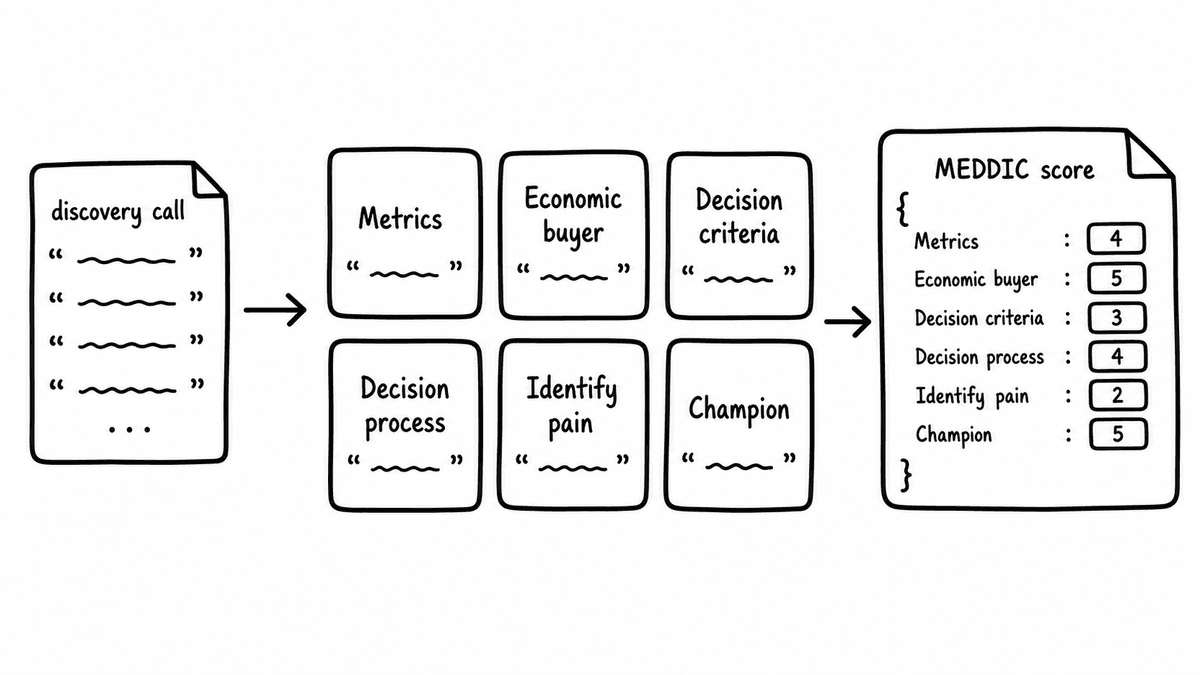
Conversation intelligence closes that gap by scoring MEDDIC from the transcript instead of from recall, and then writing those scores somewhere the forecast can use them. This is a full loop that runs from a call ending to a forecast being weighted, and it has a specific shape: one typed evaluation per MEDDIC element, grounded in buyer-side evidence, made comparable across reps through a versioned schema, and written to the CRM opportunity and a warehouse table where a forecasting process can treat MEDDIC coverage as a leading indicator of risk.
The problem: MEDDIC lives as stale, rep-entered CRM fields
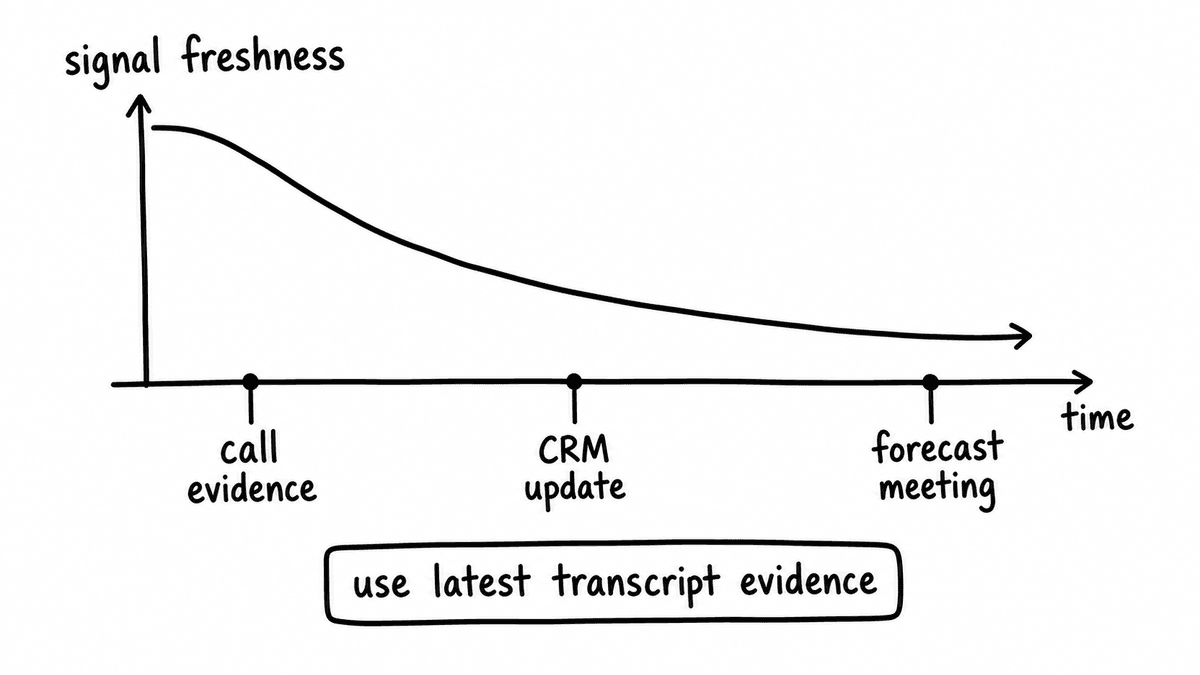
MEDDIC fields in most CRMs are a record of rep diligence, not deal reality, because the task of updating them competes with selling and selling wins. The Economic Buyer field says “procurement,” the Metrics field says “strong business case” with no number attached, and the Champion field points at whoever answers email quickly rather than whoever is selling internally on the team's behalf. These fields were often written once, early in the cycle, and never revised even though several calls have happened since, so the opportunity that looks most complete on paper can be the one running furthest ahead of the evidence.
Forecasts built on that foundation are forecasts built on qualification data nobody trusts, and the weekly pipeline review turns into an exercise in discounting the rep narration rather than reading the deal. Forecasting models that weight a deal up because their MEDDIC fields are populated are rewarding data entry, not qualification, because populated and grounded are different facts. The teams that feel this most acutely are the ones running deal inspection and forecast calls against fields that pass a completeness check while quietly failing an evidence check, and no amount of rep chasing has fixed it in twenty years of trying.
Turning MEDDIC into evidence-grounded scores
Conversation intelligence scores MEDDIC by reading the transcript and evaluating whether each element was actually established in the conversation, which changes the data source from rep memory to buyer evidence. In Semarize this runs as one Brick per MEDDIC element, where Bricks are single typed evaluations that each ask one specific, evidence-answerable question and return one concrete value. The Metrics Brick returns a boolean or string for whether the buyer stated a quantified consequence of their problem; the Economic Buyer Brick returns a boolean for whether the buyer named the specific individual who controls the budget; the Champion Brick returns a boolean for whether someone inside the account is demonstrably selling internally rather than merely being cooperative on calls.
Across the six elements each Brick tests a different concrete signal: Metrics looks for a number tied to the pain, Economic Buyer looks for a named decision-maker, Decision Criteria looks for the factors the buyer will judge solutions against, Decision Process looks for the sequence of steps and people involved in approval, Identify Pain looks for a problem with a cost and a timeline, and Champion looks for internal selling. Teams running MEDDICC add a Competition Brick, and teams running MEDDPICC add Paper Process for the procurement steps that follow a verbal yes, so the same pattern extends to whatever variant you qualify against. The distinction that makes this useful is between scoring what the rep claims and scoring what the buyer said: a rep can assert that budget is confirmed, but the Economic Buyer Brick only returns true when the transcript contains a buyer naming the person who signs, with the quote attached as evidence.
Consistency: a versioned Kit so scores are comparable
Scores only feed a forecast usefully when they mean the same thing across reps and over time, which is what a versioned Kit provides. Kits are versioned bundles that group the MEDDIC Bricks and return the same shaped JSON object on every run, with one typed field per element, so the Metrics score on one rep's call is computed against the identical criterion as the Metrics score on another rep's call. Without that discipline, MEDDIC scores are just another subjective grade wearing a number, and a forecast that aggregates them is aggregating noise.
Versioning matters because qualification criteria change, and a change that happens silently destroys comparability across a quarter. When the definition of a qualified Economic Buyer is tightened, versioning the Kit makes that explicit, so a score from March is known to have come from a different version than a score from June and the two aren’t compared as if identical. For a forecasting process this is the difference between a MEDDIC trend that reflects deal movement and one that reflects an unannounced scoring change, and only the first is safe to weight a forecast on.
Feeding forecasting with MEDDIC coverage
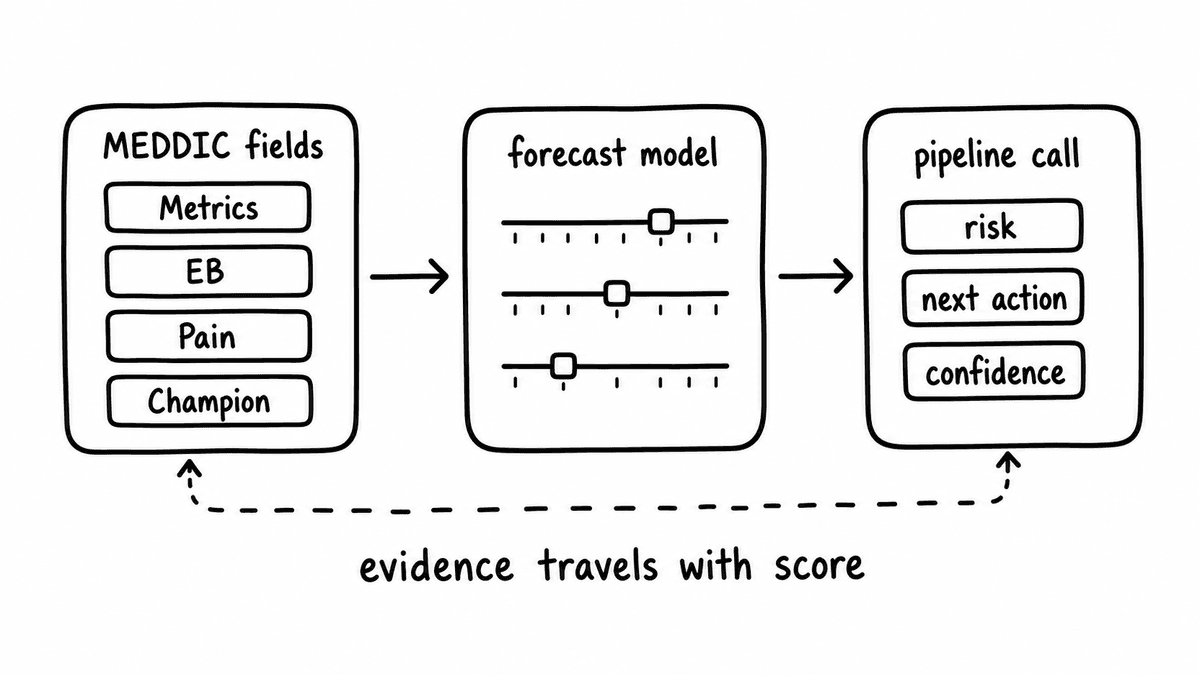
The loop closes when the MEDDIC fields are written to the CRM opportunity and to a warehouse table, because that is where a forecasting model or a forecast review can read them as structured inputs rather than prose. A webhook fires when the call transcript arrives, the Kit runs, and the automation writes each typed field to its matching CRM property and appends a row to the warehouse, giving you both the current state on the opportunity and the full call-by-call history for analysis. From there the forecast can use MEDDIC coverage directly: deals missing an Economic Buyer or a quantified Metric across recent calls get weighted down or flagged as risk independent of stage, so a deal sitting in Proposal with no named signer and no number stops being counted as if it were qualified.
Coverage of MEDDIC elements becomes a leading indicator when it is tracked across the deal cycle rather than read as a single snapshot, so deals where Champion engagement scored high early and decayed through the middle calls surface as a risk before the stage label moves. Being honest about the boundary matters here, because conversation intelligence produces the signal and the forecasting model or process still has to use it: writing accurate MEDDIC scores to a field changes nothing if the forecast is still driven by stage and rep confidence alone. The signal-to-workflow gap is exactly this: the signals are only worth extracting if something downstream is wired to weight, flag, or route on them.
Rep-claimed MEDDIC versus call-extracted MEDDIC
The practical value of the loop rests on the gap between what a rep enters and what a buyer said, because those two data sources produce very different forecasts. Rep-entered MEDDIC reflects a rep's judgement, optimism, and available time, and it is partial by construction because the fields only get updated when the rep gets round to it. Call-extracted MEDDIC reflects the transcript, with an evidence quote behind each score, and it runs on every call rather than the subset a rep chose to log, so the coverage gap that rep updates never close is closed by default.
Most RevOps teams keep both, in separate fields, because each carries information the other lacks. The automated score reflects what was in the transcript, with the supporting quote, and the rep-annotated field reflects context the transcript never captured, such as qualification shared over email or in an unrecorded corridor conversation. Keeping the two separate makes it obvious to a forecast reviewer which evidence is system-sourced and which is rep-reported, which preserves the analytical value of the extracted score for weighting while leaving the rep room to add what the recording missed. This same structured-data discipline runs through the wider practice of automating MEDDIC scoring from calls and the deterministic approach behind it.
Practical rollout: start with a few high-signal Bricks
The rollout that works starts narrow, with two or three high-signal MEDDIC Bricks rather than the full framework wired to the forecast on day one. Economic Buyer and Metrics are the usual starting pair, because a named signer and a quantified pain are the two elements whose absence most reliably predicts a deal that will slip, and they are the least ambiguous to score from a transcript. Running just those two against every call, writing the results to the CRM and the warehouse, and adding a simple forecast rule that flags any Proposal-stage deal missing either one gives you a leading indicator within a single quarter without a large integration project.
Once those Bricks are trusted, adding the remaining elements is a versioned Kit change rather than a rebuild, and the forecast rule extends element by element as confidence grows. The groundwork for this is the same deterministic scoring that turns a discovery call into typed fields, covered in detail in the MEDDIC without the admin playbook, which shows how each element becomes a Brick that writes back to the opportunity with no rep data entry. Start with the Bricks that move the forecast, prove the signal, and grow the Kit from there.
Semarize scores MEDDIC from every call as typed Bricks in a versioned Kit and writes the results to your CRM and warehouse, so your forecast can weight deals on what the buyer said rather than what a rep remembered to enter.
Common questions
Can conversation intelligence score MEDDIC automatically?
Yes. Conversation intelligence scores MEDDIC by reading the call transcript and evaluating whether each element was established, instead of relying on a rep to fill in fields from memory. In Semarize this runs as one Brick per element, each returning a typed value such as a boolean for whether the economic buyer was named or a string for a quantified metric, grouped into a versioned Kit that produces the same JSON shape on every run. The scores write back to the CRM opportunity and a warehouse table automatically, so every call produces grounded, evidence-backed MEDDIC data with the supporting quote attached rather than the partial, self-reported fields manual entry leaves behind.
How do MEDDIC scores from calls improve forecasting?
They give the forecast a leading indicator that is independent of stage and rep confidence. When MEDDIC scores are written to the opportunity and a warehouse table, the forecasting model or review can weight deals on coverage: deals missing an economic buyer or a quantified metric across recent calls get weighted down or flagged as risk even when their stage looks healthy. Tracked across the deal cycle, MEDDIC coverage shows which signals improve, stall, or decay before the stage label moves. Conversation intelligence produces the signal, but the forecasting process still has to be wired to use it, or the scores sit in a field changing nothing.
What is the difference between rep-entered MEDDIC and call-extracted MEDDIC?
Rep-entered MEDDIC reflects what a rep judged and chose to type, from memory, when they had time, so it’s partial and self-graded by construction. Call-extracted MEDDIC reflects the transcript, with an evidence quote behind each score, and it runs on every call rather than the subset a rep logged, which closes the coverage gap rep updates never could. A rep can claim budget is confirmed; the extracted Economic Buyer score only returns true when the buyer actually named the signer on the call. Most teams keep both in separate fields, so a forecast reviewer can tell system-sourced evidence from rep-reported context without losing either.
Which MEDDIC elements can be scored from a transcript?
All six core elements can be scored when the evidence is in the conversation: Metrics as a quantified consequence stated by the buyer, Economic Buyer as a named budget owner, Decision Criteria as the factors solutions will be judged on, Decision Process as the steps and people in approval, Identify Pain as a problem with a cost and timeline, and Champion as evidence of internal selling. Teams running MEDDICC add Competition, and teams running MEDDPICC add Paper Process for the procurement steps after a verbal agreement. Each is its own Brick with a specific criterion, and elements not discussed on a given call return a not-established value rather than a failing score.
Continue reading
Read more from Semarize
MEDDIC Without the Admin: Automated MEDDIC Scoring for Every Discovery Call
MEDDIC fields in CRM reflect what reps remember and choose to enter, not what buyers said. Automated MEDDIC scoring runs one typed Brick per element against the transcript, returns structured JSON, and writes qualification data back to the opportunity with no rep admin.
MEDDICC Scoring From Discovery Calls
Most MEDDICC data is stale before it reaches CRM. Reps update fields from memory after the call, introducing timing gaps and sampling bias that make qualification scores unreliable. Extracting MEDDICC signals directly from transcripts fixes the data freshness problem that better training never will.
Conversation Intelligence Produces Signals, Not Workflows
CI vendors sell outcomes - better forecasts, improved coaching, higher win rates. The outcome claims are accurate for teams that wire CI signals into their downstream workflows. For teams that don't, the dashboards fill up and the outcomes don't move. The gap between running CI and seeing results is always an implementation gap, not a vendor gap.