
5 Ways to Automate MEDDIC Scoring Directly From Sales Calls
MEDDIC scoring should happen after every discovery call, automatically, without a rep opening the CRM and deciding what to fill in. Most teams have tried to get there and landed somewhere short of it: a manual process that works inconsistently, a Gong dashboard that summarises calls but doesn’t write structured fields to the opportunity record, or a rubric that lives in a training document and gets applied to maybe twenty percent of calls.
Automating MEDDIC scoring from sales calls is a solvable problem. The specific approach depends on your existing stack, your engineering capacity, and how much you want the output to live in your CRM versus a separate analytics layer. The five approaches below cover the range from no-code to fully engineered, and each one produces deterministic, typed MEDDIC field data from the conversations themselves rather than from rep memory after the fact.
Why automate MEDDIC scoring from calls
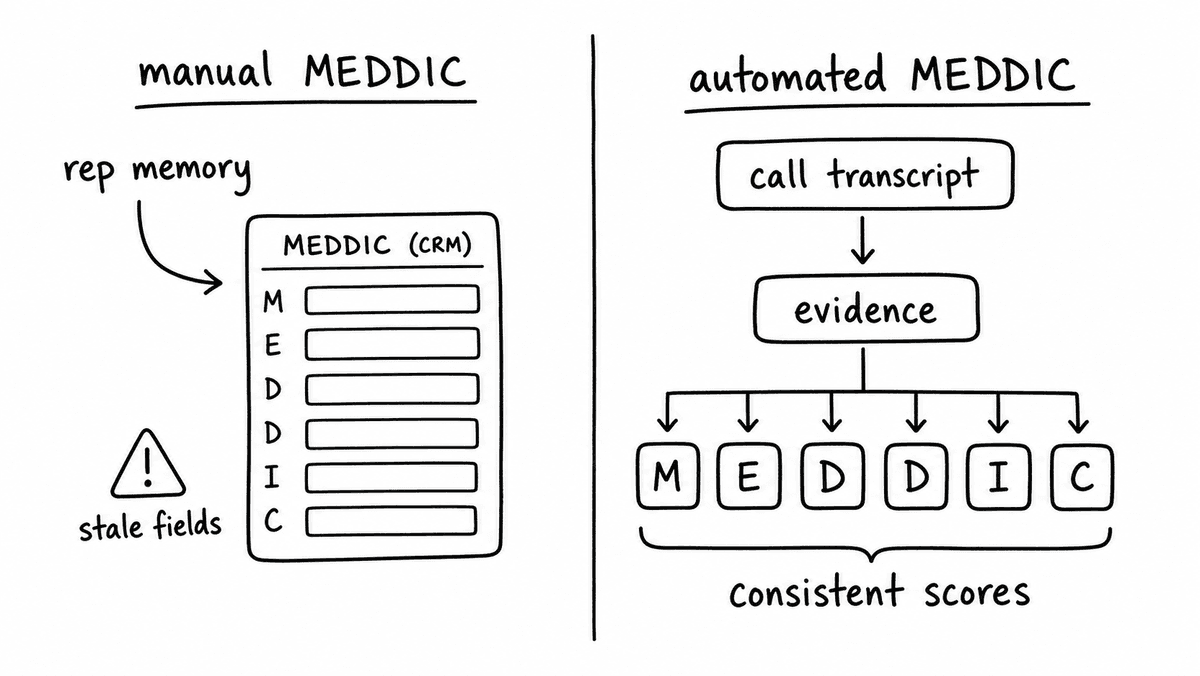
The practical problem with manual MEDDIC scoring is that it relies on two things that are consistently unreliable: rep compliance and rep recall. A rep who finished a tough call is not the best person to objectively assess whether they established a quantifiable metric or whether the economic buyer was genuinely identified. They will fill in the fields they remember to fill in, and they will be optimistic. The result is MEDDIC data that goes stale the moment it is entered, built on subjective self-assessment rather than evidence from the conversation.
Automated scoring from the transcript solves both problems. The evidence comes from what was actually said, the scoring is consistent across every call, and the CRM fields update without any manual step after the call ends. The pipeline data that managers use for forecast decisions reflects what happened in the conversations, not what reps reported.
1. Semarize API with Make or n8n (no-code)
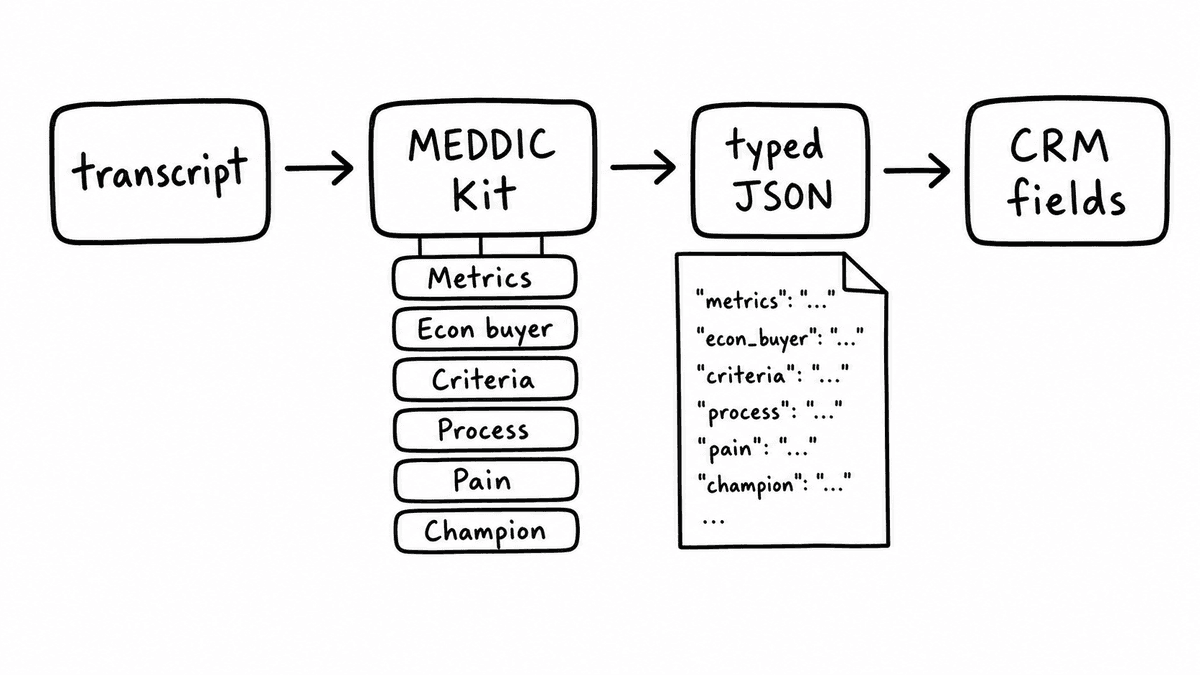
The fastest path to automated MEDDIC scoring for teams without dedicated engineering resource runs through a no-code automation tool like Make or n8n. The workflow has three steps: a transcript arrives (from Gong, Fireflies, Fathom, or any other recording platform that can deliver transcript text via webhook), the automation tool sends it to the Semarize API with the MEDDIC Kit ID, and the structured JSON response is written to the corresponding fields on the Salesforce or HubSpot opportunity record.
The MEDDIC Kit defines one Brick per element of the framework: a score for Metrics (did the buyer articulate a quantifiable business impact), a boolean for Economic Buyer (was the economic buyer identified and referenced), a score for Decision Criteria (was the evaluation criteria discussed), a score for Decision Process (were the next steps in the buying process established), a score for Identify Pain (was a specific pain confirmed), and a score for Champion (is there a clear internal advocate). The API evaluates each one against the transcript and returns a typed JSON object. The automation tool reads the fields and writes them to the CRM.
No code, no pipeline infrastructure, and the whole flow can be running the same day the Kit is built. Make’s Semarize integration and n8n’s HTTP request module both support this pattern without custom development. The Make integration guide covers the specific setup in detail.
2. Direct API integration with Salesforce or HubSpot (engineering-built)
For teams with engineering support, the more robust approach is a direct integration: a webhook endpoint receives transcripts from the recording platform, sends them to the Semarize API, and the structured response is written directly to CRM opportunity fields via the Salesforce or HubSpot API. No automation tool is required; the flow runs in your own infrastructure.
The advantage of the direct integration is control and reliability. The logic for which calls trigger scoring, which Kit to run based on call type or stage, and how to handle partial or inconclusive scores can all be defined in the integration layer rather than configured through an automation tool interface. Field mapping to Salesforce custom objects or HubSpot deal properties is handled explicitly, and retries and error handling can be built in. For teams processing high call volumes or needing the data to update in real time before the next pipeline review, this approach is more predictable than a no-code flow.
The output is identical to the Make/n8n approach: typed MEDDIC fields on the opportunity record, populated from the transcript, without manual rep input.
3. Semarize MCP for analyst and RevOps workflows
For RevOps analysts and sales managers who want to score calls interactively rather than through a fully automated pipeline, the Semarize MCP provides direct access to the conversation intelligence API from within Claude or any MCP-compatible client. A RevOps analyst can send a transcript to the API, get back structured MEDDIC scores, compare them against the CRM record, and update fields directly, all within a conversational workflow rather than a formal data pipeline.
This approach is particularly useful for pipeline reviews: before a forecast call, an analyst can run the MEDDIC Kit against the five most recent discovery calls for deals over a certain value threshold, compare the scores against the stage the rep has self-reported, and flag discrepancies for the manager. The scoring happens in minutes, the evidence from the conversation backs up every field, and the pipeline review starts with data rather than rep narrative.
4. Gong with a supplemental extraction layer
Teams already using Gong can add structured MEDDIC scoring without replacing their platform. Gong’s API exposes call data including transcripts, which can be pulled on a schedule or via webhook and sent to the Semarize API for structured scoring. The scored output then flows to CRM fields or a separate analytics layer, running alongside whatever Gong provides natively.
The distinction is in the output format. Gong’s built-in scoring and deal intelligence produce narrative insights and UI-level summaries designed for individual rep and manager consumption. The Semarize layer produces typed JSON fields designed for aggregate reporting, automated CRM enrichment, and programmatic access by RevOps tools. They are not substitutes for each other; teams using Gong for rep-facing coaching can add Semarize as the structured data layer that feeds forecasting and pipeline analytics, with the transcript as the shared input to both.
5. Salesforce Flow or HubSpot workflow as orchestration
For teams whose operational logic lives in Salesforce or HubSpot, the CRM’s native workflow tool can serve as the orchestration layer once structured MEDDIC data is available. Salesforce Flow or HubSpot Workflows can trigger on incoming field updates, route deals to different stages based on MEDDIC completeness scores, notify sales managers when key elements are missing, or send automated nudges to reps when a deal advances to a stage without the required qualification evidence.
The CRM automation handles the “what to do with the score” logic; the Semarize API handles the “how to score the call” logic. Combining the two means that MEDDIC scoring triggers downstream process automation without any manual intervention at any step in the chain: call ends, transcript scores, CRM updates, workflow fires. For RevOps teams that have already built operational logic inside the CRM, adding the scoring layer in front of that logic activates workflows that were previously dependent on reps doing the right thing.
Choosing the right approach
The no-code Make or n8n approach suits most teams getting started: it is fast to set up, requires no engineering involvement, and works reliably for standard volumes. The direct API integration is the right choice for high-volume teams or those with more complex scoring logic and CRM field mapping. The MCP approach fits RevOps teams that want to embed scoring into analyst workflows rather than a background data pipeline. The Gong supplemental layer is for teams that want structured output without migrating away from their existing platform. And the CRM-native orchestration layer is the final step once the data is flowing, connecting the scoring to whatever downstream process logic the team already has in place.
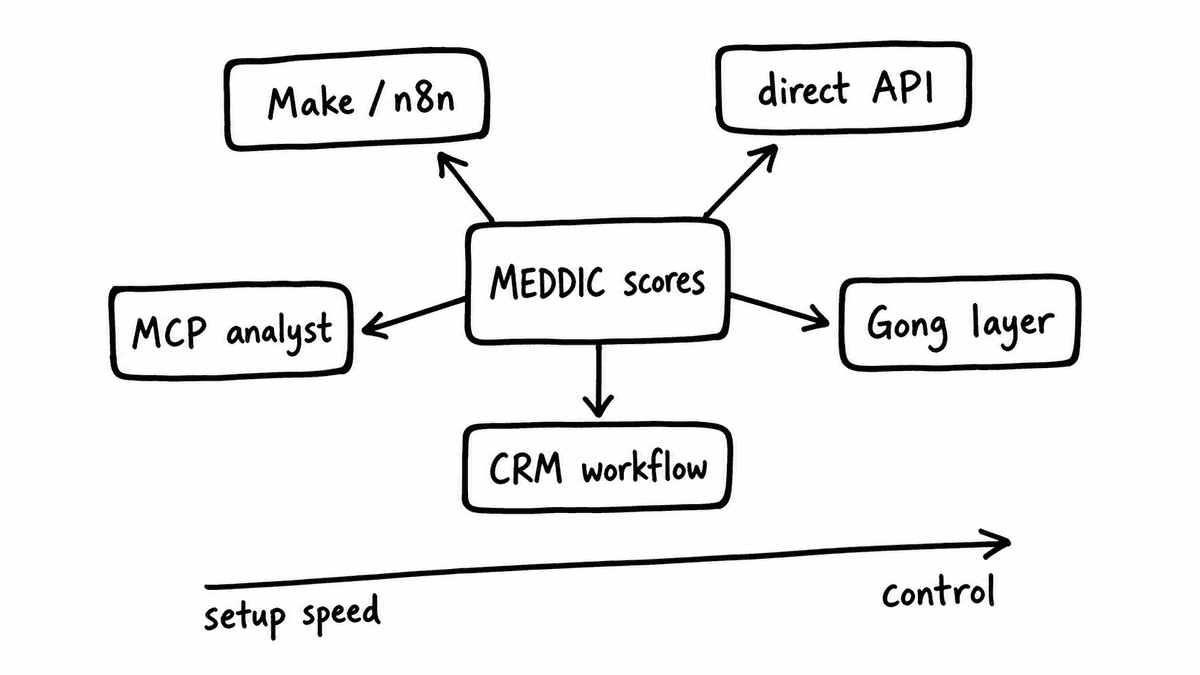
In practice, most teams combine two or three of these: extraction via API, routing via automation tool, and orchestration via CRM workflow. The scoring itself, extracting typed MEDDIC fields from transcript content consistently and without manual input, is the piece that makes everything else possible.
Semarize provides the extraction layer: one API call, one structured JSON response, typed MEDDIC fields from the conversation ready to write wherever your stack needs them.
Common questions
How do you define a MEDDIC scoring schema for call extraction?
A MEDDIC Kit in Semarize contains one Brick per element of the framework. Each Brick defines the specific question to evaluate (for example, “did the buyer articulate a quantifiable business impact in their own words?”) and the format of the answer (a score from 1–5, a boolean, or a short extracted string). The Kit version is fixed at the time of scoring, so scores are comparable across calls and over time. You can add your own scoring criteria, qualification notes, or sub-elements within any MEDDIC element as additional Bricks.
Can MEDDIC scores be written to custom fields in Salesforce or HubSpot?
Yes. The structured JSON output from the Semarize API maps directly to CRM custom fields via the field names you define. For Make and n8n workflows, the mapping is configured in the automation tool interface without code. For direct integrations, the field names in the JSON response map to whatever Salesforce opportunity field or HubSpot deal property you specify. The output can also be written to a data warehouse or BI layer if the team wants aggregate MEDDIC analytics outside the CRM.
Does the transcript need to be from a specific recording platform?
No. The Semarize API accepts transcript text regardless of the source. Any platform that can deliver transcript content via webhook, API, or export, including Gong, Fathom, Fireflies, Otter, and most calendar-connected note-takers, can feed the scoring workflow. The intelligence layer is platform-agnostic by design; the recording setup does not need to change.
What is the difference between automated MEDDIC scoring and Gong’s built-in deal intelligence?
Gong’s deal intelligence produces narrative summaries, keyword flags, and UI-level insights designed for individual call and deal review. Automated MEDDIC scoring via the Semarize API produces typed JSON fields, one per MEDDIC element, designed for aggregate reporting, CRM enrichment, and programmatic access. The two serve different use cases and can run on the same transcript; Gong’s output goes to reps and managers, the structured scoring goes to the CRM record and RevOps analytics.
How long does it take to set up automated MEDDIC scoring with Make or n8n?
Building the MEDDIC Kit takes one to two hours depending on how many sub-elements you want to include. The Make or n8n automation flow, connecting the transcript source to the Semarize API and mapping the output to CRM fields, typically takes another one to two hours. Most teams have their first calls scoring automatically the same day they start, with refinements to the rubric following over the first week as they see how the scores look against real calls.
Continue reading
Read more from Semarize
MEDDICC Scoring From Discovery Calls
Most MEDDICC data is stale before it reaches CRM. Reps update fields from memory after the call, introducing timing gaps and sampling bias that make qualification scores unreliable. Extracting MEDDICC signals directly from transcripts fixes the data freshness problem that better training never will.
CRM Enrichment From Sales Calls: The RevOps Data Ops Playbook
Most CRM enrichment stalls at 30% field coverage because the output is unstructured - reps updating from memory, summaries stored as notes. The fix is a structured extraction pipeline: transcript to consistent fields to CRM to automation triggers. This playbook covers the schema, the routing, and the implementation in Salesforce and HubSpot.
MEDDIC Without the Admin: Automated MEDDIC Scoring for Every Discovery Call
MEDDIC fields in CRM reflect what reps remember and choose to enter, not what buyers said. Automated MEDDIC scoring runs one typed Brick per element against the transcript, returns structured JSON, and writes qualification data back to the opportunity with no rep admin.