
2026 Transcript Analysis APIs: Structured Extraction, Ingestion Mechanics, and the Comparison That Actually Matters
Transcript analysis rarely breaks down because the model is bad; it breaks down because the API can’t reliably turn transcripts into the specific structured fields their CRM and automation workflows need, at a cost they can forecast before they commit to a volume. Model quality gets the attention in vendor demos, but structured extraction, ingestion mechanics, and pricing predictability are what determine whether the programme works in production.
This comparison covers the transcript analysis APIs worth evaluating in 2026 for teams processing call and meeting transcripts at scale. The evaluation criteria are structured extraction quality, NLP capability fit, ingestion mechanics (backfill, incremental polling, webhook support), and pricing predictability, not features or demo impressiveness.
What “transcript analysis API” means at scale
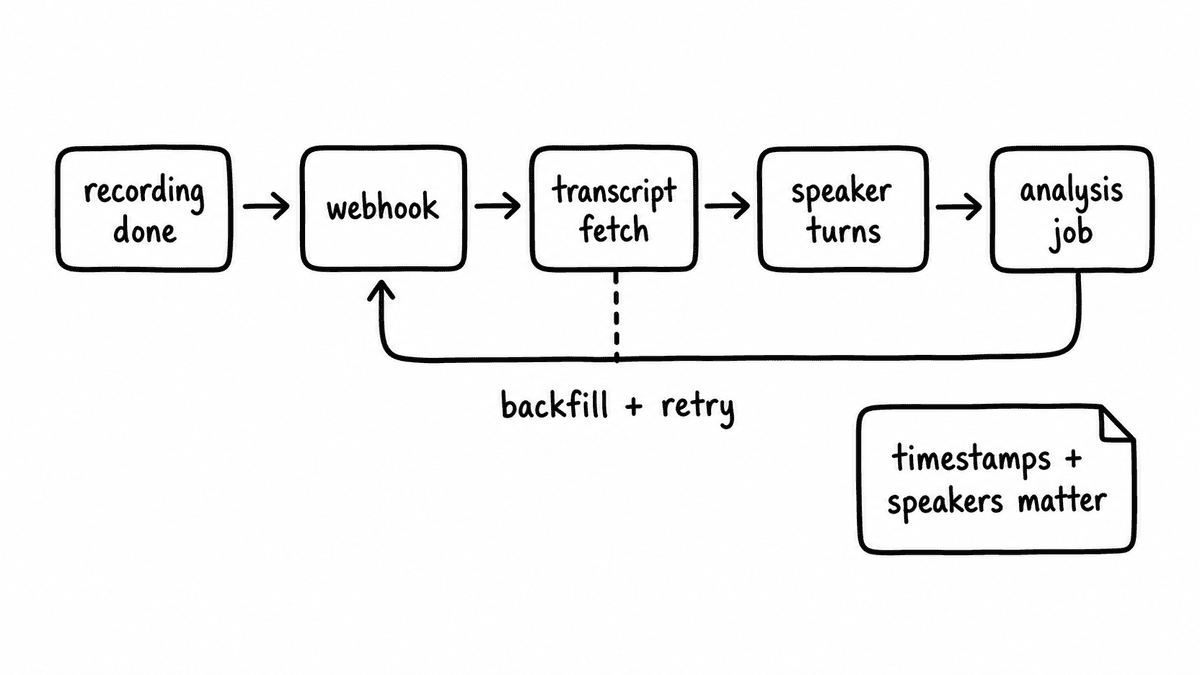
Transcript analysis APIs do more than return a text file; at scale, they cover four distinct jobs. First, ingestion: getting transcripts in, whether that means processing them directly from a recording platform via webhook, running historical backfill against an archive, or polling for new calls incrementally. Second, processing: normalising the transcript into a consistent format across call types, speakers, and recording conditions. Third, structured extraction: turning unstructured conversation content into typed fields with stable definitions, comparable across deals, reps, and time periods. Fourth, NLP outputs: semantic signals that go beyond transcription to identify topics, entities, sentiment, and buyer-stated facts.
The gap between APIs that handle the first two jobs and APIs that handle all four is where most programmes stall. Transcription APIs give you text; transcript analysis APIs give you signals. The question for any team building workflows on top of call data is which of the four jobs they need done, and whether they want to assemble that themselves from lower-level components or use a layer that handles structured extraction natively.
The real buying criteria
The default evaluation approach is to shortlist APIs by AI model quality and featured NLP capabilities, then figure out integration and cost after. This produces an expensive gap. If the API can’t deliver the specific structured fields your workflows need, you either rework all downstream logic or you end up coaching and forecasting from the wrong signals because the extraction was never precise enough to feed CRM properties reliably.
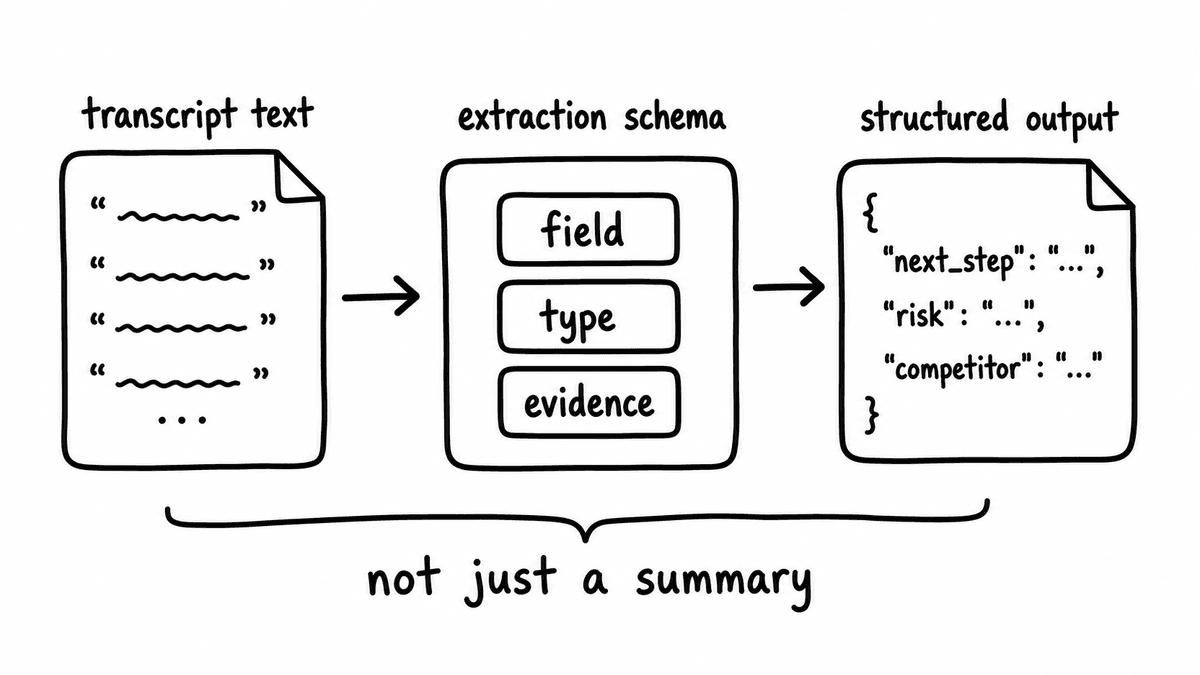
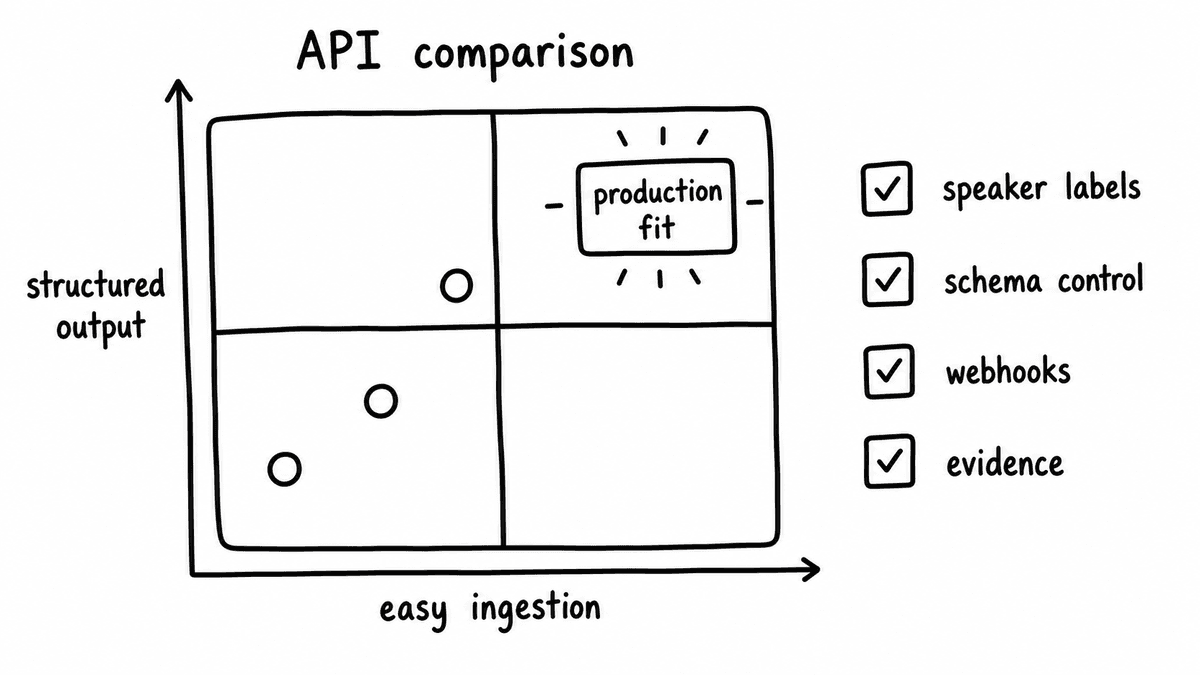
The more useful frame is to write your required structured fields and ingestion timeline before you evaluate any vendor. Define the typed outputs you need (booleans, scores, enums, extracted strings), the objects those outputs need to reach (CRM deal fields, warehouse tables, Slack alerts), and the ingestion pattern required (real-time on call completion, daily backfill, incremental polling). Then score APIs on whether they can produce that output reliably, at the volume you need, with pricing you can forecast. The vendor that matches your workflow shape wins, not the one with the most impressive demo.
2026 transcript analysis APIs: the comparison
| API | Structured extraction | NLP layer | Webhooks | Backfill / polling | Pricing model | Best for |
|---|---|---|---|---|---|---|
| Semarize | Typed fields via Bricks and versioned Kits | Custom semantic criteria, buyer-stated facts | Yes | Yes, via API | Usage-based | RevOps and GTM teams that need CRM-ready structured signals from call transcripts |
| AssemblyAI | Custom extraction via LeMUR (LLM layer); no typed field schema | Sentiment, entities, auto chapters, topic detection | Yes | Async batch; polling required | Per audio hour | Developers building custom NLP pipelines on top of transcription |
| Deepgram | None natively; transcription only | Speaker diarisation, summarisation | Yes | Batch endpoints available | Per minute / per character | High-volume real-time transcription where structured extraction is handled separately |
| Symbl.ai | Action items, follow-ups, topics, custom trackers | Conversation insights, entity extraction, sentiment | Yes | Async batch; polling supported | Per minute | Teams that need conversational insights without building custom extraction schemas |
| OpenAI Whisper API | None; transcription only | None natively | No | Synchronous only | Per minute | Simple transcription for teams that will build their own analysis layer |
Semarize: structured extraction as the primary output
Semarize is built around the assumption that the output of transcript analysis is structured data, not a summary or a scorecard. The evaluation logic lives in Bricks: typed criteria that test for specific observable things in the transcript and return concrete values (booleans, scores, enums, extracted strings). Bricks are grouped into Kits that are versioned, so the field schema is stable over time and historical scores remain comparable as the evaluation logic evolves.
The output is typed JSON, ready to route to a CRM deal record, a warehouse table, or an automation trigger. Semarize isn’t a transcription service and doesn’t store calls. It takes transcript text as input and returns structured signals as output. The right fit is a team that already has transcripts and needs a reliable extraction layer between those transcripts and the downstream systems that need to act on them.
Semarize isn’t the right fit for teams that need basic ASR, real-time transcription of live audio, or a coaching dashboard with a rep-facing interface. For those requirements, a transcription API or a purpose-built CI platform is the more direct solution.
AssemblyAI: transcription with a custom extraction layer
AssemblyAI provides transcription plus a set of built-in NLP models (sentiment analysis, entity detection, topic classification, automatic chapter summaries) and LeMUR, an LLM layer for custom extraction tasks. Teams that need to go from audio to custom-structured outputs without building their own LLM integration can use LeMUR to run extraction prompts against the transcript after it is processed.
The trade-off is that LeMUR-based extraction doesn’t produce typed fields with versioned schemas. The output depends on the prompt, which means schema consistency is the responsibility of the team building the pipeline rather than the API. For teams that need stable, auditable extraction for CRM enrichment or time-series analysis, this requires additional engineering on top of the AssemblyAI layer. For teams that want flexible, ad-hoc extraction where consistency is less critical, LeMUR handles a wide range of custom tasks without a separate evaluation framework.
Deepgram: transcription at speed and scale
Deepgram is optimised for fast, accurate transcription at high volume, with real-time streaming as a primary capability alongside batch processing. It includes speaker diarisation and basic summarisation but doesn’t have a structured extraction layer for business-specific signals. For teams that need transcription as a cheap, fast commodity input to their own analysis pipeline, Deepgram is cost-effective and well-documented. For teams that need the transcription and the structured extraction to come from the same API, Deepgram requires a second layer built on top.
Ingestion mechanics: the gap that breaks programmes at scale
Transcript processing isn’t a one-time job. Teams that start with a live webhook integration for new calls quickly discover they also need to backfill six months of historical calls for rep performance analysis and cohort comparisons. The API that handles real-time webhooks well may not have a clean batch endpoint for backfill at volume, and the pricing that seemed reasonable per call becomes significant when multiplied by a historical archive.
Before committing to any API, the ingestion questions worth resolving are: can the API process transcripts in batch with predictable throughput, does it support incremental polling for calls completed since the last run, and are there rate limits that affect historical backfill at realistic archive sizes? The APIs that handle all three well are the ones that remain manageable as the programme scales. The conversation data warehouse post covers how the warehouse schema needs to be designed to accommodate backfill and incremental updates alongside real-time data.
Common questions
How do we define the structured fields we need before we know which API we’ll buy?
Start from the downstream systems, not from API capabilities. List the CRM deal properties, warehouse columns, and automation triggers that conversation data is supposed to populate or feed. For each one, define the required output type (boolean, enum, number, string) and what evidence in a transcript would produce a non-null value. That list of typed outputs is your structured field schema, and it exists before you look at any vendor. Vendor evaluation then becomes a test of whether the API can produce those specific outputs reliably, not whether it has the most features.
What should we test in a vendor trial to validate extraction quality at scale?
Run a sample of 50 to 100 real calls from your archive through the API and measure fill rate per structured field: what percentage of calls where the relevant topic was discussed produce a non-null value. Fields that fill on fewer than half the calls where they should fill have an extraction definition problem, not a model quality problem. Testing on real calls from your own team reveals mismatches between the API’s default evaluation logic and your specific call vocabulary that a demo on curated examples won’t surface.
What is the difference between NLP features and NLP outputs that drive workflows?
NLP features are capabilities the API can perform, such as sentiment analysis, topic detection, or entity extraction. NLP outputs that drive workflows are specific values written to specific fields that downstream systems act on. The gap between them is the extraction and routing layer. Sentiment analysis is a feature; a boolean field on a CRM deal record that records whether the buyer expressed urgency in the last call is an output that drives a workflow. Evaluating vendors on features rather than on whether they can produce the specific outputs you need is how teams end up with capable APIs that don’t move their operational metrics.
How do we handle historical backfill without making pricing unpredictable?
Model the backfill volume before the contract is signed. Estimate the number of historical calls, the average duration, and the pricing unit (per minute, per hour, per call) to get a total cost for the backfill run. Run the backfill at a controlled rate to avoid hitting rate limits and spreading the cost across a billing period rather than creating a single large invoice. For versioned extraction schemas, backfill against a specific Kit version so the historical data is scored consistently and comparable to current calls processed against the same version.
Continue reading
Read more from Semarize
Conversation Intelligence for Developers: Don't Build a Fragile Pipeline, Don't Buy a Black Box
Most teams don't fail to add conversation intelligence because the model is bad; they fail because the integration is fragile and unstructured. The fix isn't a better LLM pipeline or a platform API you can't control. It's a layer that takes a transcript, runs it against a versioned Kit, and returns deterministic typed JSON you can test, version, and route into your product.
Gong Captures the Transcript. Here’s What It Can’t Score.
Gong’s scoring runs against a fixed model — you can’t attach your product documentation, rate card, or qualification playbook to its evaluation layer. For four evaluations that matter — product accuracy, pricing audit, methodology A/B testing, and deal readiness scoring — knowledge grounding and KB isolation are the only architecture that works.
CRM Enrichment From Sales Calls: The RevOps Data Ops Playbook
Most CRM enrichment stalls at 30% field coverage because the output is unstructured - reps updating from memory, summaries stored as notes. The fix is a structured extraction pipeline: transcript to consistent fields to CRM to automation triggers. This playbook covers the schema, the routing, and the implementation in Salesforce and HubSpot.