
Zoom Revenue Accelerator Alternatives: Get Structured Call Data via API
Teams looking for Zoom Revenue Accelerator alternatives usually aren’t unhappy with the coaching experience; they want the call data out. Zoom Revenue Accelerator gives reps and managers a capable analytics and coaching surface inside the Zoom ecosystem, and for a team standardised on Zoom Meetings that is often enough. The point where teams start searching for a Zoom Revenue Accelerator API is when they need those conversations as structured fields they own: values that can enrich a CRM record, land in a warehouse table, and trigger automation without anyone opening the Zoom analytics UI to read a chart.
This post describes what Zoom Revenue Accelerator does, who it fits, and why some teams look beyond the built-in analytics for programmatic, customer-owned structured call data. It also covers where Semarize fits as a complementary layer that takes a Zoom transcript and returns typed JSON, and where Semarize is the wrong tool because it does not record meetings or run a rep-facing coaching dashboard.
What Zoom Revenue Accelerator is, and who it fits
Zoom Revenue Accelerator (ZRA) is Zoom’s native conversation-intelligence add-on for Zoom Meetings. It records and transcribes sales calls, then layers analytics on top: talk-time ratios, topic and keyword tracking, deal and pipeline signals, and rep-facing coaching cues, all presented inside the Zoom environment reps already work in. Because it is part of the Zoom platform, setup is light for teams that already run their sales calls on Zoom Meetings, and there is no separate recorder to deploy or second bot to admit into every call.
ZRA is a strong fit for sales organisations standardised on Zoom Meetings who want built-in coaching and deal analytics without adding another vendor. Managers get a call-review surface, reps get feedback in a familiar interface, and revenue leaders get pipeline and deal-risk views that sit close to where the calls happen. If the job to be done is coaching reps and reviewing deals through a dashboard, staying inside ZRA keeps the workflow simple and the data close to the source.
Why teams look for Zoom Revenue Accelerator alternatives
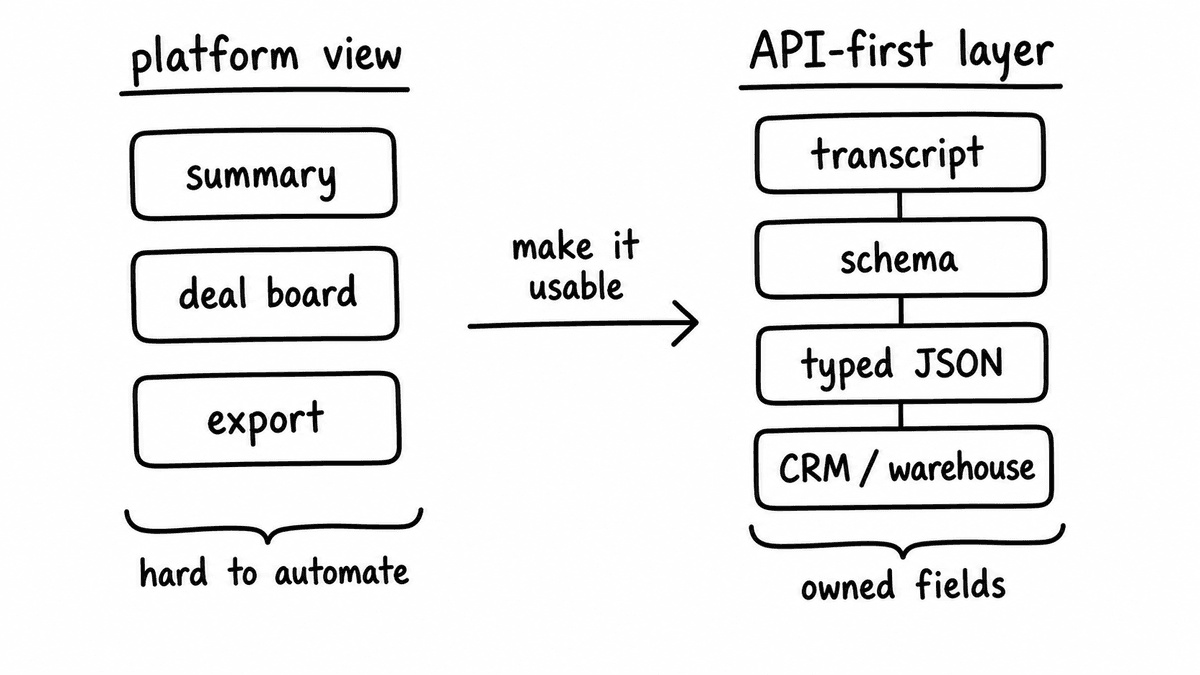
The reason teams search for a Zoom Revenue Accelerator alternative is rarely dissatisfaction with the coaching; it is that dashboards are a viewing surface, not a data source. RevOps teams and GTM engineers want the signals from each call as typed fields they can query, join, and automate against: a boolean for whether next steps were agreed, a score for discovery quality, a string for any competitor named, an extracted list of stated objections. Those fields need to live where the rest of the revenue stack lives, in the CRM opportunity record and the warehouse, not only in an analytics view that a person has to open and interpret.
The requirement underneath the search is ownership and portability. Teams building forecasting models, QA scoring, or CRM enrichment want the evaluation logic and the output schema under their own control, so the same criteria apply consistently across every call and the resulting data can be reprocessed or moved without rebuilding a pipeline. When the structured signals a workflow depends on are defined by a platform’s analytics layer rather than by the team, changing tools later means losing the historical signal and starting the schema again. Teams that reach this point aren’t looking to replace Zoom as the place calls happen; they’re looking for a way to turn the transcript into data they hold.
Where Semarize fits alongside Zoom
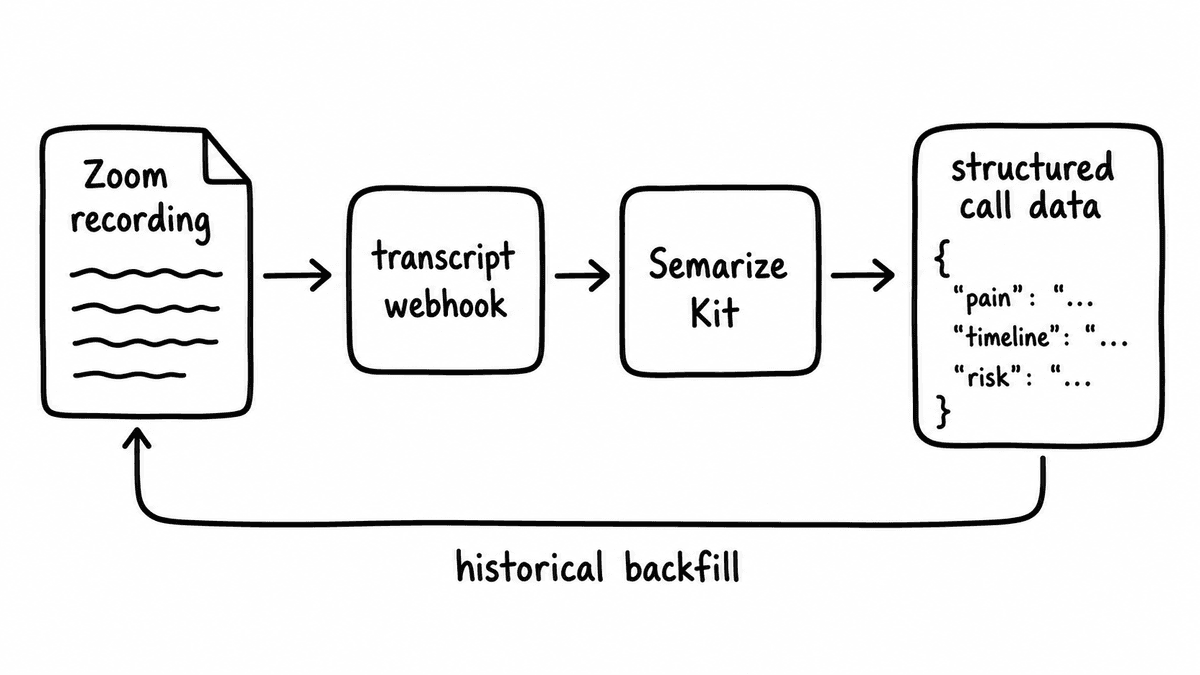
Semarize is a conversation intelligence API that takes a Zoom transcript and returns structured JSON signals, platform-agnostic on the way in and on the way out. It doesn’t record the meeting or compete with ZRA for the coaching surface; it sits after the call as the layer that converts transcript content into typed fields. The evaluation logic is defined by the customer using Bricks, which are single typed evaluation criteria that each return one value, and grouped into Kits, which are versioned bundles of Bricks that run together against one transcript. Boolean Bricks return true or false, score Bricks return a number on a defined scale, category Bricks return a label, and list Bricks return an extracted array, so the output is data your downstream systems can consume directly.
The integration is straightforward for a team already on Zoom. Once a call ends and a transcript is available, it is sent to the Semarize API with the Kit ID that defines the schema, and the response is a JSON object with one typed field per Brick, tagged with the Kit version so the field names and types stay stable across releases. From there the same payload can be written to a Salesforce opportunity, a HubSpot deal, and a warehouse table in parallel. The get your data from Zoom Revenue Accelerator guide covers the specifics of retrieving the transcript so it can flow into this pipeline.
Where Semarize is not the right tool
Semarize isn’t a meeting recorder and not a rep-facing coaching dashboard, so teams whose only requirement is recording calls and giving reps a review UI don’t need it and should stay with what ZRA already provides. There’s no talk-time widget to open, no in-app coaching card for a rep to read after a call, and no manager view for scrolling through call recordings; those jobs belong to the recording and coaching platform. Semarize starts from a transcript and ends at structured data, which means it depends on a source like Zoom for the recording and transcription in the first place.
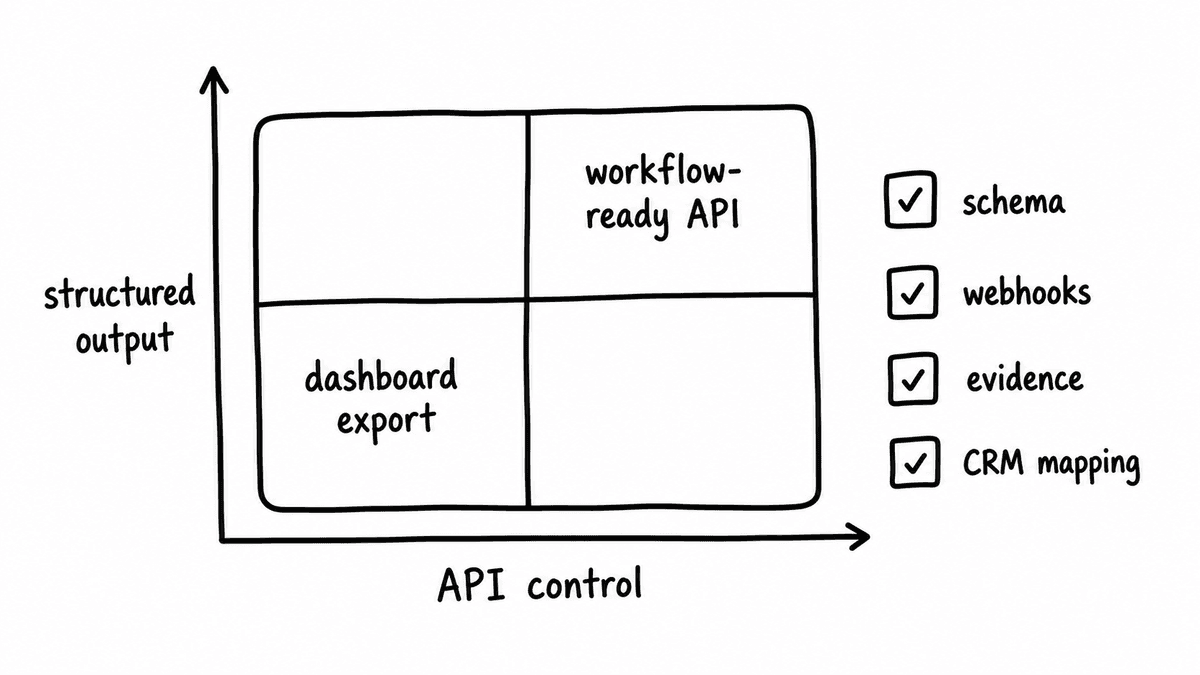
The honest boundary is that ZRA and Semarize solve adjacent problems and are strongest when they run together. ZRA keeps reps coached and managers reviewing deals inside Zoom, and Semarize turns the same conversations into the typed fields RevOps and data teams automate against. Teams that need both a coaching surface and customer-owned structured output usually keep ZRA as the surface and add Semarize as the data layer, rather than trying to make either tool do the other’s job.
Zoom Revenue Accelerator and Semarize compared
The two tools differ most in their data-access model and who owns the output schema. The table below compares them on the dimensions that matter when the goal is structured call data you can automate against, with a general row for other conversation-intelligence platforms where a fair, non-specific comparison holds.
| Dimension | Zoom Revenue Accelerator | Semarize | Other CI platforms |
|---|---|---|---|
| Data access model | Analytics and coaching UI inside the Zoom ecosystem | API-first; typed JSON returned per call | Usually dashboard-first, with API access varying by vendor |
| Structured output | Charts, topic tracking, and deal signals in-app | Typed fields per Brick: boolean, score, category, list | Often prose summaries and vendor-defined fields |
| CRM enrichment | Deal and pipeline views; native CRM sync where supported | Writes typed fields to opportunity or deal records | Varies; often summary or activity sync |
| Data ownership | Signals defined by the platform’s analytics layer | Customer defines the schema; owns the output | Typically vendor-defined output schema |
| Best for | Teams on Zoom Meetings wanting built-in coaching and deal analytics | RevOps and GTM teams wanting owned, automatable call data | Teams wanting an all-in-one recording and review platform |
Use cases Semarize handles differently
The clearest example is CRM enrichment. Inside a coaching dashboard, discovery quality is a chart a manager reads, whereas with a Semarize Kit the same discovery call becomes a set of typed fields written straight to the opportunity: a score for discovery depth, a boolean for whether the economic buyer was named, a string for any competitor mentioned. Those fields can drive a forecasting model, a routing rule, or a stalled-deal alert without a person interpreting a view first, which is the difference between analytics you look at and data you build on. The sales call transcripts to CRM-ready JSON post walks through that pipeline in detail.
The second example is standardising across recording sources. Many teams run Zoom for most calls but pick up transcripts from Teams or a dialer elsewhere, and because Semarize takes the transcript rather than the platform, the same Kit applied to a Zoom call and a Teams call returns the same field types, so the resulting data is comparable regardless of where the call happened. The conversation intelligence across Zoom and Teams post covers how a single schema spans multiple meeting tools without adopting a new platform.
Semarize takes your Zoom transcripts and returns typed JSON against a schema you control, ready for CRM enrichment, warehouse analytics, and RevOps automation.
Common questions
Does Zoom Revenue Accelerator have an API?
Zoom exposes APIs across its platform, and access to conversation and meeting data depends on your plan, scopes, and the specific endpoints available to your account, so the practical answer is to confirm current API coverage and terms directly with Zoom for your configuration. Zoom Revenue Accelerator itself is built primarily as an in-product analytics and coaching surface rather than a data-delivery API, which is why teams that need structured call data as typed fields often add a separate layer that takes the transcript and returns JSON, rather than relying on the analytics UI as their data source.
Can I get structured data out of Zoom Revenue Accelerator?
ZRA presents structured analytics inside its interface, including talk-time, topic tracking, and deal signals, but that is designed for viewing and coaching rather than for feeding typed fields into downstream systems. To get structured data you can query, join, and automate against, teams commonly take the Zoom transcript and run it through a tool that returns typed JSON. Semarize does exactly this: it evaluates the transcript against a customer-defined schema and returns one typed field per criterion, which can then be written to a CRM record, a warehouse table, or an automation without anyone opening the analytics view.
What is the difference between Zoom Revenue Accelerator and an API-first tool like Semarize?
Zoom Revenue Accelerator is a recording, transcription, and coaching product that surfaces call insights through analytics inside the Zoom ecosystem, and it is strongest for teams that want built-in coaching and deal views. Semarize is an API-first conversation intelligence layer that takes a transcript and returns typed JSON against a schema the customer defines with Bricks and Kits, and it is strongest for teams that want to own the output and automate against it. They solve adjacent problems: ZRA is the coaching surface, and Semarize is the structured-data layer, and many teams run both together.
Do I have to leave Zoom to use Semarize?
No. Semarize isn’t a meeting platform and doesn’t replace Zoom; it works from the transcript your Zoom calls already produce. Reps keep meeting on Zoom, managers keep coaching where they do today, and Semarize runs after the call to convert the transcript into typed fields for your CRM and warehouse. Because the input is a transcript rather than a specific platform, the same Kit also applies to calls captured elsewhere, so adopting Semarize adds a data layer without asking anyone to change how or where they take calls.
Continue reading
Read more from Semarize
How to Get Conversation Intelligence From Zoom and Teams Without Buying Another Platform
Zoom and Teams already generate the transcripts you need. This guide shows how to get conversation intelligence from Zoom and Teams by routing those transcripts through an evaluation API, producing CRM enrichment, coaching signals, and QA coverage without adding a recording platform or paying per-seat for a duplicate transcript.
Conversation Intelligence for Developers: Don't Build a Fragile Pipeline, Don't Buy a Black Box
Most teams don't fail to add conversation intelligence because the model is bad; they fail because the integration is fragile and unstructured. The fix isn't a better LLM pipeline or a platform API you can't control. It's a layer that takes a transcript, runs it against a versioned Kit, and returns deterministic typed JSON you can test, version, and route into your product.
Zoom Transcripts to CRM-Ready Sales Signals: An API-First Pipeline for Scoring and Field Extraction
Transcript access isn't the same as usable data. Here is how to turn Zoom transcripts into CRM-ready sales signals with an API-first pipeline: webhooks, scoring built around buyer understanding, and typed field extraction into CRM or BI.