
What Conversation Intelligence Is Missing
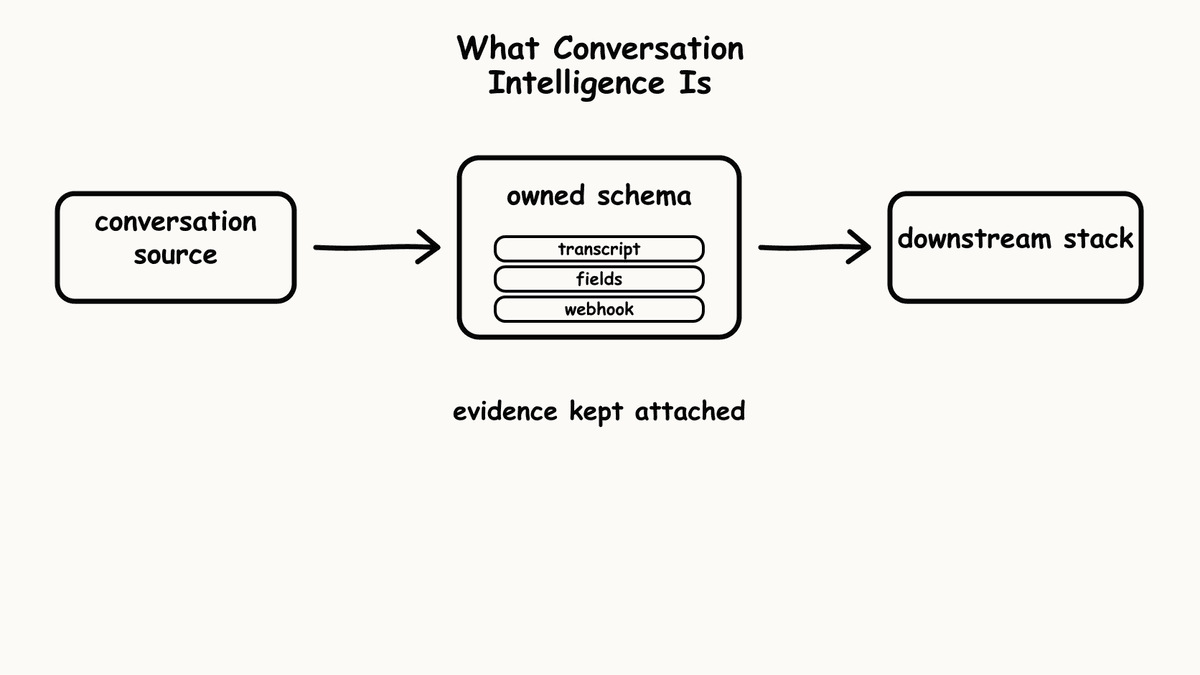
If your team already uses conversational intelligence platforms like Gong, Chorus, or something similar, you'll have recordings, transcripts, and a dashboard, but what you probably don't have is conversation data in a format your other tools can use automatically.
If you're recording through Zoom, Microsoft Teams, or Google Meet and exporting the transcripts, you have the same gap, just bigger - and probably a growing library of conversation data with no structured way to do anything with it.
In both cases the missing piece is the same: a way to turn what was said in conversations into something your CRM, your reporting, and your automations can actually read.
What that actually means
A transcript is text, and a summary is still text - both are useful for humans and hard for software to do anything reliable with.
What's useful for software is structured data - consistent fields that arrive in the same format every time. The kind that lands cleanly in a CRM record, feeds a report, or triggers a workflow without anyone having to read it first.
For most revenue teams, the fields they start with look like this:
- Buyer role and use case
- Stated pains and priorities
- Confirmed success criteria
- Objections raised, and the buyer's reasoning
- Decision process and timeline signals
- Whether a next step was genuinely agreed, or just mentioned
And that's just the deal mechanics. The same conversations contain signals that most teams never get close to capturing consistently - how reps are actually performing against a coaching framework, whether customer sentiment is shifting before it shows up in product usage, which compliance disclosures were or weren't given, what competitors are being mentioned and in what context, how often calls end without a clear next step and who owns it.
Most teams know this data exists. The problem is that capturing it manually across every conversation isn't workable - so it gets sampled, or skimmed, or lost entirely. A manager reviews a handful of calls. A CSM takes notes after a customer meeting. A QA team works through a fraction of the queue. The rest stays in the transcript, unread and unmeasured.
That's the gap. Not the absence of conversation data - most teams have more of it than they know what to do with. The absence of any reliable way to turn it into something their systems can use.
What teams with no CI foundation are actually missing
Teams without any dedicated conversation intelligence tool tend to assume the gap is better notes - faster summaries, less time spent reviewing calls. And many of them already have transcripts: Zoom generates them automatically, Teams transcribes by default, Meet exports them with a click.
That's a real problem, but it's also the smaller one.
The bigger problem is that those transcripts - sitting in Zoom Cloud, Teams channels, or a shared Drive folder - are locked in text no system in your stack can read. Your CRM doesn't know what pain the buyer described. Your forecasting model doesn't know whether the decision process was confirmed. Your enablement team can't tell which reps are consistently skipping qualification, because there's no field to measure it against.
Semarize doesn't replace a note-taker. If reps want readable summaries, keep Otter or Fireflies. What Semarize adds is a structured layer on top - the same conversation, evaluated against your logic, returning data your tools can use.
The two things do different jobs. One produces a document, the other produces data.
How it works
Semarize uses two simple concepts: Bricks and Kits.
A Brick is a single question about a conversation. "Did the buyer confirm a next step?" comes back as a yes or no, with a confidence score, a short explanation, and the exact quote that supports the answer. "How specific was the pain?" comes back as a score out of 100, with evidence attached. "What competitors were mentioned?" comes back as a list. Every Brick returns one specific type of answer, so your systems always know what to expect.
A Kit is a collection of Bricks grouped for a specific purpose. A discovery quality Kit might include eight Bricks covering pain specificity, stakeholder identification, timeline signals, and next step commitment, while a deal risk Kit covers different ground entirely. You build the Kits that match your process, using the questions that matter to your team.
You send a conversation - a Zoom or Teams transcript, an email thread, a chat log - along with the Kit you want to run, and you get back structured JSON.
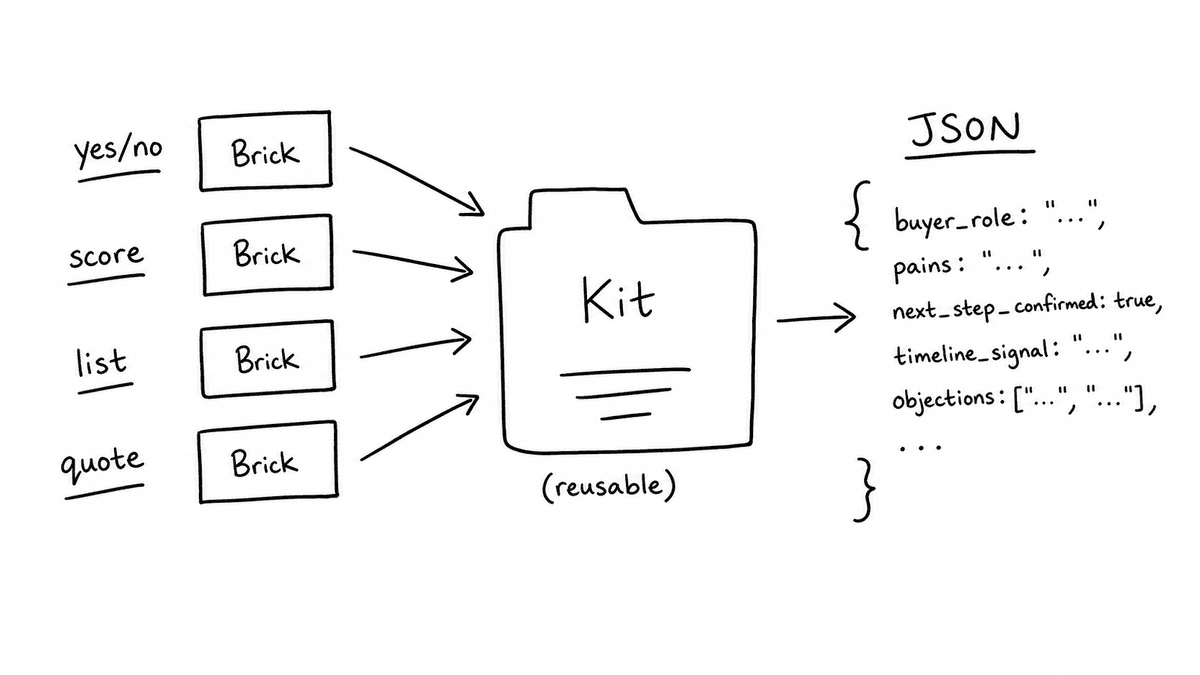
What you do with that output is entirely up to you. Connect it to your CRM through an automation tool like n8n, Zapier, or Make. Feed it into a BI table. Fire a webhook when a deal shows three risk signals in the same call. Build an internal dashboard that surfaces exactly the signals your team cares about. Because the output is clean, structured data, you're not limited to the integrations a platform decided to build - you can route it anywhere, analyse it any way, and build whatever your team actually needs.
The part most teams overlook: grounding
AI evaluation without context drifts. Ask "did the rep follow the pricing policy?" without giving the system your actual pricing policy, and you get an answer based on what pricing policies generally look like.
Semarize lets you attach Knowledge Bases to Kits. Those Knowledge Bases hold your playbooks, product docs, rate cards, qualifying criteria, and other source material, so evaluation runs against your documents, not generic assumptions. When your rate card changes, you update the Knowledge Base, the Bricks don't change, and the answers stay accurate.
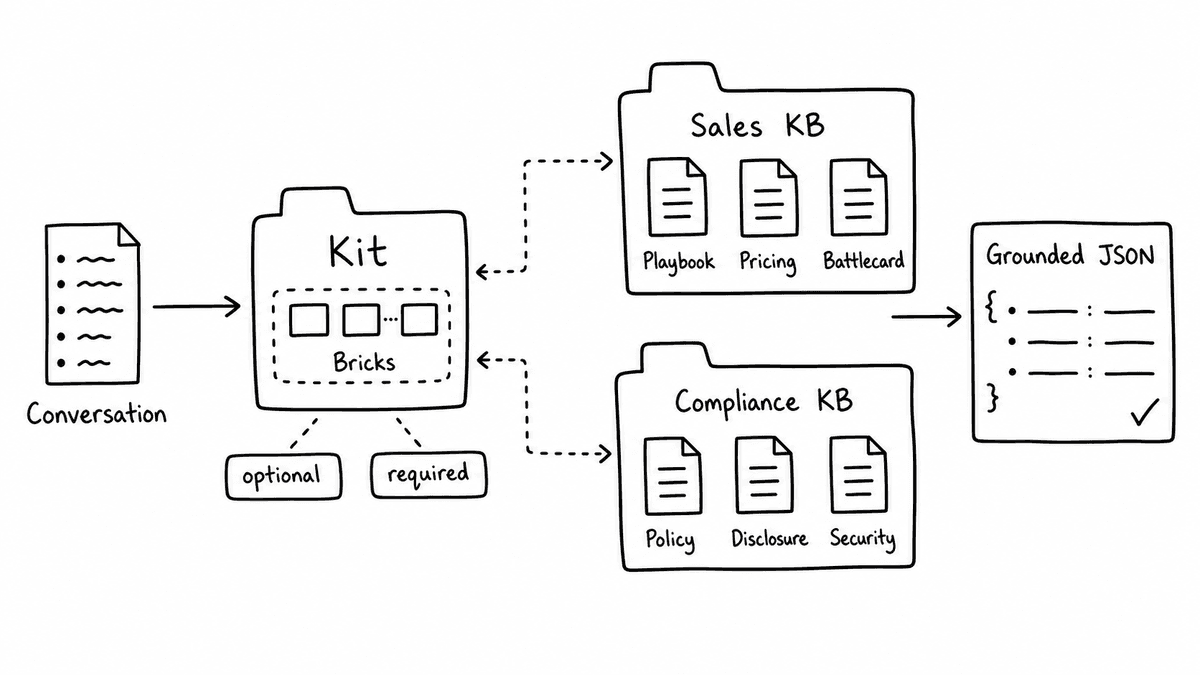
This matters most for teams with specific rules - compliance requirements, approved messaging, current pricing - but it's useful for any team that wants evaluation grounded in how they actually work, not how an AI assumes they probably do.
What this makes possible
- CRM enrichment without chasing reps. Budget signals, timeline mentions, decision makers, objections, next steps - pulled from every conversation and pushed into CRM fields automatically. The data reflects what was actually said.
- Consistent scoring across every call. The same Bricks run against every call, every rep, every segment, with confidence scores attached so you know when to trust the result and when to look closer.
- Coaching based on data, not impressions.When coaching comes from consistent fields rather than a manager's read of a transcript, you can track real progression - discovery depth by rep, over time, against a baseline. Something measurable.
- Automation triggered by what buyers actually said. Follow-ups based on agreed next steps. Deal routing based on qualification depth. Pipeline flags based on specific signals - not a feeling that something seemed off.
Conversation data is infrastructure now
Most teams treat conversation data as a byproduct - something that exists in transcripts, gets summarised, and gets forgotten. The insight that came out of a discovery call, the objection a buyer raised three times, the commitment that never made it into the CRM - it's all there, in text, going nowhere.
The shift that's happening is that some teams have stopped treating it that way. They're pulling structured signals out of every conversation and routing them into the same stack they use for everything else. Their CRM reflects what was actually said. Their pipeline reviews are based on evidence, not rep memory. Their coaching programmes track real progression because the same questions run against every call, every rep, every week, not just the ones someone had time to review.
That's what conversation data as infrastructure looks like. Not a dashboard you check, but a data layer your systems read automatically.
Continue reading
Read more from Semarize
Bricks and Kits: the mechanism for stable conversation evaluation
Freeform prompts produce inconsistent evaluation results - scores drift, output shapes change, and you can't tell whether coaching improved anything or whether the rubric moved. Bricks define a locked evaluation schema: one question, one output type. Kits group them into reusable evaluation workflows. The result is schema-stable conversation analysis you control.
What is a Conversational Intelligence API?
Conversational intelligence gets applied to three very different things - deal intelligence, note-taking, and pattern-level analysis. Only one produces data your systems can act on. Here's what a CI API actually does and how the shift away from full-platform solutions is changing what's possible.
CRM Enrichment From Sales Calls: The RevOps Data Ops Playbook
Most CRM enrichment stalls at 30% field coverage because the output is unstructured - reps updating from memory, summaries stored as notes. The fix is a structured extraction pipeline: transcript to consistent fields to CRM to automation triggers. This playbook covers the schema, the routing, and the implementation in Salesforce and HubSpot.