
What is a Conversational Intelligence API?
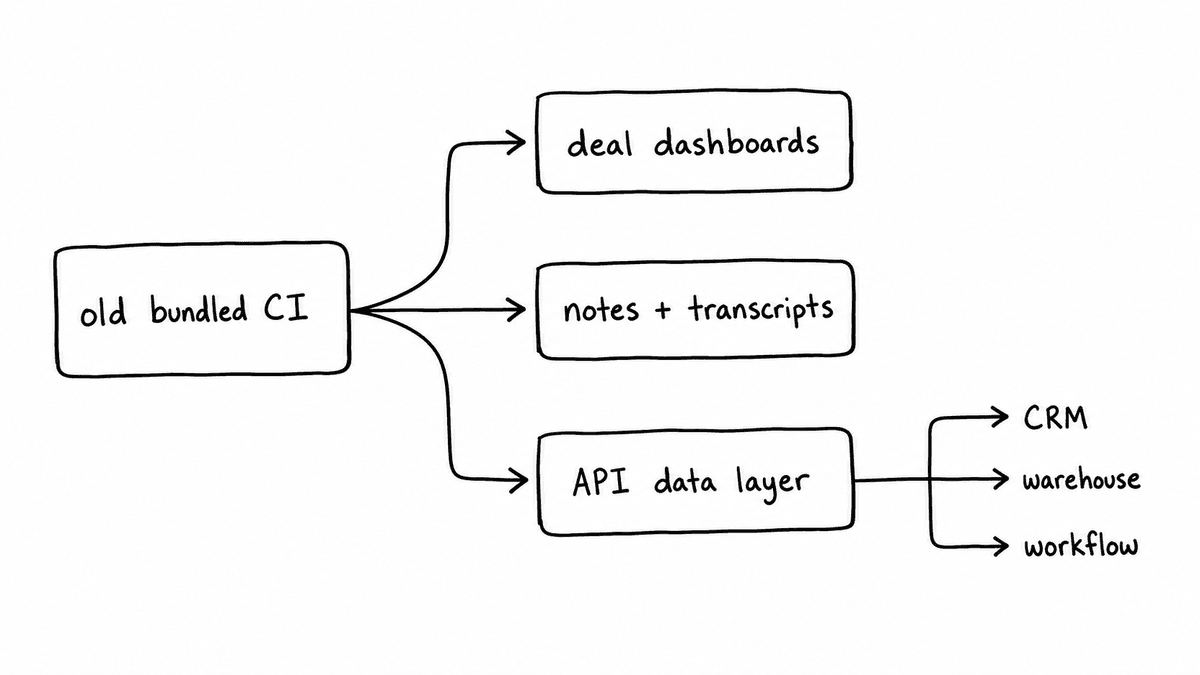
The term conversational intelligence covers a lot of ground - more than it probably should. It gets used for deal dashboards, call summaries, and structured data extraction, and those are three quite different things. Which one a tool actually does determines whether you end up with a view for a manager, a document for a rep, or data your systems can act on.
Deal intelligence - Gong's deal boards being the obvious example - gives managers visibility into pipeline health, stage progression, and risk flags. Useful at the portfolio level. The output is a reading of the pipeline, not something you can query, automate from, or feed into another system.
Note-taking and transcription tools like Otter and Fireflies produce call recordings and summaries for a human to read. Also useful - but text in, text out. Not data. You can't trend a summary, join it to a CRM object, or trigger a workflow from it.
The third is the dedicated conversational intelligence API. It extracts consistent, structured signals from conversations so you can measure things across your whole pipeline. Whether deals with an early confirmed timeline close at a different rate. Whether a training programme changes how often reps reach pain specificity. Whether a particular objection is appearing in 40% of deals that slip. These questions can't be answered with summaries or dashboards. They need the same fields, extracted the same way, from every call - and that's what a conversational intelligence API produces.
Semarize is a dedicated conversational intelligence API for turning calls, emails, and chats into typed fields, scores, flags, confidence, reasons, and evidence-backed JSON. See the product overview.
How conversational intelligence has evolved
Part of why the term covers so much ground is that these three things used to come bundled together. If you wanted any intelligence on your calls, you bought the full platform - recording, transcription, dashboards, and the analysis layer as one package. That made sense when recording and transcription were genuinely hard problems.
That's no longer the case. Zoom ships with transcription. So does Teams. Otter and Fireflies are cheap enough that most teams already have one running. The recording and transcription layer has become table stakes - which means buying a full CI platform now often means paying for infrastructure you already own just to access the intelligence piece on top of it. You're double-running on transcription, forcing your whole team through a recording tool that wasn't part of the plan, or carrying seat licences that made more sense when the platform was doing more of the heavy lifting. Both the practical and financial case gets harder to make.
What's replacing it is a separation of concerns. Bring your own recording and transcription - whatever you already have. Add the intelligence layer as an API. You define what gets extracted, you own the output, and you pay for the capability you actually wanted rather than the full platform it used to be bundled with.
What structured output actually means
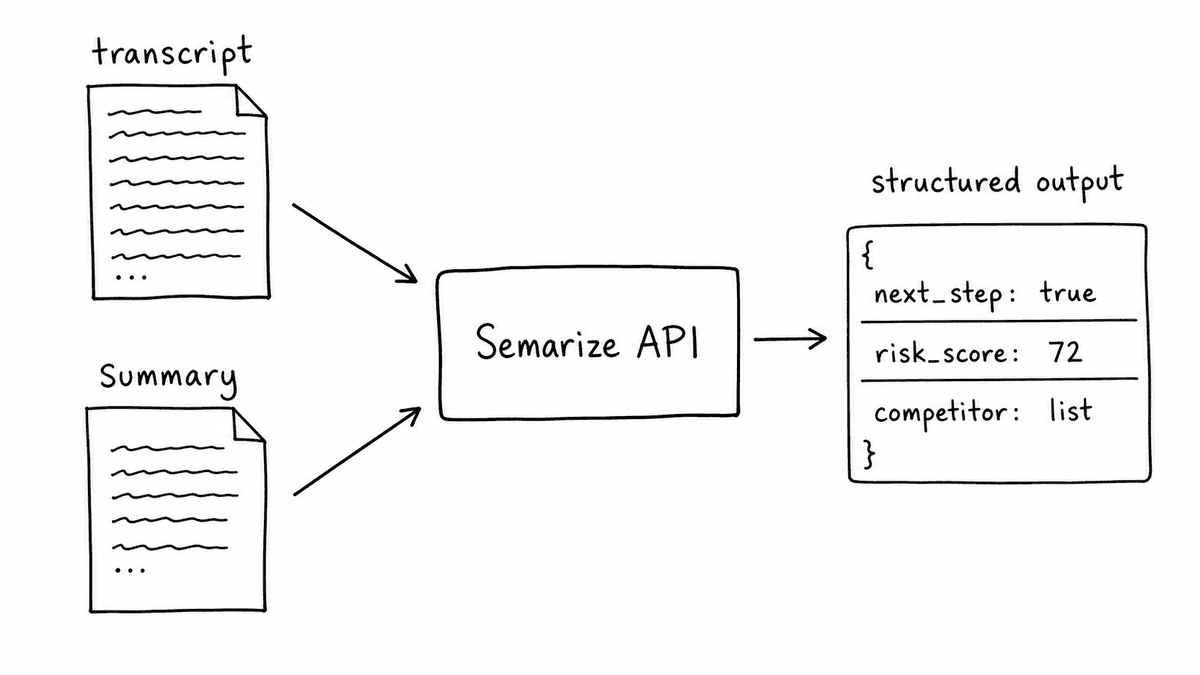
A summary is text. A transcript is text. Structured data is different: consistent fields with predictable types that arrive the same way every time. budget_confirmed: false, competitor_mentioned: "Salesforce", next_step_confirmed: true, discovery_depth: 68. Yes/no values, numeric scores, extracted text, categories.
Your Salesforce integration doesn't know what to do with a paragraph. It knows exactly what to do with a yes/no field and a score. Because you define what gets extracted - the questions, the output types, the evidence standard - the API runs that same logic against every conversation. One call or ten thousand, the output shape doesn't change. That's what makes it queryable, joinable, and automatable in ways that summaries never can be.
How Semarize works: Bricks and Kits
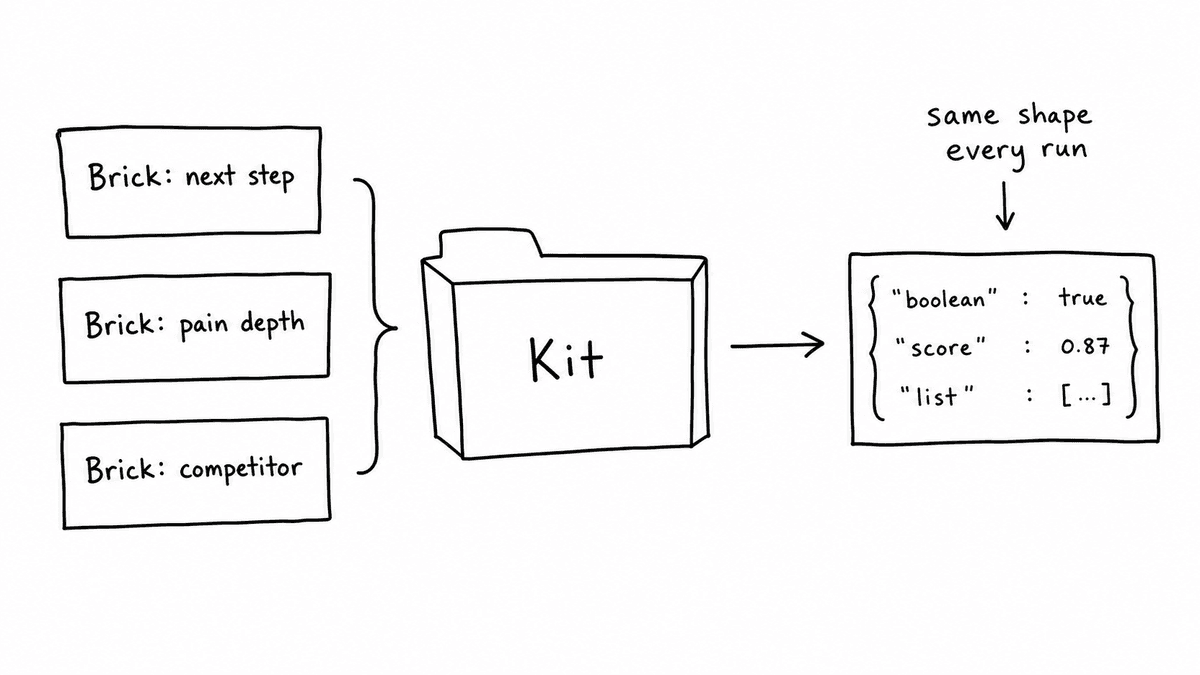
Semarize is built around two concepts: Bricks and Kits.
A Brick is one evaluation unit - one question, one output type. “Was a next step agreed?” returns yes or no. “How specific was the pain described?” returns a score out of 100. “What competitors were mentioned?” returns a list. Every Brick also returns a confidence score and the exact transcript quotes that support the answer.
A Kit is a collection of Bricks grouped for a specific purpose. A discovery quality Kit might have eight Bricks covering qualification depth, pain specificity, stakeholder identification, timeline signals, and next step commitment. A deal risk Kit covers different ground. You build the Kits that match your process, using the questions that actually matter to your team.
To run an evaluation: send the transcript to the API with the Kit ID. You get structured JSON back - one field per Brick, with its value, confidence, and supporting evidence. Feed it to Salesforce, push it to BigQuery, trigger a Zapier flow, render it in your own dashboard. The output is yours.
Why knowledge grounding matters
Without grounding, AI evaluation answers based on training data, not your reality. Ask “was pricing discussed accurately?” without providing your actual pricing and the model infers what accuracy probably looks like in general - which may have nothing to do with your rate card. The same problem applies to ICP qualification, approved product claims, compliance disclosures, anything with a specific right answer that lives in your documents rather than in the model.
Semarize lets you attach documents to Kits - pricing sheets, playbooks, ICP definitions, qualification frameworks - so evaluation runs against your knowledge. When your pricing changes, update the document. The Bricks stay the same. The answers stay accurate. More on this in knowledge grounding.
Who uses a conversational intelligence API
The common thread across use cases is needing data from conversations rather than summaries of them. RevOps teams enriching CRM fields automatically and detecting forecast risk without manual pipeline reviews. Sales coaching and enablement teams scoring every call against a consistent rubric and tracking skill development over time. Customer success teams surfacing churn risk and expansion signals before they appear in usage data. QA and compliance teams evaluating 100% of calls against regulatory criteria rather than the 5% that get manually reviewed.
Common questions
What's the difference between a conversational intelligence API and a note-taker?
A note-taker produces a human-readable summary or transcript - a human is the intended consumer. A conversational intelligence API produces structured data your CRM, warehouse, and automation tools can consume directly. One is a productivity tool; the other is infrastructure.
Do I need to build NLP pipelines to use a CI API?
No. You define what to evaluate using Bricks, bundle them into Kits, and send transcripts to the API. The evaluation logic is yours to define; the NLP infrastructure is handled by Semarize. No ML engineering required.
What conversation types does a conversational intelligence API support?
Any text-based conversation: sales calls via Gong, Zoom or Teams transcripts, customer success meetings, support chat logs, email threads, and AI agent conversations. The API processes the transcript - how you get it is up to you.
How is output consistency guaranteed across runs?
Bricks define a fixed evaluation schema. The same Brick run against the same transcript returns the same output type every time - fundamentally different from freeform LLM prompts, which vary with phrasing, model version, and context length.
The Semarize conversational intelligence API turns conversations into structured data. No platform required.
Continue reading
Read more from Semarize
Bricks and Kits: the mechanism for stable conversation evaluation
Freeform prompts produce inconsistent evaluation results - scores drift, output shapes change, and you can't tell whether coaching improved anything or whether the rubric moved. Bricks define a locked evaluation schema: one question, one output type. Kits group them into reusable evaluation workflows. The result is schema-stable conversation analysis you control.
Conversation Intelligence for Developers: Don't Build a Fragile Pipeline, Don't Buy a Black Box
Most teams don't fail to add conversation intelligence because the model is bad; they fail because the integration is fragile and unstructured. The fix isn't a better LLM pipeline or a platform API you can't control. It's a layer that takes a transcript, runs it against a versioned Kit, and returns deterministic typed JSON you can test, version, and route into your product.
Gong Captures the Transcript. Here’s What It Can’t Score.
Gong’s scoring runs against a fixed model — you can’t attach your product documentation, rate card, or qualification playbook to its evaluation layer. For four evaluations that matter — product accuracy, pricing audit, methodology A/B testing, and deal readiness scoring — knowledge grounding and KB isolation are the only architecture that works.