
Conversation Intelligence Platform vs API-First: The Ownership, Integration, and Cost Decision
A RevOps lead signs a conversation intelligence contract to fix one thing: empty qualification fields in the CRM. Six months later the dashboards are full of coaching highlights nobody on the data team can query, the call signals they actually wanted still arrive as prose, and the schema that produces them belongs to the vendor. That gap is what the conversation intelligence platform vs API-first decision is really about, and most teams only feel it after the contract is signed. The category label covers two different operating models, and choosing the wrong one shows up later as data-ownership lock-in, integration drag, and a total cost that was never on the quote.
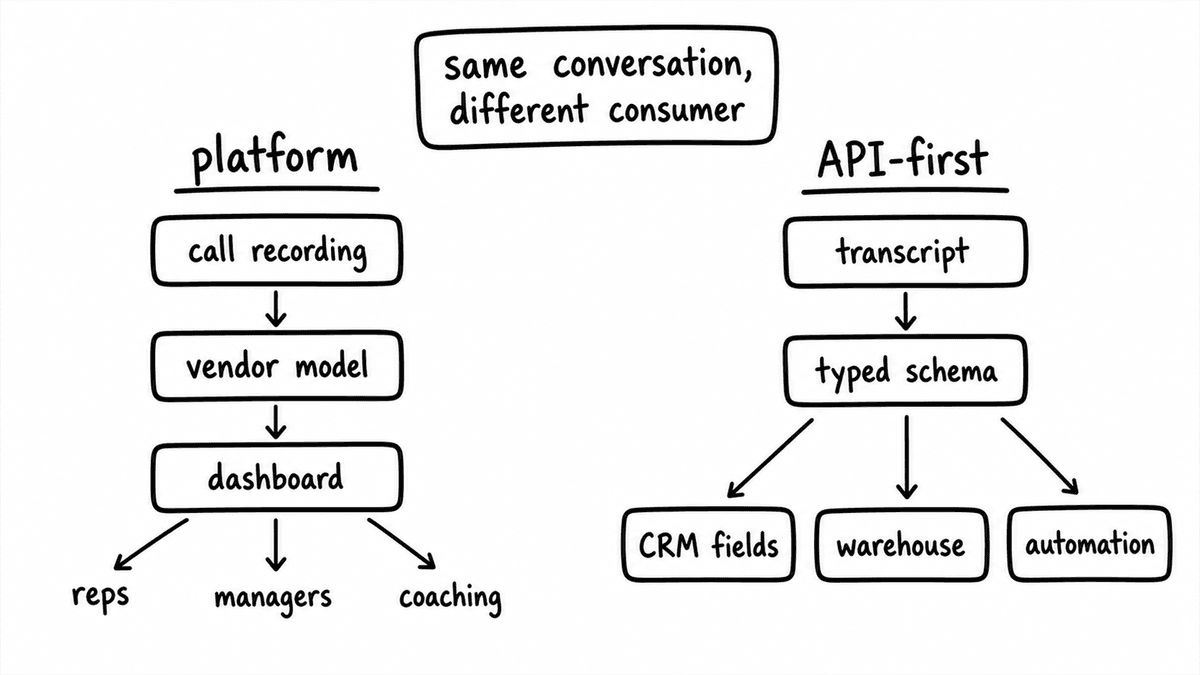
Both models are legitimate. A platform like Gong or Chorus is built to put conversation insight in front of people: reps reviewing their own calls, managers scanning deal intelligence, enablement teams running coaching. An API-first layer like Semarize is built to put conversation insight in front of systems: CRM fields, warehouse tables, scoring jobs, and automation triggers. The mistake is almost always buying for the wrong consumer rather than picking a bad vendor.
Conversation intelligence platform vs API-first: the short answer
Choose a platform when the people on your calls are the primary consumers of the output and a polished review-and-coaching experience is the job to be done. Choose an API-first layer when your systems are the primary consumers and you need typed, stable fields you can write into CRM, push to a warehouse, or score against your own criteria. Plenty of teams run both: the platform handles recording and rep-facing coaching, and the API-first layer reads the same transcript and returns structured data for everything downstream. The decision turns on three things that features lists hide: who owns the evaluation logic, how the output integrates with the rest of your stack, and what the arrangement actually costs once you account for the work each side leaves you holding.
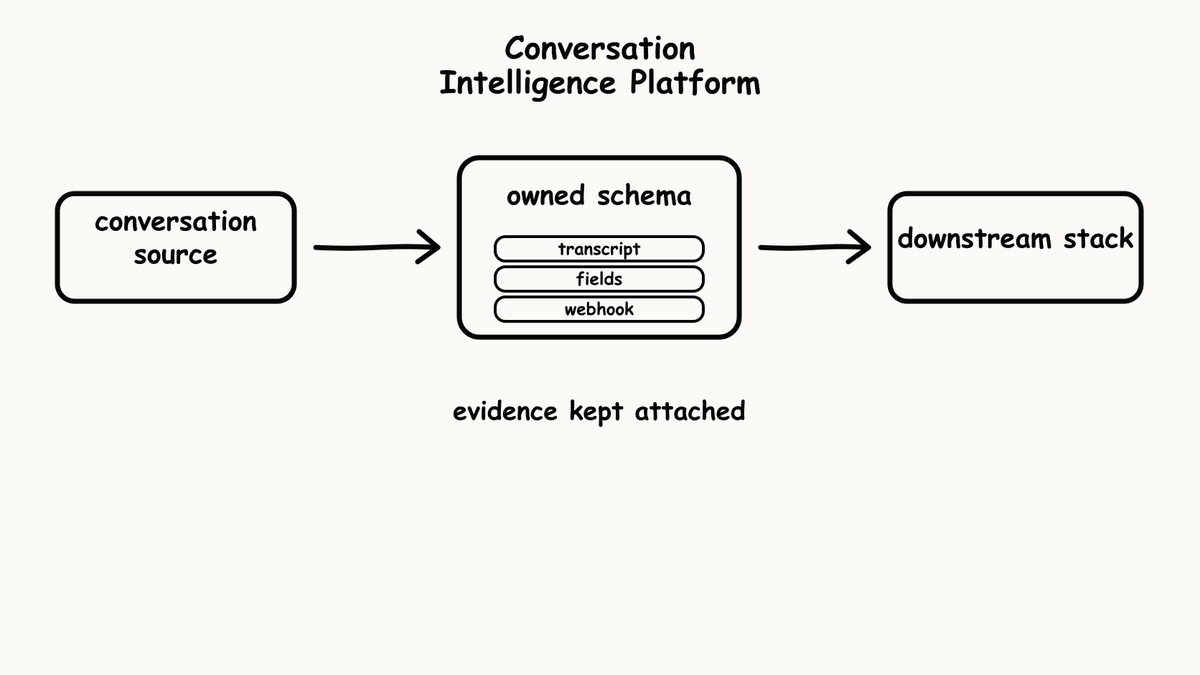
A platform operates as a closed loop. A bot joins the call, the platform captures and transcribes the audio, its models decide what to surface, and the result lands in a dashboard and a set of pre-built CRM fields. The evaluation logic is the vendor's, the categories are the vendor's, and the output is shaped for a human to read. An API-first layer operates as a step in a pipeline you control. A transcript arrives from wherever your calls already live, you define the questions you want answered, and the layer returns one typed value per question for a system to act on. Semarize is transcript-agnostic by design: it accepts transcript text from Gong, Fathom, Zoom, Teams, Meet, or a direct upload, processes after the call, and returns typed JSON over a webhook or API. It’s supplemental to the platforms, not a replacement for them, because it adds a structured-output layer they don’t expose natively.
Ownership: who controls the evaluation logic and the data
Feature comparisons flatter platforms because platforms ship more visible surface area: a recorder, a transcription engine, a review UI, coaching scorecards, deal boards. An API-first layer deliberately ships none of that. Comparing the two on feature count answers the wrong question. The question that predicts whether you will be happy in a year is how each model operates: where the conversation content comes from, who defines what gets measured, what shape the output takes, and which system consumes it.
The least visible difference is the one that hurts most on the way out. When your conversation intelligence lives inside a platform, the evaluation schema is the vendor's property. The categories shift when their models update, the output format can change without your sign-off, and migrating to another vendor means rebuilding the pipeline and abandoning the historical signal your reporting was built on. You rent the logic, and you rent the comparability of your own history.
An API-first layer inverts that. With Semarize, the unit of measurement is a Brick, a single typed criterion that asks one evidence-answerable question about a conversation and returns one concrete value: a boolean, a score on a defined scale, a category, or a string list. Related Bricks group into a Kit, a versioned schema that returns the same shaped JSON object on every run, so a contract change is explicit rather than silent. Because the criteria are written by you, the schema is an asset you own. You can rescore historical calls against a new Kit version without asking the vendor, you can ground evaluation against your own approved documents so a Brick returns a flag plus the transcript quote and the document reference as evidence, and if you ever change tools the logic moves with you because it was never buried in someone else's model. This portability gap is the same one covered in the Gong API field-contract post, where teams found that a platform's API returned the same prose its UI displayed rather than the typed fields their workflows needed.
Integration flexibility: where the output is allowed to go
A platform integrates well with the destinations it already supports and poorly with the ones it doesn’t. Its native CRM connector writes the fields it was designed to write, in the format it chose, on the schedule it controls. If that matches your workflow, the integration feels effortless. If you need a field the platform doesn’t extract, a join key the platform doesn’t expose, or a delivery into a warehouse the platform doesn’t target, you end up building an extraction layer on top of its API to reshape human-readable output into machine-readable data, and that layer becomes yours to own and maintain.
An API-first layer treats integration as the whole point. Delivery is built for systems: Semarize supports webhooks for real-time push, incremental polling, and historical backfill, so you can enrich new calls as they finish and reprocess years of archived transcripts against the same Kit. Because the output is typed JSON with stable field names, the same run can feed a RevOps automation, a warehouse table for BI, and a scoring model without anyone reshaping it three times. Teams without engineering capacity reach those destinations through no-code automation tools that speak HTTP, so the flexibility isn’t gated behind a developer.
Total cost: what each quote leaves off
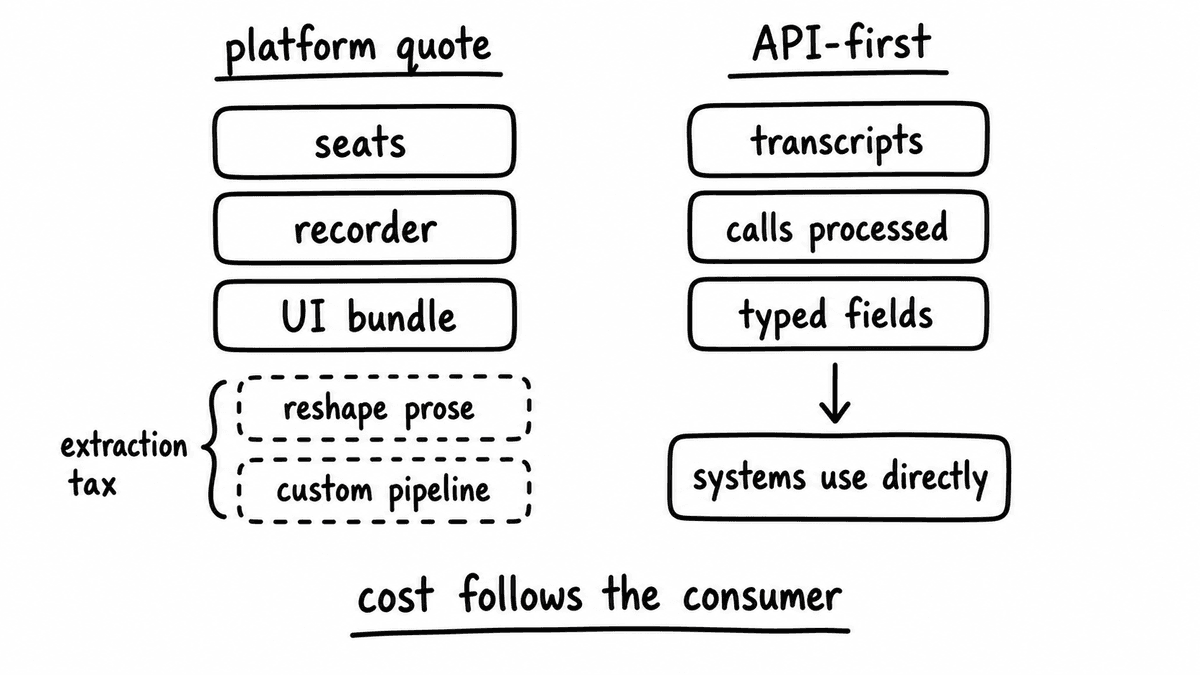
Platform pricing is most often per seat and bundles recording, transcription, analysis, and the UI into one number. For a sales floor that uses all of it, every seat earns its cost. For a RevOps team that only wants structured data from calls, per-seat pricing means paying for a recorder, a transcription engine, and a coaching dashboard nobody on that team opens, and then paying again in engineering time to extract the data the bundle was never shaped to hand over. The sticker price is visible; the extraction tax is not.
API-first pricing is consumption-based, charged per call or transcript processed, which lines up with how a data layer is actually used. For teams that need only the signals, that is the cheaper path, and there is no rep-facing surface to license per head. For teams that need both a coaching experience and a structured data layer, the durable pattern is to run a platform for the rep-facing work and an API-first layer for the data, feeding both from the same transcript so you aren’t paying twice to capture the call. The total-cost question is which model leaves you doing unpaid integration work to reach the output you bought the tool for, regardless of which line item looks smaller.
Platform vs API-first at a glance
The two models diverge along the same handful of dimensions in every evaluation, so it helps to see them side by side. The table below maps each model against the choices that actually predict fit: who consumes the output, who owns the logic, where the data can go, and how the bill is calculated.
| Dimension | Conversation intelligence platform | API-first layer (Semarize) |
|---|---|---|
| Primary consumer | People: reps, managers, enablement | Systems: CRM, warehouse, automation, scoring |
| Output shape | Summaries, highlights, dashboards for human reading | Typed JSON, one field per criterion, stable schema |
| Who owns the logic | Vendor-defined categories and models | Customer-defined Bricks and versioned Kits |
| Capture model | Bundled recorder and transcription | Transcript-agnostic: Gong, Fathom, Zoom, Teams, Meet, upload |
| Delivery | Native CRM fields and in-app UI | Webhook, incremental polling, historical backfill |
| Typical pricing | Per seat, full bundle | Consumption: per call or transcript processed |
| Strongest at | Rep-facing review, coaching, deal intelligence | CRM enrichment, scoring, reporting, internal tooling |
Values for any specific vendor vary by plan and change over time, so treat platform pricing and API exposure as configurable rather than fixed. The table shows the shape of each model rather than scoring any one vendor.
Choose a platform if…
Your primary job is rep-facing. You want reps reviewing their own calls, managers scanning deal intelligence, and enablement building coaching into the flow of work, and the value lands when a person reads the output. The team isn’t technical and needs a pre-built experience with minimal setup, recording infrastructure is a constraint you would rather not own, and your downstream workflows are satisfied by the platform's native CRM integration without custom field extraction. If a polished review-and-coaching surface is the deliverable, a platform is the right model, and an API-first layer would leave you building the UI you actually needed.
Choose API-first if…
Your primary job is data infrastructure. You are enriching CRM fields, scoring calls against your own methodology, feeding a warehouse, or automating qualification, and the value lands when a system acts on the output. The evaluation logic needs to reflect your criteria rather than vendor categories, the output needs to be typed and stable enough to compare across quarters, and you want to own the schema so historical data and tool changes stay under your control. You already capture calls somewhere, so a transcript-agnostic layer that reads what you have and returns structured JSON fits without ripping anything out. This is the same reasoning behind extracting MEDDICC fields from transcripts rather than waiting for reps to backfill them by hand.
Where the two models meet
The honest answer for many teams is that this isn’t an exclusive choice, and treating it as one is how the wrong-consumer mistake happens in reverse. A sales organisation can keep its platform for everything a person needs to see and add an API-first layer for everything a system needs to consume, drawing both from the same transcript so the call is captured once and used twice. The platform serves the coaching conversation; the API-first layer serves the warehouse, the scorecard, and the CRM. Read that way, the decision comes down to which consumer each requirement is really for, answered one requirement at a time.
Semarize turns calls, emails, chats, and transcripts into structured JSON signals your CRM, warehouse, and automation tools can use directly, as a data layer alongside the platforms rather than a replacement for them.
Common questions
What is the difference between a conversation intelligence platform and an API-first layer?
A platform such as Gong or Chorus is built so people consume the output: it records, transcribes, and surfaces summaries, coaching highlights, and deal intelligence in a UI. An API-first layer such as Semarize is built so systems consume the output: it reads a transcript you already have and returns typed JSON for CRM fields, warehouses, scoring, and automation. The platform owns the evaluation logic and shapes output for reading. The API-first layer lets you define the logic and shapes output for downstream systems to act on.
Can we use both a platform and an API-first tool together?
Yes, and it is the most common pattern for teams with strong requirements in both categories. The platform handles recording, transcription, and the rep-facing coaching experience. The API-first layer receives the same transcript and returns structured signal fields for CRM enrichment and RevOps workflows. Both layers use the same call content as input and produce different outputs for different consumers: a coaching surface for reps and managers, typed JSON for downstream systems. Because Semarize is transcript-agnostic, it reads the transcript your platform already produces without recapturing the call.
Why does data ownership matter when choosing between the two?
Inside a platform, the evaluation schema belongs to the vendor: categories shift when models update, the output format can change without your sign-off, and leaving means rebuilding the pipeline and losing historical comparability. With an API-first layer, you write the criteria as Bricks and version them into Kits, so the schema is an asset you own. You can rescore historical calls against a new Kit version without vendor cooperation, and if you change tools the logic moves with you because it was never buried in someone else's model.
How do the costs actually compare?
Platform pricing is most often per seat and bundles recording, transcription, analysis, and the UI, which pays off when a whole sales floor uses all of it. For a RevOps team that only needs structured data, those seats fund features nobody on the team opens, plus engineering time to extract data the bundle wasn’t shaped to hand over. API-first pricing is consumption-based, charged per call or transcript processed, with no rep-facing seats to license. The decisive figure is the integration work each model leaves you doing.
Is API-first conversation intelligence only for technical teams?
Building a custom integration from scratch needs engineering capacity, but reaching the API doesn’t. Many RevOps teams connect Semarize to their CRM and data destinations using no-code automation tools like Make, which send HTTP requests natively without writing code. For teams comfortable with automation tools, an API-first approach is accessible without a developer. The Make integration guide walks through the workflow step by step.
Continue reading
Read more from Semarize
Conversation Intelligence for Developers: Don't Build a Fragile Pipeline, Don't Buy a Black Box
Most teams don't fail to add conversation intelligence because the model is bad; they fail because the integration is fragile and unstructured. The fix isn't a better LLM pipeline or a platform API you can't control. It's a layer that takes a transcript, runs it against a versioned Kit, and returns deterministic typed JSON you can test, version, and route into your product.
Gong API Alternatives for Structured Output
Most teams that struggle integrating Gong data into RevOps workflows describe it as an API problem. It is almost always a requirements problem. Before evaluating alternatives, write the exact JSON fields your downstream systems need and test vendors against that contract.
What is a Conversational Intelligence API?
Conversational intelligence gets applied to three very different things - deal intelligence, note-taking, and pattern-level analysis. Only one produces data your systems can act on. Here's what a CI API actually does and how the shift away from full-platform solutions is changing what's possible.