
Overhiring Is a Measurement Failure, Not a Hiring Strategy
Most post-mortems on sales overhiring land on the same explanation: the pipeline looked bigger than it was. Deals were counted that shouldn't have been, coverage ratios looked adequate on paper, and hiring decisions were made against a picture that turned out to be false.
That framing treats overhiring as a judgment error - someone trusted the wrong number. The more useful framing is structural: the numbers that drove headcount decisions didn't contain the information needed to make those decisions accurately. The pipeline looked a certain way because CRM data records what happened to deals, not what was actually happening inside them.
What “overhiring under uncertainty” actually means
By overhiring, the pattern is specific: adding headcount based on pipeline numbers that don't reflect deal truth, then discovering the coverage was illusory after the ramp period has already started. By uncertainty, the underlying condition is equally specific: not knowing whether the deals in the pipeline are genuinely progressing or stalling behind a stage label no one has updated.
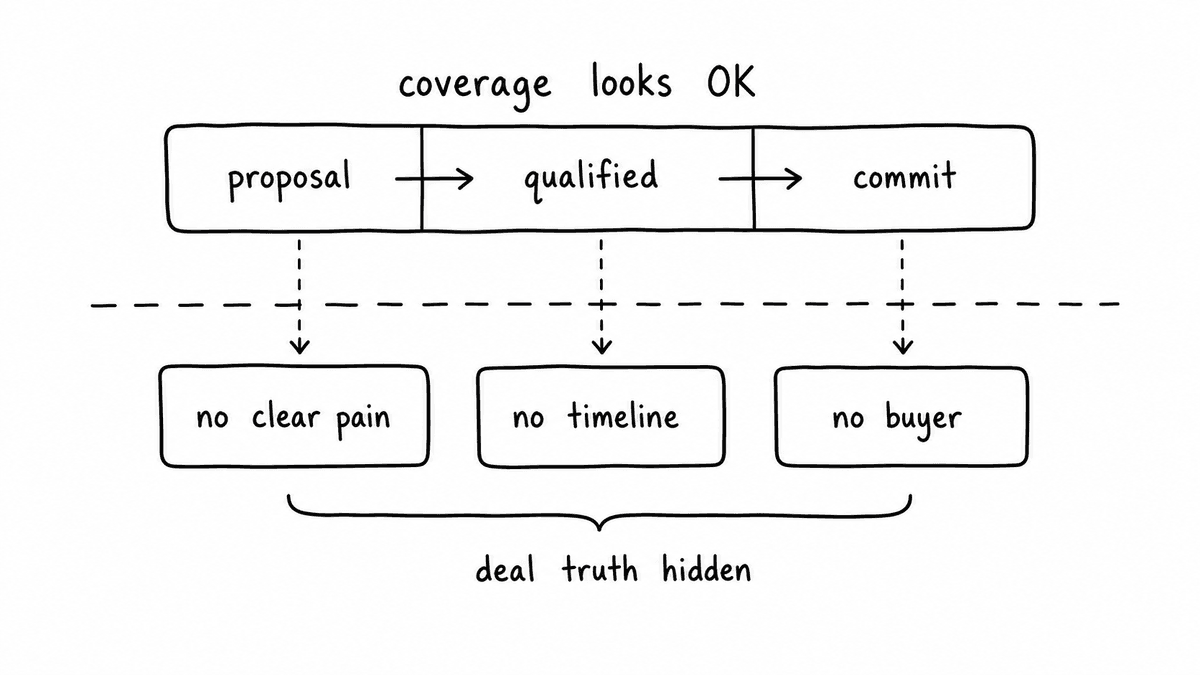
That uncertainty is largely invisible in standard reporting. The pipeline shows deals in Proposal. The weighted forecast looks adequate. The coverage ratio clears the threshold. None of that tells you whether the buyers in those deals have articulated a clear pain, confirmed a timeline, or have any intention of moving. The model produces a number; the number looks like signal; the hiring decision follows.
What CRM-driven capacity planning is actually measuring
Sales capacity models built on CRM datawork with opportunities, stages, and activities. A deal in “Proposal” stage for 30 days gets weighted at whatever probability the model assigns to that stage. The model doesn't know whether the buyer has a genuine pain, understands the product, or has the authority and budget to close. It knows the stage and the age.
That would be fine if stage reliably predicted outcome. But stage is a label applied by the rep, updated when the rep remembers to update it, and defined by criteria that vary by rep even when the definitions are written down. The mathematical confidence of a capacity model built on this data is a feature of the model, not a reflection of deal quality.
Headcount decisions made on this basis aren't wrong because the forecast methodology failed. They're wrong because the input data doesn't contain what you actually need to predict: whether buyers in the pipeline have the understanding and intent to close.
How the lag compounds over time
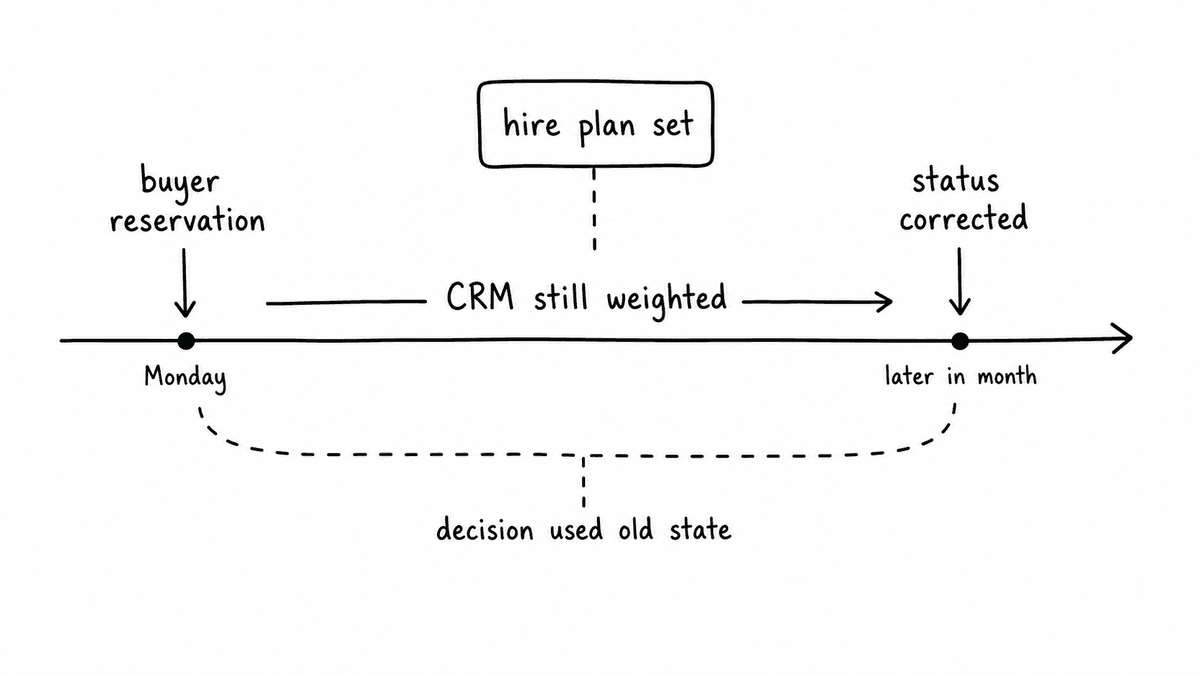
The other dimension of the problem is timing. A buyer signals serious reservation on a Monday call. The rep doesn't update the opportunity until Thursday, doesn't move the stage until it's unavoidable, and the deal stays in the pipeline at its existing weight for weeks. The capacity model incorporates this deal in its coverage calculation throughout.
By the time the deal status is reflected accurately in CRM, the headcount decision that relied on it has already been made. The lag between conversation reality and CRM state is structural: event-driven data is always retrospective, and decisions that depend on it are always slightly behind.
When teams overhire under pipeline uncertainty, they're not being reckless. They're making reasonable decisions with the data available. The data available happens to systematically underrepresent deal risk until deals are already slipping.
What would make capacity planning more accurate
Improving capacity inputs means adding data that reflects what's happening inside deals as it happens - not waiting for stage changes and activity counts to tell the story after the fact.
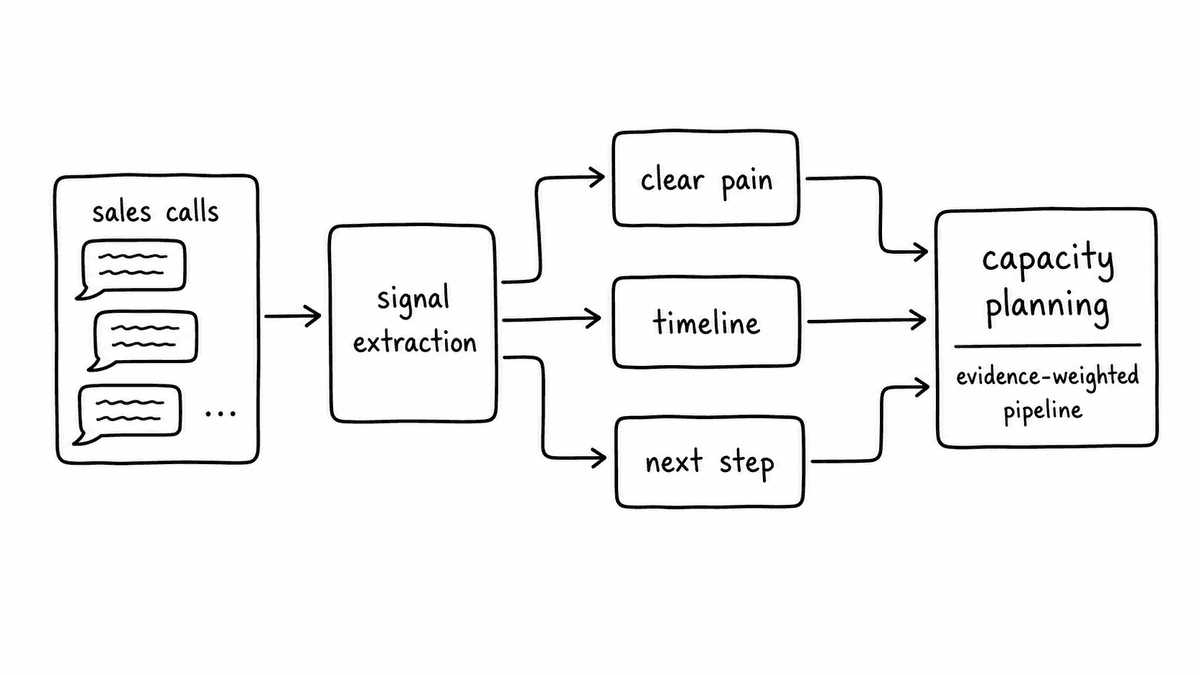
The signals that predict deal movement most reliably are buyer signals: whether the buyer articulated a specific, quantifiable pain; whether they demonstrated understanding of how the product addresses it; whether they confirmed a timeline and named the next step. These signals exist in every sales call as it happens. They don't require rep judgment to produce - they require extraction.
When buyer understanding signals are extracted automatically from calls and pushed into the data that feeds capacity models, the inputs become fresher and more reflective of what's actually happening. A deal where the buyer has articulated clear pain and confirmed a timeline looks different from a deal where the buyer has stayed non-committal across three calls - even if both are labelled the same stage in CRM.
What to do before adding headcount
The behavioural shift the data problem requires is to instrument selling before acting on pipeline numbers. That means scoring deal understanding and conversation outcomes as structured signals, and feeding those signals into capacity planning alongside the CRM events already there.
Before adding headcount against a pipeline number, the question worth asking is: what percentage of deals in that pipeline have produced extractable buyer understanding signals? If the buyer hasn't articulated a quantifiable pain, confirmed a timeline, or identified a next step with a specific owner and date, the deal's contribution to coverage should be discounted - not because the rep managed it badly, but because the evidence for progression isn't there yet.
That is a different number from the weighted pipeline figure, and it tends to be a more honest one. Teams that plan headcount against observed selling signals rather than pipeline events find they hire less reactively, because the picture they're hiring against is closer to real.
The measurement problem behind the hiring problem
Teams don't overhire because they can't forecast. They overhire because the data available for forecasting doesn't contain the signals that would let them see deal risk early enough to act on it.
Fixing that requires treating call data as a pipeline input, not as a coaching artefact. When structured evidence from every sales conversation flows into the same stack as CRM events, capacity planning can work from what buyers are actually doing - not from what the pipeline looked like at last quarter's forecast review.
Common questions
What's the difference between capacity planning with CRM data and capacity planning with conversation signals?
CRM data tells you what happened to an opportunity: stage, age, activity count. Conversation signals tell you what's happening inside it: whether the buyer articulated a pain, confirmed a timeline, named a next step. The first produces a weighted pipeline number. The second tells you whether the deals behind that number are real. Combining both gives capacity planning a foundation that's harder to game and faster to update.
How do buyer understanding signals improve forecast accuracy?
Deals where the buyer has confirmed a quantifiable pain and a specific timeline close at materially higher rates than deals where those signals are absent - regardless of what stage they're in. When those signals are extracted automatically from calls, the capacity model can weight deals by evidence rather than by rep-assigned stage. The result is a pipeline view that reflects progression rather than administrative label.
How do you extract deal understanding signals at scale without adding a manual step?
Extraction runs automatically after each call: the transcript is evaluated against a defined schema, buyer understanding signals are returned as structured fields, and those fields are pushed to CRM via automation. No rep input required. The pipeline picture updates at the rate of conversations, not at the rate of CRM updates - which is where the lag currently lives.
Semarize extracts structured signals from sales calls and returns them as data your forecasting and capacity tools can use directly.
Continue reading
Read more from Semarize
Capacity Planning Lags Because Sales Data Misses the Act of Selling
Sales capacity models built on CRM events are structurally late. Stage labels and activity counts record what happened to deals, not what was happening inside them. The missing ingredient isn't more pipeline data - it's structured signals from selling conversations that show whether buyers actually understood, committed, and progressed.
Sales is human. Sales data is not.
CRM data captures events - stage changes, activity counts, timestamps. It doesn't capture the human act of selling. The evidence that explains why deals move or stall lives in conversations, not in fields a rep updated.
Conversation Intelligence Produces Signals, Not Workflows
CI vendors sell outcomes - better forecasts, improved coaching, higher win rates. The outcome claims are accurate for teams that wire CI signals into their downstream workflows. For teams that don't, the dashboards fill up and the outcomes don't move. The gap between running CI and seeing results is always an implementation gap, not a vendor gap.