
How to Turn Your Note-Taker Into a Serious Sales Enablement Source
Most sales teams already have transcripts. They’ve been generating them for years, every call recorded, every conversation turned into text by whatever note-taker is connected to the calendar. The transcripts sit in the platform, get summarised, and the summary gets attached to the CRM record or emailed to the rep. Then, for almost every team, that’s where the value stops.
The same data that could be powering coaching analytics, feeding CRM enrichment, driving QA programmes, and surfacing rep skill trends is doing none of those things, because the output format it comes back in doesn’t support any of them. Transcripts and prose summaries are useful for reading, they’re not useful for measuring, querying, or automating anything at scale. The gap isn’t in the recording - it’s in what happens to the transcript after the call ends.
What your note-taker is actually giving you
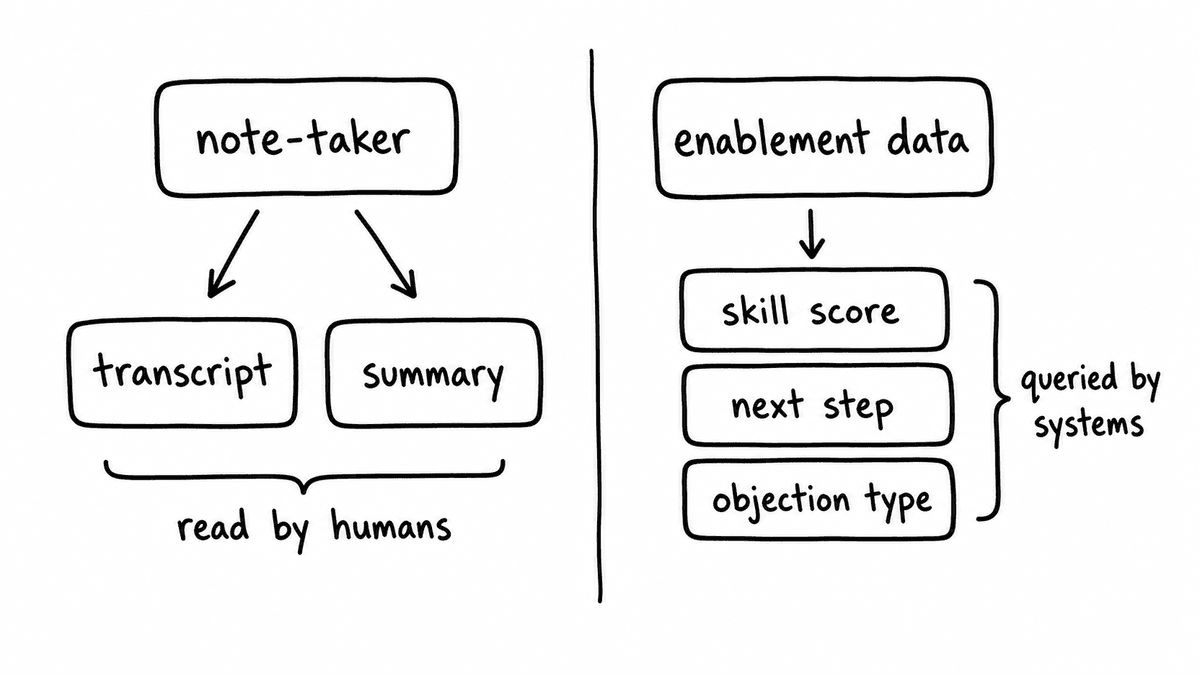
A note-taker gives you three things: a recording, a transcript, and a summary. The recording is the source. The transcript is that recording converted to text, containing everything said on the call, verbatim, in sequence. The summary is the note-taker’s attempt to compress that transcript into something a human can read in sixty seconds: key points, action items, topics covered. All three are genuinely useful in the right context.
The transcript, in particular, is rich with signal: every question the rep asked or didn’t ask, every moment the buyer mentioned a business case or failed to, every pricing objection, every reference to a competitor, every expression of urgency or its absence - all of it is in there, available in full. The reason this signal doesn’t flow into coaching, CRM, or QA workflows isn’t that it’s missing, it’s that it’s locked in unstructured text, and extracting value from unstructured text at scale requires a human to read each document and decide what matters, which is a bottleneck that kills scale before it starts.
Sales teams often respond to this by building manual review queues: a sample of calls per rep per week, reviewed by a manager or enablement team, scored on a rubric, fed back into coaching sessions. The process works at low volume and breaks down as the team grows, because the number of calls scales with headcount but the capacity to review them doesn’t. The result: most calls go unreviewed, most signals go unmeasured, and the enablement programme runs on a fraction of the data it theoretically has access to.
What sales enablement actually needs from conversation data
The job of a sales enablement programme is to improve the behaviours of the team in ways that translate to better pipeline outcomes. Doing that well requires being able to measure those behaviours in the first place, understand where the gaps are across the team and for individual reps, track whether interventions are moving the needle, and do all of this consistently across the full volume of calls rather than on a sample. None of those requirements are met by summaries and notes.
What enablement needs is structured signal data from conversations: typed values that record specific things about how a call went, extracted consistently across every call, stored in a format that can be queried and aggregated. Did the rep ask an open discovery question before pitching? Did the buyer articulate a specific pain? Was a next step agreed with a date? How well did the rep handle the competitor mention that came up? These aren’t questions that require reading a transcript to answer - they’re questions that require a structured extraction layer that reads the transcript and returns a typed value for each one. That extraction layer is what most note-taker-equipped sales teams are missing, and adding it is what turns a transcript archive into a coaching and reporting data source.
The extraction layer: turning transcripts into structured signals
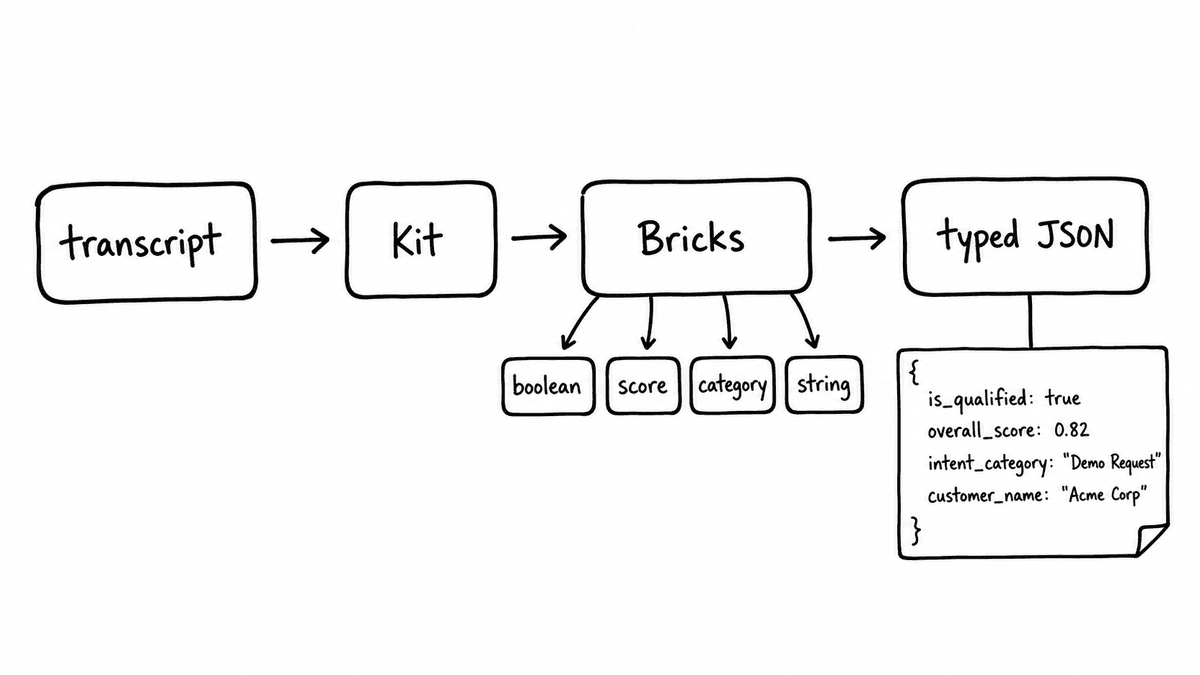
The workflow is straightforward: the transcript is the input, a set of evaluation criteria defines what to extract, and the output is a structured JSON object with one typed field per criterion, returned via API and ready to be sent downstream to CRM, a dashboard, or an automation workflow.
In Semarize, those evaluation criteria live in Bricks and Kits. A Brick is a single typed question about the conversation: did X happen (boolean), how well was Y done on a scale (score), what type of objection came up (categorical), what did the buyer say about Z (extracted string). A Kit groups Bricks into a complete evaluation schema for a specific use case, versioned so that scores are comparable over time. The API call takes in the transcript and the Kit ID, and what comes back is the structured JSON object with every field populated based on what the AI found in the conversation.
This works with any transcript source - the note-taker platform doesn’t need to change. The transcript gets delivered to the Semarize API via webhook, automation tool, or direct API call, and the structured output flows to wherever you need it: a CRM field, a coaching dashboard, a warehouse table, a Slack notification. The note-taker keeps doing what it does, the intelligence layer sits between the transcript and your downstream systems and converts the unstructured text into data.
Three workflows this unlocks
The most immediate value for most enablement teams comes from three workflows that become possible once the extraction layer is in place.
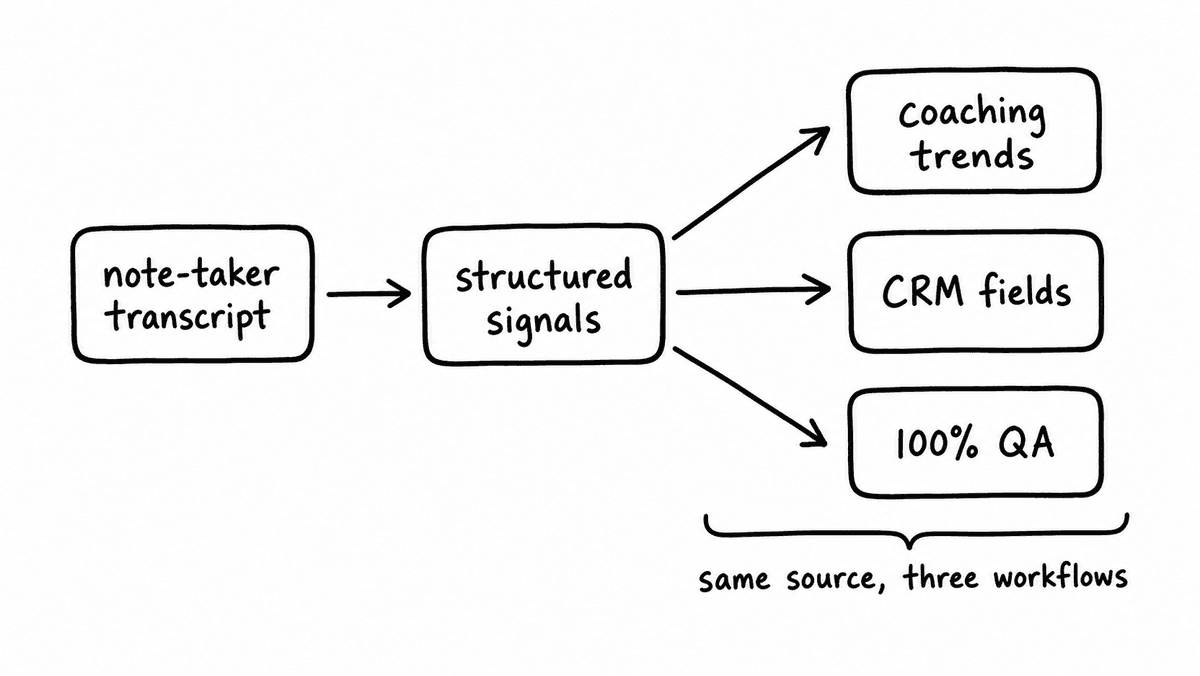
The first is coaching score tracking over time. With a defined scoring rubric applied consistently to every call, you can track how individual reps score on specific skills across weeks and months, see whether coaching interventions shift scores in the right direction, and compare skill levels across the team without manual QA. This is the enablement equivalent of moving from anecdote to data: instead of a manager’s impression of how a rep is developing, you have a time series of scored observations from every call they’ve made since you switched on the extraction.
The second is CRM field enrichment from conversation content. Fields that currently depend on reps updating them manually after calls - whether a business case was established, which pain points were mentioned, what the buyer said about their evaluation timeline - can be populated automatically from the structured extraction output. This removes a compliance burden from reps, improves data quality in the CRM, and means the pipeline data reflects what actually happened in conversations rather than what a rep remembered to type in.
The third is QA scoring at 100% coverage. Once the extraction runs automatically on every call, the QA programme is no longer limited by reviewer capacity: every call is scored against the same rubric, every deviation from the playbook is flagged, and the coaching prioritisation becomes a data-driven exercise - you work with the reps whose scores show the largest gaps rather than those whose calls happened to be in the review sample that week.
What to extract: defining your evaluation schema
The value of the extraction layer depends on the quality of the evaluation schema, and building a useful schema means being specific about what you want to measure and why. Generic scoring rubrics produce generic insights; a schema built around the specific behaviours your top performers exhibit, grounded in your sales methodology and qualification framework, produces signals that are actually actionable.
A discovery call Kit might include scores for how thoroughly the rep explored the buyer’s current state, whether a quantifiable business impact was established, how clearly next steps were agreed, and whether the rep spent more time talking than the prospect. A qualification call Kit might extract MEDDIC or SPICED fields - each element of the framework as a separate structured field, populated from whatever the transcript contains rather than from rep memory after the fact. An objection-handling Kit might categorise the type of objection raised and score the quality of the rep’s response.
The more closely the schema maps to the specific coaching conversations your enablement team is already having, the faster the extracted data becomes part of those conversations. The goal isn’t to build a comprehensive measurement framework in week one - it’s to start with the two or three behaviours that matter most and add to the schema as the programme matures.
Getting the data where it needs to go
Structured extraction output is only useful if it reaches the systems where decisions are made, and for most enablement teams that means CRM records, coaching dashboards, and wherever the weekly pipeline review lives. The output from the Semarize API is JSON, and routing it onward is a matter of using whatever integration approach fits your existing stack.
For teams already using automation tools like Make or n8n, the workflow typically looks like this: call ends, note-taker delivers transcript, automation tool sends transcript to the Semarize API, structured JSON comes back, automation tool writes the relevant fields to CRM and sends a summary to a coaching dashboard or Slack channel. No custom code is required for the basic version of this flow, and it can be running the same day the Kit is built.
For teams with engineering support, the API connects directly into whatever data pipeline infrastructure the team uses: a webhook endpoint that receives transcripts, an API call that returns structured output, and a write to the destination system. The output format is consistent and typed, so it integrates cleanly with warehouse connections, CRM APIs, and BI tooling without the normalisation overhead that prose summaries would require.
The note-taker doesn’t need to change. The transcript is the raw material, and adding a structured extraction layer on top of it is additive rather than disruptive. Most teams already have everything they need to make this work - the missing piece is the extraction layer itself, and adding it is what finally makes the data in your transcript archive useful beyond individual call review.
Semarize connects directly to your existing transcript source and returns structured, queryable signal data ready for CRM enrichment, coaching analytics, and QA workflows.
Common questions
Do I need to replace my existing note-taker to add structured extraction?
No. The extraction layer sits between your note-taker and your downstream systems, using the transcript your note-taker already produces as input. It doesn’t require changing your recording setup, your CRM, or your coaching workflows. The note-taker keeps producing summaries for reps to review, the structured extraction runs in parallel and sends typed signals to wherever your enablement and RevOps systems need them.
What types of signals are most useful for sales coaching?
The most useful signals are the ones that map directly to the behaviours your top performers exhibit and your current coaching conversations focus on. Common starting points include discovery quality scores (did the rep ask open questions before pitching, did the buyer articulate a business case), qualification coverage (which framework elements were addressed), and call balance (ratio of rep talk time to prospect talk time). The key is grounding the schema in your specific methodology rather than adopting a generic rubric.
How does structured extraction compare to reviewing call recordings manually?
Manual recording review produces subjective assessments from a sample of calls, limited by reviewer time. Structured extraction produces consistent, typed scores across every call, automatically, against a predefined rubric. The extraction doesn’t replace the coaching conversation that follows from the data - it replaces the manual data-gathering step that currently limits how many calls can be reviewed and introduces reviewer subjectivity into the scores.
Can extracted signals be written directly to CRM fields?
Yes. The structured JSON output from the extraction API maps directly to CRM fields via automation tools like Make or n8n, or via direct API integration. Fields that currently depend on manual rep entry after calls - qualification scores, pain point summaries, agreed next steps - can be populated automatically from the conversation content. This improves CRM data quality and removes the compliance overhead from reps.
How quickly can a structured extraction workflow be set up?
For teams using automation tools like Make or n8n, a basic workflow from transcript to structured output to CRM field write can typically be running on the same day the evaluation Kit is built. The Kit itself takes an hour or two to define if you have a clear view of the behaviours you want to measure. Engineering-supported implementations that connect directly to the API and a data warehouse typically take a day or two depending on the destination system.
Continue reading
Read more from Semarize
Conversation Intelligence Isn't Enablement Analytics. Here's What Is.
Sales enablement teams buy conversation intelligence to measure coaching impact, then find the dashboards don't produce what they need: consistent rubric scoring, queryable time-series data, and before-and-after skill lift metrics. Visibility into calls and measurement of skill development are different problems - and most CI tools only solve the first one.
CRM Enrichment From Sales Calls: The RevOps Data Ops Playbook
Most CRM enrichment stalls at 30% field coverage because the output is unstructured - reps updating from memory, summaries stored as notes. The fix is a structured extraction pipeline: transcript to consistent fields to CRM to automation triggers. This playbook covers the schema, the routing, and the implementation in Salesforce and HubSpot.
Conversational Intelligence API vs AI Note-Taker: What Changes?
AI note-takers produce prose summaries for humans to read. A conversational intelligence API produces structured data for systems to consume directly, and that difference determines what you can build.