
Conversational AI API vs Conversational Intelligence API: What’s the Difference
A conversational AI API and a conversational intelligence API sit in two different product categories that happen to share most of a name, and the overlap in wording sends a steady stream of developers to the wrong tool. Both touch conversation, both return JSON, and both get pitched with the same slide about turning talk into value, so the confusion is understandable: one category produces conversation, and the other analyses conversation that has already happened. Getting that distinction right before you start integrating saves a rebuild later.
This explainer draws the line clearly. It covers what a conversational AI API is for, what a conversational intelligence API is for, the inputs and outputs each expects, who typically buys each, where the two genuinely overlap, and how to tell from the job in front of you which one you actually need. Semarize sits firmly in the conversational intelligence column, and the sections below explain why that matters when you are choosing between the two.
What a conversational AI API does
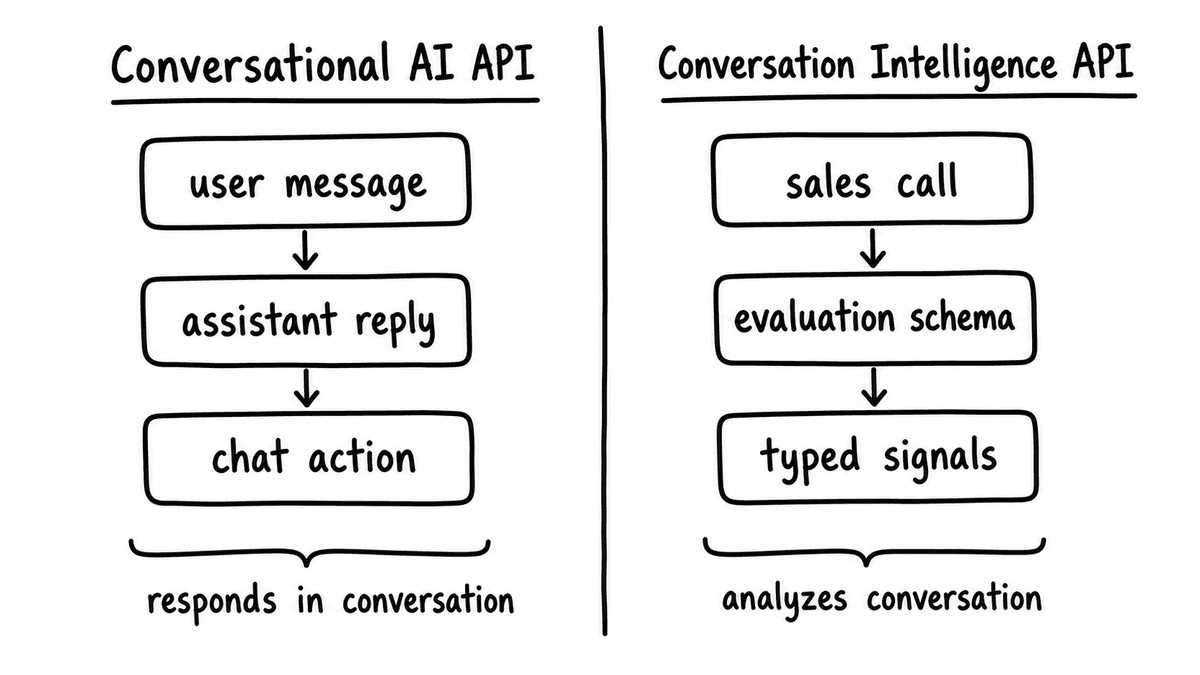
Conversational AI APIs generate conversation. They take a user message, some context, and a set of instructions, and they produce the next turn in a live dialogue: a reply in a support chat, a spoken response in a voice agent, a routed answer in an IVR flow, or a completion from a large language model chat endpoint. The direction of travel is outward, because the API is participating in a conversation that is still happening, and its job is to say the right thing next. Dialogue platforms, chatbot frameworks, virtual-agent and IVR APIs, and LLM chat completion endpoints all belong here, and though they differ in how much of the dialogue they manage, they share the same core purpose of producing responses in real time.
The teams building against these APIs are usually product engineers, support and CX engineers, and anyone shipping an interface a person talks to. Their inputs are the running message history plus system instructions, and their outputs are generated text or speech that becomes the assistant’s next turn. Success is measured by whether the generated response is helpful, on-brand, and safe, which is a very different bar from the one an analysis tool is measured against. When someone says they need an API to “build a chatbot” or “answer customer questions automatically,” they are describing a conversational AI API.
What a conversational intelligence API does
Conversational intelligence APIs analyse conversation that already exists. They take a transcript of a human interaction, a sales call, a discovery meeting, a support chat, or an email thread, and they return structured signals about what happened in it: scores, booleans, categories, and extracted facts. The direction here is inward, because nothing is being said back to a user; the conversation is finished, and the API reads it and reports on it. The input is transcript text that a person or a group of people produced, and the output is typed data describing that text, which is the opposite flow from a system that produces the text in the first place.
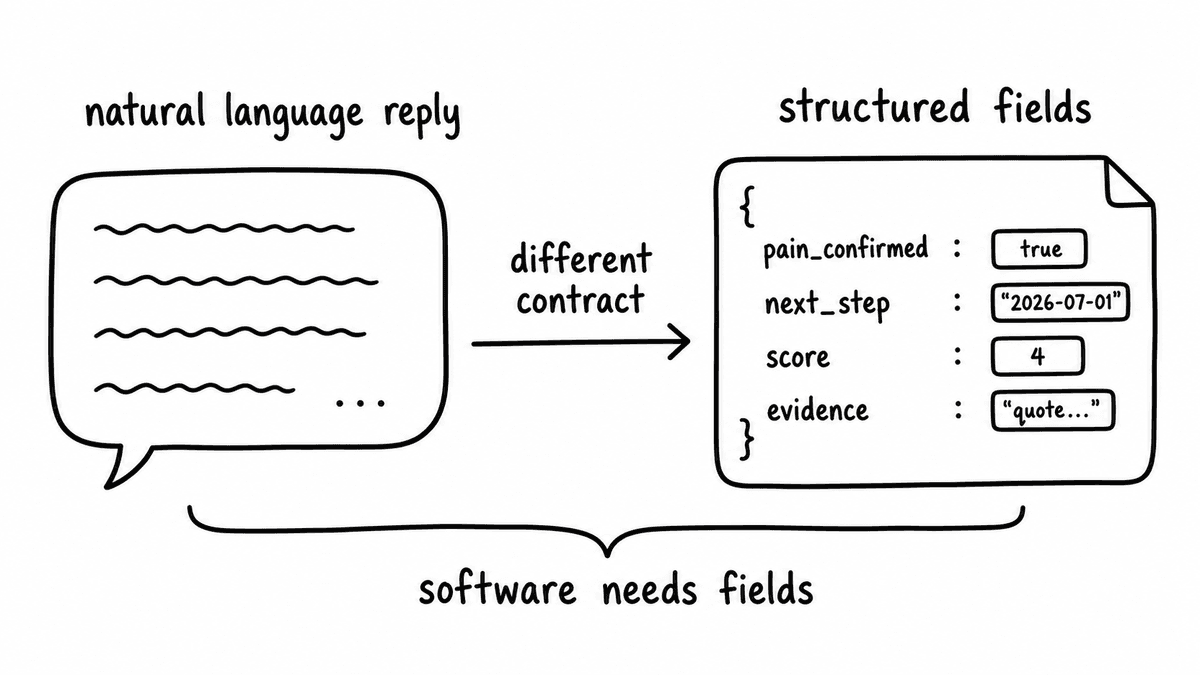
The people buying conversational intelligence APIs are RevOps leads, GTM engineers, and technical sales leaders who need call and conversation content as data they can query, route, and report on. Their question is not “what should we say next” but “what actually happened across these hundred calls, and can I get it as fields.” Semarize is a conversation intelligence API in exactly this sense: it consumes transcript text and returns typed JSON, one field per evaluation criterion, so that a discovery call becomes a boolean for whether the economic buyer was named, a score for discovery quality, and a string for any competitor mentioned. You can read a fuller treatment in what a conversational intelligence API is.
Conversational AI API vs conversational intelligence API at a glance
The two categories separate cleanly once you line them up by purpose, input, output, and direction. The table below is the fastest way to check which side of the line your use case falls on, and neither column is better than the other: they solve different problems, and plenty of teams end up running both, one to talk to users and one to understand the conversations their reps had.
| Dimension | Conversational AI API | Conversational intelligence API |
|---|---|---|
| Purpose | Produce the next turn in a live dialogue | Describe a conversation that already happened |
| Input | Running message history and instructions | A finished transcript of a call, chat, or email |
| Output | Generated text or speech for the user | Typed signals: scores, booleans, categories, extracted facts |
| Direction | Generates conversation | Analyses conversation |
| Typical buyer | Product, support, and CX engineers building bots | RevOps, GTM engineers, technical sales leaders |
| Example use case | A support assistant that answers customers in chat | Scoring every discovery call and writing fields to CRM |
Where the two categories overlap and where people conflate them
Both categories are built on the same underlying models, and that is the root of the confusion, because a large language model can generate a reply and it can also read a transcript and return a structured judgement about it. The model is shared, but the API around it is designed for one job or the other, and the design decisions are what matter in production: a generation API is optimised for low-latency single turns and creative freedom, whereas an analysis API is built to return the same typed schema for every transcript so the outputs are comparable across thousands of calls. People conflate the two most often when they reach for a raw chat completion endpoint to do analysis, because it can technically read a transcript and emit some JSON, but without a fixed schema and versioning the fields drift between runs and the results stop being queryable.
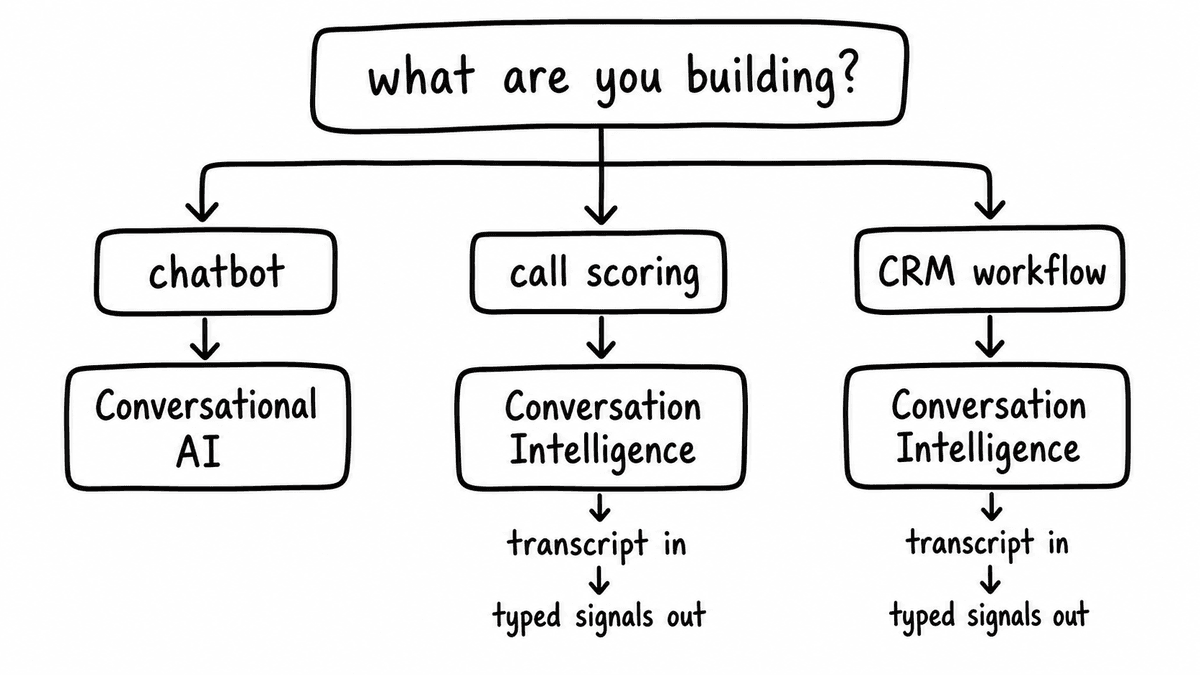
The other common mix-up runs in the opposite direction, where teams want to understand their sales calls and start evaluating chatbot platforms because the marketing language overlaps. Chatbot platforms can hold a conversation, but they aren’t built to take a finished rep-buyer call and return a discovery score you can trust to mean the same thing next quarter. Recognising which flow you’re in, generating a response or analysing a record, is the single most reliable way to avoid picking the wrong category.
How to tell which one you actually need
Start from the job, not the vendor. If the thing you are building talks to a person and has to decide what to say next, you need a conversational AI API, because your output is a turn in a live dialogue and your success metric is the quality of that turn. If instead you have conversations that already happened and you need to turn them into fields you can score, route, filter, and report on, you need a conversational intelligence API, because your output is structured data about a finished record. The tell is the direction of the arrow: generation points at the user, and analysis points at your database.
For the analysis side, the part that separates a production pipeline from a one-off script is a stable schema. Semarize builds that stability from Bricks, which are typed evaluation criteria that each return one value of a known type, grouped into Kits, which are versioned bundles of Bricks that run together against a transcript. Because the Kit version fixes the field names, types, and valid values, the score a call earns today is comparable to the score a call earned last quarter, which is the property a raw chat completion endpoint doesn’t give you. The broader case for treating conversation intelligence as data infrastructure rather than a note-taking add-on is covered in API-first conversation intelligence.
Where Semarize fits, and where it doesn’t
Semarize is a fit when you have transcript text from real human conversations and you want that content back as typed JSON your CRM, warehouse, or automation can consume directly. It suits API-first teams, RevOps functions, GTM engineers, and technical sales leaders who are building scoring, QA, CRM enrichment, or reporting from calls, emails, chats, and transcripts, and it is platform-agnostic on both ends because it consumes transcript text regardless of source and returns data any downstream system can read. You can see the full shape of the product on the product overview.
Semarize isn’t the tool for the other category. It doesn’t record calls, transcribe audio, hold a live conversation, or generate replies to a user, so if the job is to build a chatbot or a voice agent, a conversational AI API is the right choice and Semarize isn’t. It’s also not a coaching dashboard or a CRM replacement: it produces the structured signals that feed those systems rather than being the interface a rep clicks around in. Drawing that boundary honestly is the point, because forcing an analysis API into a generation job, or the reverse, is exactly the mistake the shared name encourages.
Common questions
Is a conversational AI API the same as a conversational intelligence API?
No. They are two different categories that share a confusing name. Conversational AI APIs generate conversation: they take a running dialogue and produce the next turn, such as a chatbot reply or a voice-agent response. Conversational intelligence APIs analyse conversation that already happened: they take a finished transcript and return structured signals about it, such as scores, booleans, and extracted facts. The simplest test is the direction of the output. If it points at a user as a reply, it is conversational AI. If it points at your database as typed data about a record, it’s conversational intelligence.
Which do I need to analyse sales calls?
A conversational intelligence API. Analysing sales calls means taking a transcript that already exists and turning it into fields you can score, route, and report on, which is the analysis job rather than the generation job. A conversational AI API would help you build a bot that talks to buyers, but it isn’t designed to read a finished rep-buyer call and return a discovery score that means the same thing across every call. Semarize is built for this case: it consumes transcript text and returns typed JSON, one field per evaluation criterion, ready for CRM enrichment, QA, and reporting.
Can an LLM chat API do conversation intelligence?
It can read a transcript and emit some JSON, but that isn’t the same as a production conversation intelligence pipeline. LLM chat completion endpoints are built to generate the next turn in a dialogue, so without a fixed schema the fields they return drift between runs and stop being comparable across calls. Conversation intelligence needs a stable, versioned schema so the same criterion returns the same field type every time. Semarize provides that with Bricks as typed evaluation criteria and Kits as versioned bundles, so scores stay comparable over time rather than changing shape from one request to the next.
Is Semarize a conversational AI API?
No. Semarize is a conversational intelligence API. It analyses conversations that already happened rather than generating new ones, so it doesn’t hold a live dialogue, reply to a user, record calls, or transcribe audio. It takes transcript text from calls, emails, chats, and meetings and returns structured JSON signals: scores, booleans, categories, and extracted facts. If you need to build a chatbot or a voice agent, a conversational AI API is the right category. If you need to turn finished conversations into typed data for automation, scoring, and reporting, that is what Semarize does.
Semarize turns calls, emails, chats, and transcripts into structured JSON signals through typed Bricks and versioned Kits, so finished conversations become data your CRM, warehouse, and automation can use directly.
Continue reading
Read more from Semarize
What is a Conversational Intelligence API?
Conversational intelligence gets applied to three very different things - deal intelligence, note-taking, and pattern-level analysis. Only one produces data your systems can act on. Here's what a CI API actually does and how the shift away from full-platform solutions is changing what's possible.
Conversation Intelligence for Developers: Don't Build a Fragile Pipeline, Don't Buy a Black Box
Most teams don't fail to add conversation intelligence because the model is bad; they fail because the integration is fragile and unstructured. The fix isn't a better LLM pipeline or a platform API you can't control. It's a layer that takes a transcript, runs it against a versioned Kit, and returns deterministic typed JSON you can test, version, and route into your product.
Conversational Intelligence API vs AI Note-Taker: What Changes?
AI note-takers produce prose summaries for humans to read. A conversational intelligence API produces structured data for systems to consume directly, and that difference determines what you can build.