
Chorus.ai Alternatives for Conversation Data Extraction
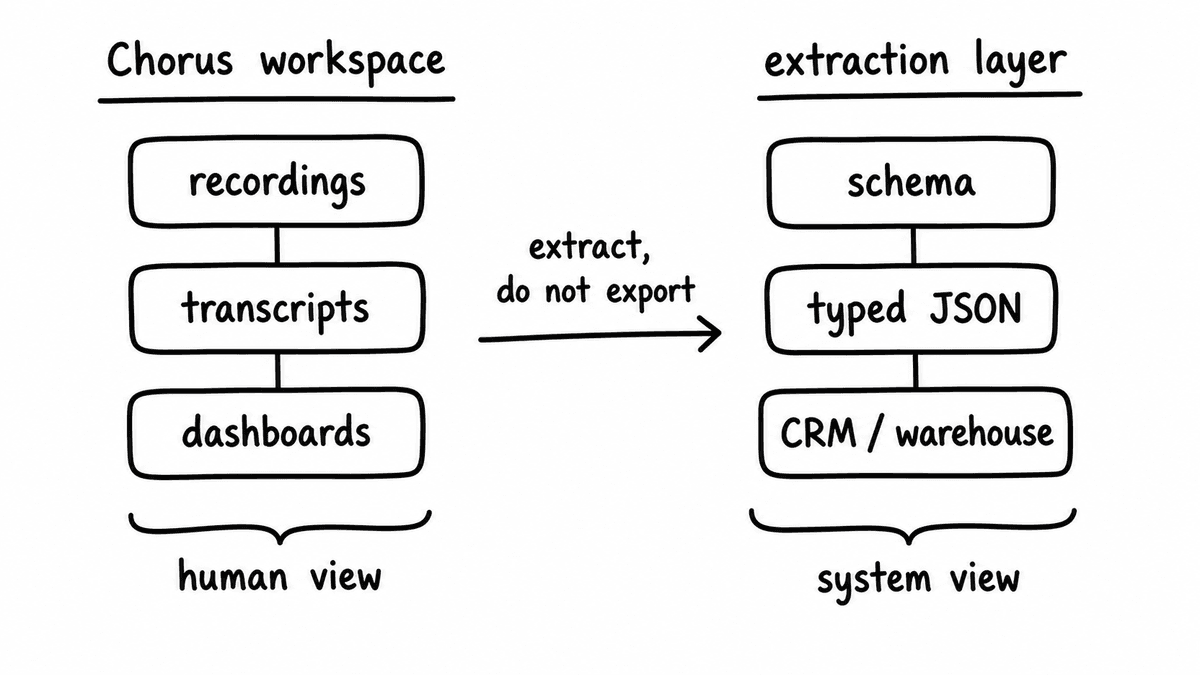
The search for Chorus.ai alternatives usually isn’t about the recording, the transcription, or the deal analytics; it starts when someone tries to get structured conversation data out of the platform and into a system that expects typed fields. The question behind “chorus.ai alternatives” and “chorus api transcript access” is rarely whether Chorus records calls well, because it does, and it’s whether the output that leaves the platform arrives as portable, customer-owned fields that a CRM property, a warehouse table, or a scoring model can consume without a reshaping step in the middle.
The short answer is that teams who want deal intelligence and coaching analytics inside the ZoomInfo and CRM ecosystem should stay with Chorus, because that is what it is built for; teams who need conversation intelligence as portable structured output, defined by a schema they own and independent of any single platform, should look at an API-first layer that sits on top of the transcript rather than replacing the call platform. Semarize is that layer: it takes Chorus transcripts as input and returns typed JSON against criteria the customer defines, so the structured fields belong to the team rather than to the analytics view they were extracted for.
Who Chorus.ai is for
Chorus.ai is a conversation intelligence platform, now part of ZoomInfo and offered as ZoomInfo Chorus, that records, transcribes, and analyses sales calls with deal and coaching analytics built into the ZoomInfo and CRM ecosystem. It captures calls and meetings, produces searchable transcripts, tracks deal momentum and risk signals across a pipeline, and surfaces call moments and coaching insights to managers and reps inside a familiar analytics view. For a revenue team that wants call recording, deal review, and rep coaching to live where their contact and pipeline data already sits, that integration is the point.
Chorus is a strong fit for sales organisations that run coaching programmes off recorded calls, managers who review deals through momentum and engagement analytics, and teams already invested in ZoomInfo who want conversation signals joined to their existing contact and account data. The platform also offers API access to conversation data, including engagements and transcripts, for customers who want programmatic access rather than only the UI; the exact endpoints, scopes, and plan availability are best confirmed directly with ZoomInfo, because those details change and are tied to plan and contract. Teams whose primary job is call review, coaching, and deal analytics inside that ecosystem are using Chorus for what it was designed to do.
Why teams look for Chorus.ai alternatives
The friction that drives the search for a Chorus API and transcript access alternative is usually about ownership and portability of the output rather than the quality of the analysis. Coaching dashboards, deal boards, and call summaries are designed to be read by a person inside the platform, and the value they carry is scoped to that view; RevOps teams that want a boolean for whether the economic buyer was named, a category for the implied deal stage, and a date for the agreed next step need those as typed fields they control, not as insights rendered inside an analytics screen. The moment the requirement becomes “write these specific values to a CRM property or a warehouse column”, the gap between an analytics platform and a structured data layer becomes visible.
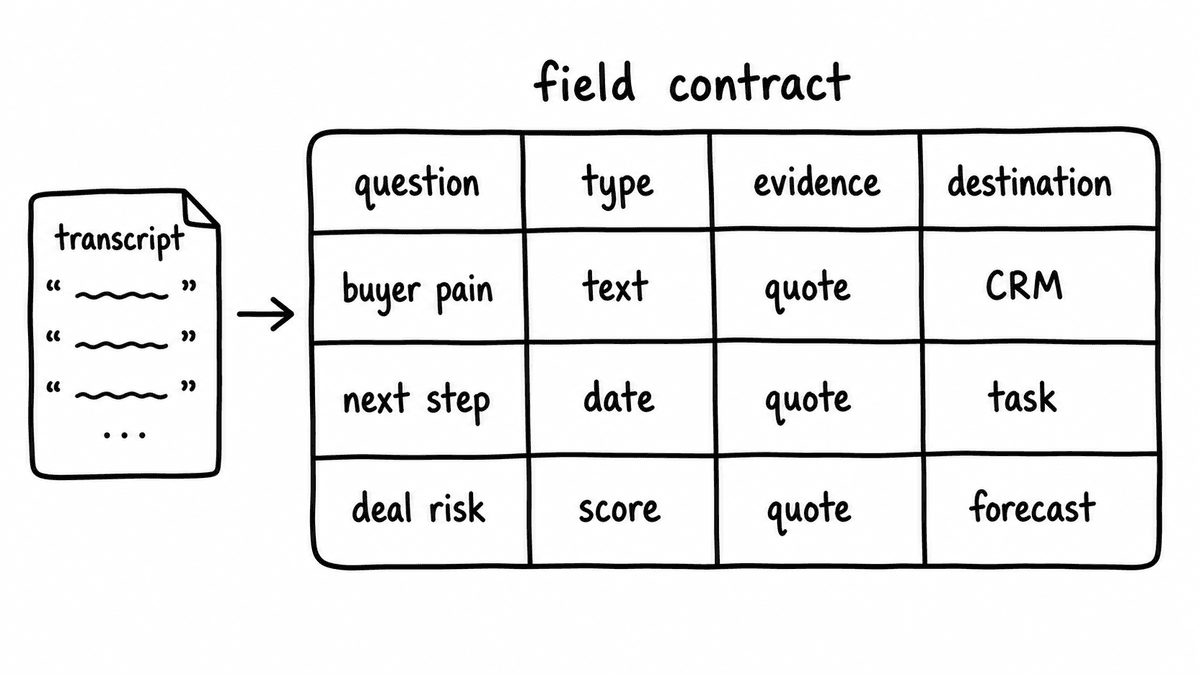
A second reason is platform coupling. When the structured signals a team depends on are produced by and locked to one platform, the schema is defined by that vendor, the analytics are tied to its ecosystem, and moving the data elsewhere means rebuilding an extraction layer to read transcripts and decide what the structured value should be. Teams looking for an alternative want three things that are hard to get from analytics scoped to a single platform: portable, customer-owned structured output as typed fields rather than dashboards; simpler programmatic extraction that returns the exact fields downstream systems need; and a platform-agnostic schema that stays the same whichever recorder or transcription source the transcript came from.
Where Semarize fits
Semarize is a conversation intelligence API that turns calls, emails, chats, and transcripts into structured JSON signals for automation, reporting, scoring, and downstream workflows. The difference from Chorus is one of buying model and architecture rather than analysis quality: Chorus is a recording and analytics platform you consume through its UI and API inside the ZoomInfo ecosystem, whereas Semarize is data infrastructure you own, where the evaluation schema is defined by the customer through Bricks, individual typed criteria that test a transcript for specific evidence and return a concrete value, grouped into versioned Kits that produce the same shaped object from every call.
In practice Semarize takes the Chorus transcript as input and evaluates it against the criteria the customer defined, returning exactly the fields those criteria specify rather than a summary or a coaching insight. Teams that have already exported or pulled a transcript from Chorus can pass that text to Semarize and get back typed JSON: booleans for whether specific evidence appeared, scores against a rubric, categories for disposition or stage, and lists of extracted entities such as competitors or objections. Because the schema is owned by the customer and the input is platform-agnostic, the same Kit produces the same fields whether the transcript came from Chorus, another recorder, or a raw text file, which is what makes the output portable rather than scoped to one analytics view.
Where Semarize isn’t a fit
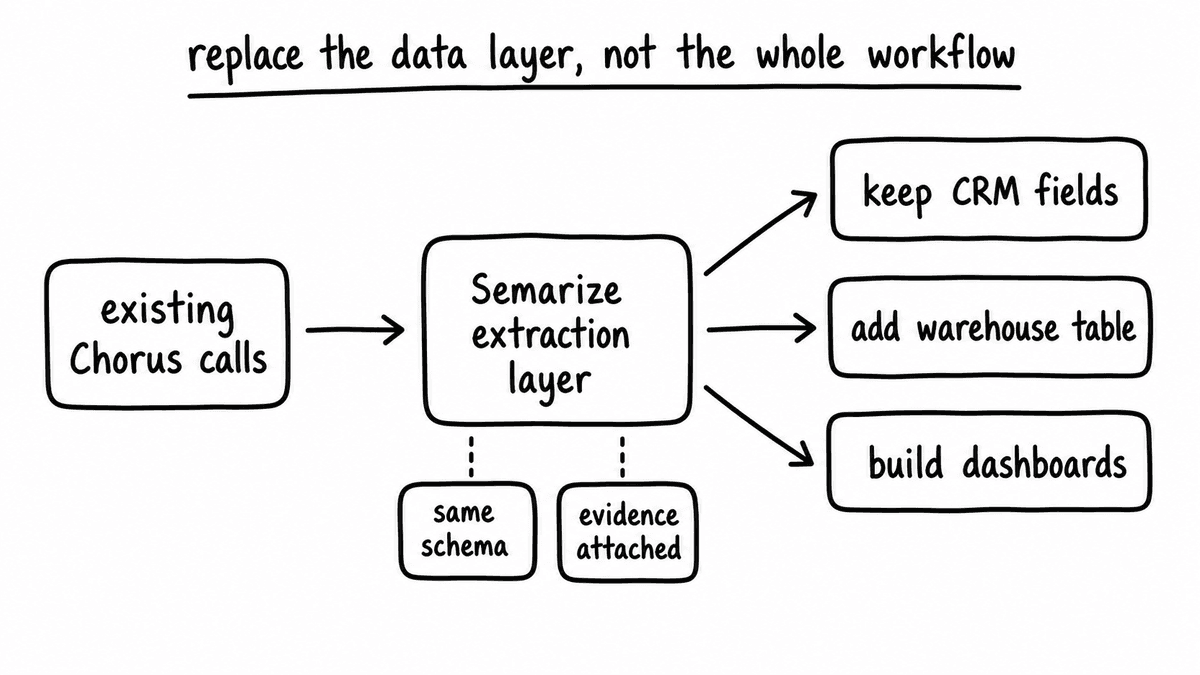
Semarize isn’t a meeting recorder, a call storage platform, or a coaching dashboard, and it doesn’t capture audio, transcribe calls, or replace the call platform. Teams that need to record and transcribe meetings, review call moments inside a rep-facing UI, or run deal and coaching analytics joined to ZoomInfo contact data will find Chorus better matched to that job, and Semarize doesn’t attempt to replace it. Semarize consumes transcript text after the call and returns structured output by API, so it fits post-call workflows that turn conversation content into data, and it doesn’t fit teams whose main requirement is the recording, the live call experience, or a rep-facing review screen. In most cases the two sit in one pipeline rather than competing: Chorus for capture, transcription, and coaching, Semarize for the typed evaluation that feeds CRM enrichment, scoring, and reporting.
Chorus.ai and Semarize compared
| Dimension | Chorus.ai (ZoomInfo Chorus) | Semarize |
|---|---|---|
| Data access model | Analytics UI plus API access to conversation data, including transcripts and engagements (endpoints and scopes confirmed with ZoomInfo) | API-first; transcript in, structured JSON out |
| Structured output | Recordings, transcripts, deal and coaching analytics surfaced for reading | Typed fields (booleans, scores, categories, lists) via Bricks and Kits |
| Data ownership | Conversation data and analytics within the ZoomInfo ecosystem | Customer owns the schema and the output fields |
| Platform coupling | Integrated with ZoomInfo and CRM; analytics scoped to the platform | Platform-agnostic input and output; same schema across any source |
| Best for | Call recording, deal review, and coaching inside ZoomInfo and CRM | CRM enrichment, scoring, and reporting from conversation data |
Use cases Semarize handles differently
The clearest way to see where an API-first layer changes the work is to look at the jobs that start with a transcript and end in another system. For CRM enrichment, teams that want every opportunity record to carry the named competitor, whether a next step was confirmed with a date, and a discovery quality score can’t get those as governed fields from a coaching view; running the transcript through a Kit returns them typed and ready to write, and the CRM-ready JSON guide covers the field-mapping patterns for Salesforce and HubSpot.
For a warehouse or reporting model, the requirement is a stable schema that stays the same across every batch of calls, because fields that appear, disappear, or change type break the tables downstream of them; versioned Kits hold the output shape fixed so the same columns land every time. For multi-source standardisation, teams pulling transcripts from Chorus for some calls and from another recorder for others need one schema across both, and a platform-agnostic evaluation layer produces the same fields regardless of where the text came from. The same thinking about writing the output contract before choosing a vendor is covered in the Gong API alternatives post, which applies to any conversation intelligence platform, Chorus included.
Semarize turns Chorus transcripts into typed JSON against a schema you define, so the fields your CRM, scoring, and reporting workflows depend on stay owned by your team and portable across sources.
Common questions
Does Chorus.ai have an API?
Yes. Chorus.ai, now part of ZoomInfo as ZoomInfo Chorus, offers API access to conversation data, including transcripts and engagements, for customers who want programmatic access rather than only the analytics UI. The exact endpoints, scopes, and plan availability change over time and are tied to your plan and contract, so confirm the specifics directly with ZoomInfo. If your goal is to pull transcript text and then produce your own typed fields from it, an API-first layer such as Semarize can take that transcript and return structured JSON against a schema you define.
How do I get structured data out of Chorus?
Chorus surfaces recordings, transcripts, and deal and coaching analytics through its UI and offers API access to conversation data. To turn that into typed fields a CRM or warehouse can consume, you pass the transcript to an extraction layer that returns structured values. With Semarize you author Bricks, individual typed criteria, and group them into a Kit, then send the Chorus transcript to the API; it returns booleans, scores, categories, and lists defined by your schema, ready to write to Salesforce, HubSpot, or a reporting table without a manual reshaping step.
What is the difference between Chorus and an API-first tool like Semarize?
Chorus is a recording and analytics platform: it captures and transcribes calls and surfaces deal and coaching analytics inside the ZoomInfo and CRM ecosystem, built for people to review calls and deals. Semarize is a conversation intelligence API that takes transcript text and returns typed JSON against a schema the customer owns, built for automation, scoring, and reporting rather than call review. Chorus scopes its analytics to its platform; Semarize produces portable, platform-agnostic fields you control. Many teams use both, Chorus for capture and coaching and Semarize for structured output.
Do I have to leave Chorus to use Semarize?
No. Semarize doesn’t record, transcribe, or replace the call platform, so it runs alongside Chorus rather than instead of it. Teams keep Chorus for recording, transcription, deal review, and coaching, and pass the transcript to Semarize when they need typed fields for CRM enrichment, scoring, or reporting. The two sit as separate layers in one pipeline: Chorus for capture and analytics, Semarize for the structured evaluation that feeds downstream systems. Because Semarize input is platform-agnostic, the same schema also works if some transcripts come from another source.
Continue reading
Read more from Semarize
Gong API Alternatives for Structured Output
Most teams that struggle integrating Gong data into RevOps workflows describe it as an API problem. It is almost always a requirements problem. Before evaluating alternatives, write the exact JSON fields your downstream systems need and test vendors against that contract.
Conversation Intelligence for Developers: Don't Build a Fragile Pipeline, Don't Buy a Black Box
Most teams don't fail to add conversation intelligence because the model is bad; they fail because the integration is fragile and unstructured. The fix isn't a better LLM pipeline or a platform API you can't control. It's a layer that takes a transcript, runs it against a versioned Kit, and returns deterministic typed JSON you can test, version, and route into your product.
Conversation Intelligence Platform vs API-First: The Ownership, Integration, and Cost Decision
Conversation intelligence platform vs API-first is a decision about operating models, not features. Compare who owns the evaluation logic, how the output integrates, and what each model really costs before you sign, so the choice doesn't show up later as lock-in and surprise spend.