
Can You Trust Automated QA Scoring? How to Make AI Call Scores Auditable
The honest answer to whether you can trust automated QA scoring is that you can trust it exactly as far as it is auditable, consistent, and grounded in evidence, and not one step further. That sounds like a hedge, but it’s the whole point: automated QA scoring earns trust through properties you can verify yourself, not through a vendor telling you the model is accurate. When teams say they don’t trust automated QA scoring, they’re usually right to be sceptical, because the scores they’ve seen came from freeform prompts that drift between runs and can’t be traced back to anything in the transcript.
So the useful question isn’t whether automated QA scoring can ever be trusted, but which properties separate a score you can defend in a coaching conversation or a compliance audit from a number that merely looks plausible on a dashboard. Those properties are testable, and once you know what to test for, you can decide for yourself where automated scoring belongs and where a human still needs to sit in the loop.
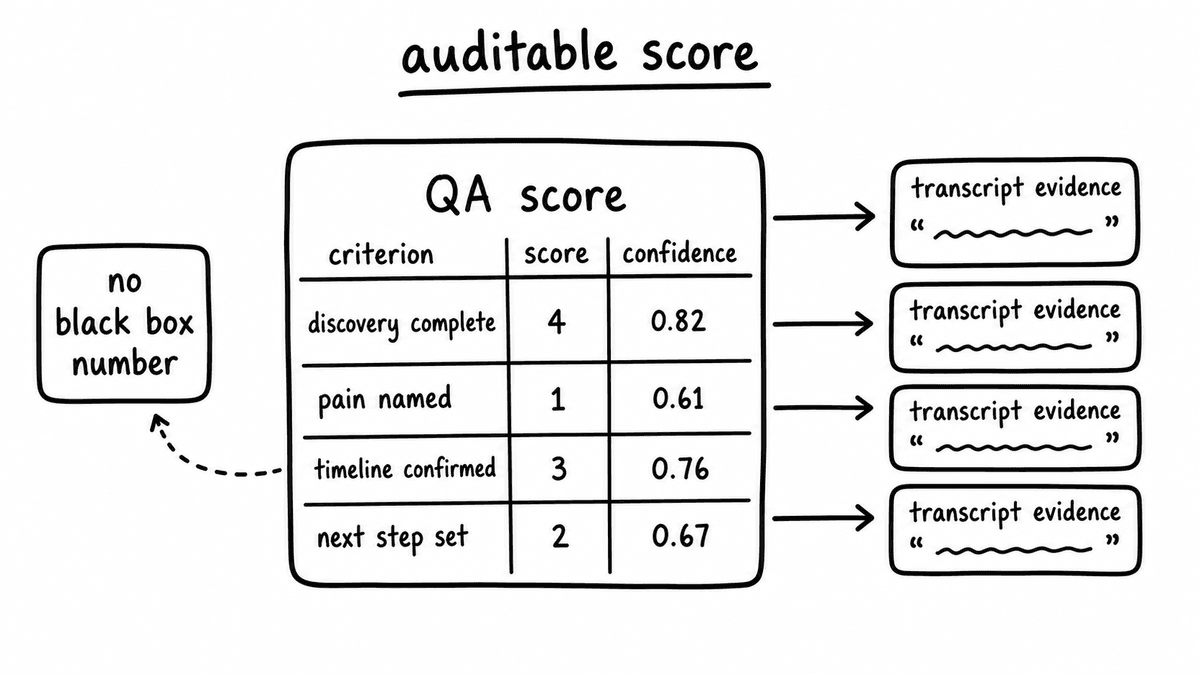
Why teams distrust automated QA scoring
The distrust is earned, and it usually traces to four specific failures rather than a general unease about AI. The first is opacity: freeform LLM scores arrive as a number with no explanation, so a manager who wants to challenge a score has nothing to point at except the model's say-so. The second is drift, where the same call scored on Monday and again on Friday returns different values because the prompt is open-ended and the model resolves ambiguity differently each time. The third is the absence of evidence, because scores that can’t cite the line in the transcript that justified them are assertions rather than measurements. The fourth is graded criteria that themselves vary, where the rubric asks whether the agent “sounded confident” and every reviewer interprets that differently.
Put those together and you get a scorecard that looks detailed but can’t survive a challenge. When a rep disputes a score there’s no evidence to resolve it, when a QA lead re-runs the batch the numbers shift, and when compliance asks how a call was assessed the answer is a paragraph of model reasoning that reads differently on the next run. Trust doesn’t fail because the model is unintelligent, but because the evaluation was never built to be checked.
What makes an automated QA score trustworthy
Automated QA scores are trustworthy when four properties hold together, and each one addresses a specific failure above. The first is determinism, meaning the same call scored twice returns the same value, so the number is a property of the call rather than a property of which run you happened to look at. The second is evidence grounding, where each score traces to a specific quote in the transcript, so a disputed result can be resolved by reading the line the evaluation cited rather than by arguing about impressions.
The third property is fixed and versioned criteria, so this month's scores compare to last month's because they were produced by the same schema rather than a subtly reworded prompt. When the criteria are locked and versioned, a trend line means something, and a change in scores reflects a change in calls rather than a change in the ruler. The fourth is clear pass conditions instead of vibes: each criterion defines what the transcript must contain for a positive result, so “did the agent acknowledge the customer's frustration before moving to resolution” replaces “was the agent empathetic.” This is the same evaluation-contract idea covered in why AI scorecards disagree: the disagreement lives in the prompt, not the model, and tightening the criterion is what removes it.
Scores that are deterministic, evidence-grounded, versioned, and defined by explicit pass conditions can be shown to a rep, re-run by a sceptic, and handed to an auditor, and they hold up in all three settings because there is something concrete to inspect at every point.
How to validate whether you can trust automated QA scoring
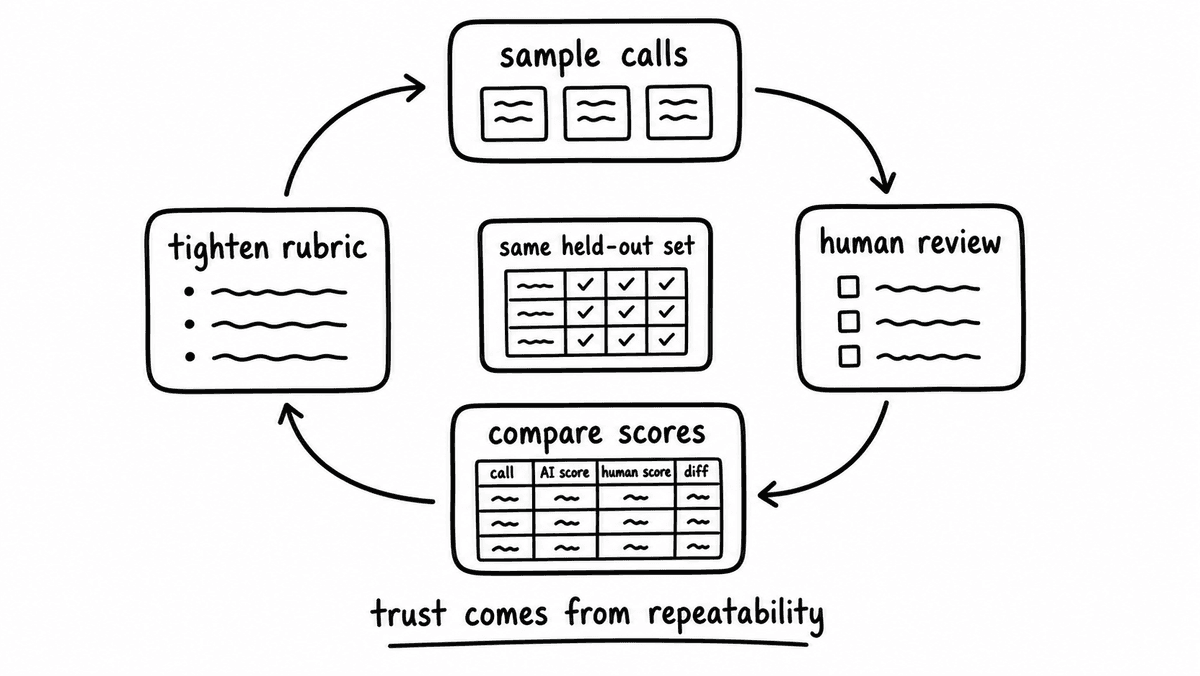
You don’t have to take any of this on faith, because trust in a scoring system is something you can measure directly with a small sample. Start by scoring a representative set of calls, ideally fifty to a hundred spanning good, poor, and ambiguous outcomes, and then run three checks against the results. The first check is inter-run consistency: score the same calls a second time and confirm the values match, because any drift here tells you the criteria are still too loose to trust at scale.
The second check is agreement with a human reviewer, where an experienced QA lead scores the same sample independently and you compare field by field. The goal isn’t perfect agreement, because humans disagree with each other too, but high agreement on the objective fields and a clear, explainable reason wherever the machine and the human diverge. The third check is where you learn the most: look specifically at the disagreements, because they tell you whether a criterion is genuinely ambiguous, whether the human was inconsistent, or whether the evidence the machine cited actually supports its call. Disagreements that resolve the moment you read the cited transcript line are a sign the system is working; disagreements nobody can adjudicate are a sign the criterion needs rewriting before you rely on it. This is the same discipline behind scoring 100% of calls without manual review, where the reviewer stops being the measurement instrument and starts maintaining it.
Auditability for compensation and compliance
The trust bar rises sharply once scores drive money or regulatory outcomes, and this is where most freeform AI scoring quietly fails. When a QA score feeds a commission adjustment, a performance-improvement plan, or a regulatory disclosure record, the score has to withstand a challenge from someone with a strong incentive to dispute it. That means every result needs to be reproducible, so the same inputs always return the same score; traceable, so each field points to the exact transcript evidence behind it; and versioned, so you can state which criteria were in force on the date the call was assessed and prove they didn’t change underneath you.
Freeform LLM scoring meets almost none of that bar, because the output varies between runs, cites no evidence, and rests on a prompt that may have been edited since the call was scored. A disputed commission clawback can’t be defended with “the model rated the call a three,” and a regulator asking how a required disclosure was verified won’t accept model reasoning that reads differently every time it is generated. Auditability isn’t an optional nicety for these uses; it’s the condition that makes the scores usable at all, and it is precisely the property that fixed, evidence-grounded evaluation is built to provide.
Where automated QA is trustworthy today, and where to keep a human
Automated QA scoring is genuinely trustworthy today for objective, evidence-checkable criteria, and this covers more of a typical rubric than most teams expect. Whether a required disclosure was spoken, whether a next step was agreed with an owner and a date, whether the customer confirmed the issue was resolved, whether a competitor was named, whether the agent used acknowledgement language before moving to a fix: these are all answerable from the transcript, and an evaluation that cites the supporting line will be right consistently and defensibly. Criteria like these are where automation earns its keep, because the machine applies the same standard to every call without fatigue, mood, or the drift that creeps into a reviewer's judgement across a long queue.
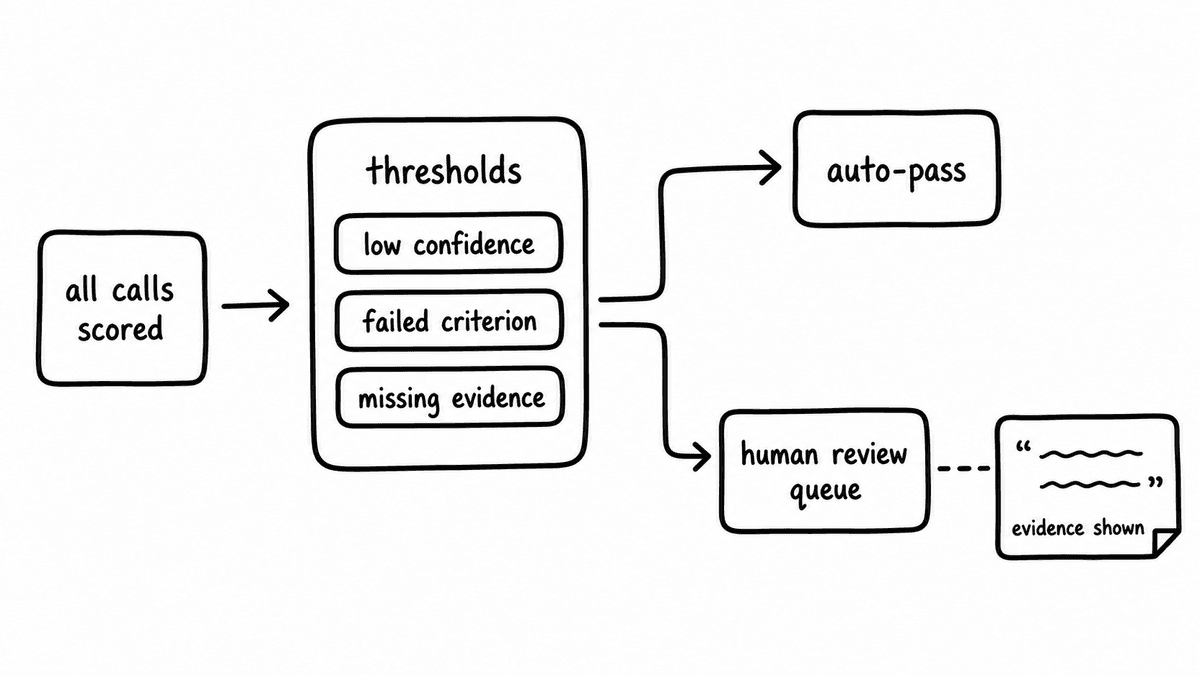
Nuanced judgement is where a human still belongs, and pretending otherwise is how scorecards become theatre. Calls that hinge on tone, on unusual context the rubric can’t anticipate, or on a defensible agent decision that technically breaks the script are cases where the evidence alone doesn’t settle the question, and those should route to a person. The workable division is that automated scoring handles the objective, high-volume majority and flags the edge cases, while human review concentrates on the genuinely ambiguous slice and on calibrating the criteria over time. This mirrors the argument in why scorecard coaching fails on buyer understanding: the machine faithfully measures whatever you define, so the trust question is really a question about how well you defined the thing.
How Semarize makes automated QA scores auditable
Semarize is built so that the four trust properties hold by construction rather than by discipline. Each criterion is defined as a Brick: one specific question, one typed output such as a boolean, a score, or a category, and a supporting quote drawn from the transcript, so every field arrives with the evidence that justifies it. Bricks are bundled into a Kit, which is versioned, so the same locked schema runs against every call and this month's scores compare cleanly to last month's. Because the criteria are fixed and the outputs are typed JSON with attached evidence, scores are reproducible, traceable, and defensible: the same call returns the same value, and any result can be checked against the line it cites.
That is what an auditable score looks like in practice, and it is useful whether or not Semarize is the tool you reach for. The principle stands on its own: define each criterion as an explicit, evidence-grounded test, lock and version the set, confirm the values are stable across runs, and reserve human judgement for the cases the evidence can’t settle. Do that, and automated QA scoring becomes something you can trust exactly because you can check it.
Semarize runs versioned, evidence-grounded QA rubrics against every call and returns typed scores with the supporting transcript quote for each field.
Common questions
Is automated QA scoring accurate?
Automated QA scores are accurate for objective, evidence-checkable criteria, and less reliable for criteria that require nuanced judgement. Whether a disclosure was spoken, a next step was agreed, or an issue was confirmed resolved can be answered consistently from the transcript, and scores that cite the supporting line can be verified. Accuracy drops when the criterion is vague, such as whether the agent sounded confident, because vague criteria produce inconsistent results regardless of whether a human or a machine applies them. The practical route to accuracy is defining each field as an explicit evidence test rather than a judgement call.
How do I know an AI call score is trustworthy?
Check four properties. The score should be deterministic, so the same call scored twice returns the same value; evidence-grounded, so it cites a specific transcript quote; produced by fixed, versioned criteria, so this month compares to last month; and defined by clear pass conditions rather than vibes. You can validate this yourself by scoring a sample of fifty to a hundred calls, re-running to confirm consistency, comparing against a human reviewer, and inspecting the disagreements. Scores you can re-run, trace to evidence, and defend to a rep are trustworthy; ones that shift between runs and cite nothing are not.
Can automated QA scores be used for compensation or compliance?
Only when the scores are reproducible, traceable, and versioned. Compensation and compliance uses raise the trust bar because the score must survive a challenge from someone motivated to dispute it, which means every result needs to reproduce on re-run, cite the exact transcript evidence behind it, and be tied to the criteria in force on the date the call was assessed. Freeform LLM scoring generally fails this bar because it drifts between runs, cites no evidence, and rests on a prompt that may have changed. Fixed, evidence-grounded evaluation with versioned criteria is what makes these higher-stakes uses defensible.
Where should a human still review calls?
Keep a human on nuanced judgement: calls that hinge on tone, unusual context the rubric can’t anticipate, or a defensible agent decision that technically breaks the script. Those are cases where transcript evidence alone doesn’t settle the question, so they should route to a reviewer rather than an automated score. Humans also belong on calibration, reviewing low-confidence results and edge cases to refine the criteria as call patterns change. The workable split is that automation handles the objective, high-volume majority and flags edge cases, while human review concentrates on the ambiguous slice and on keeping the evaluation calibrated.
Continue reading
Read more from Semarize
The 2026 Sales Call QA Stack That Actually Scales: AI Scoring, API-First Tools, and Auditable Results
A sales call QA stack limited by reviewer time can only sample. A stack with automated, auditable scoring covers every call and frees analysts to chase exceptions. Here is what each of the four layers needs to be, and which tools fit where.
Automated Sales Call Scoring
Most automated call scoring measures whether reps followed a script. Script compliance isn't the same as buyer understanding, and the scorecard that improves while win rates stagnate is the clearest sign the rubric is measuring the wrong thing.
AI Scorecards Don't Disagree. Your Prompt Does.
Inconsistent AI scorecards aren't an AI problem - they're a process failure. Freeform prompts ask the model to re-interpret evaluation criteria on every run, and that interpretation drifts with phrasing, model updates, and context. The fix is an evaluation contract: a locked schema with defined output types that produces the same result on the same call, every time.