
What’s a Good Sales Call Score? Benchmarks and How to Set Your Own
If you have searched for a good sales call score or an average SaaS sales call score benchmark, you were probably hoping for a number: a 7 out of 10 that means the discovery went well, a percentile that tells you whether your team is ahead or behind. That number doesn’t exist in any portable form, and the reason is not that nobody has measured it but that call scores are only meaningful relative to the rubric that produced them, so two teams scoring “discovery quality out of 10” against different criteria aren’t measuring the same thing and can’t be compared.
That sounds like bad news for anyone who wanted a target, but it points to a more useful answer than a fabricated industry average would. You can build a sales call score benchmark that actually means something, as long as you build it for your own rubric, your own deals, and your own definition of a good call. This post covers why a universal number is a mirage, how to set your own baseline from calls you already have, and how to keep that baseline comparable month over month so the trend is real rather than an artefact of the scoring changing underneath you.
Why there is no universal “good” sales call score
Sales call scores are only comparable within a fixed rubric, because the score is an output of the criteria, the weights, and the evidence thresholds behind it. When one team scores discovery on whether the rep asked open questions and set an agenda, and another scores it on whether the buyer stated a quantified problem and named a timeline, a 7 from the first team and a 7 from the second describe two different calls. Neither number is wrong, but neither travels: you can’t lift a benchmark out of one rubric and apply it to another, and any public “average SaaS sales call score” figure you find has been averaged across rubrics that were never reconciled.
There are three reasons a portable benchmark number doesn’t survive contact with reality. The first is rubric dependence, which is the problem above: the same call scores differently under different criteria, and there’s no canonical rubric that everyone shares. The second is drift, because most scoring is done by people or by prompts that change over time, so last quarter’s 6 and this quarter’s 6 were produced by subtly different standards even inside one team. The third is the confusion between rep-side and buyer-side scoring: a score that measures what the rep did (talk ratio, questions asked, next step mentioned) answers a different question from a score that measures what the buyer revealed (a consequence stated, an economic buyer named, a committed next step), and blending them into one figure hides which one moved.
How to set your own baseline sales call score
The benchmark you want is not an industry figure; it is a distribution of your own calls, and you can build it in an afternoon from calls you already have. Start by pulling a sample of recent calls where you already know the outcome: a handful that turned into strong, well-qualified opportunities, and a handful that stalled or died for reasons that were visible on the call. Fifty of each is plenty to see a shape, and even twenty of each will tell you something. Score every call in the sample against a single, written-down rubric, and resist the urge to adjust the criteria as you go, because a rubric that shifts mid-sample gives you a distribution you can’t trust.
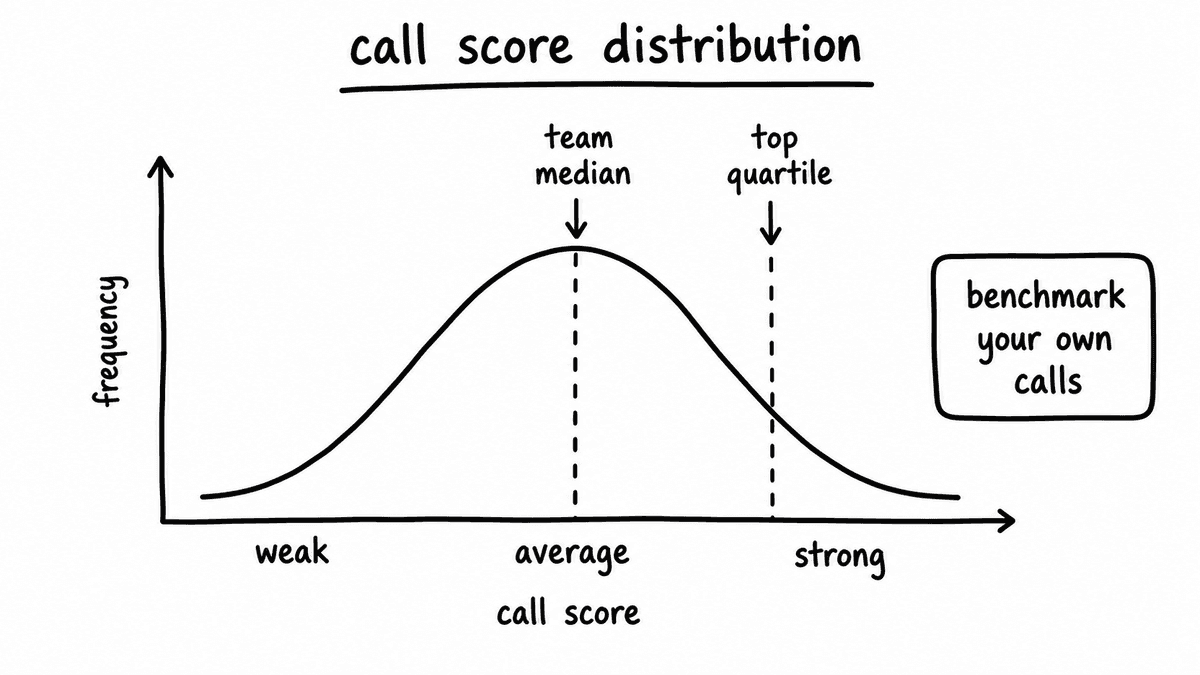
Once the sample is scored, look at the distribution rather than the mean. Plot where the known-good calls land and where the known-bad calls land, and the useful thresholds fall out of the overlap: the score below which almost every call was one you wouldn’t want to forecast, and the score above which the calls were reliably worth advancing. Those two lines, taken from your own percentiles, are the baseline. Calls that land in the bottom quartile of your own historical distribution are coaching conversations waiting to happen, whatever some external average claims, and calls in the top decile are patterns worth studying and repeating. The number on its own still means nothing to an outsider, but inside your team it now has a reference distribution behind it, which is what makes it usable.
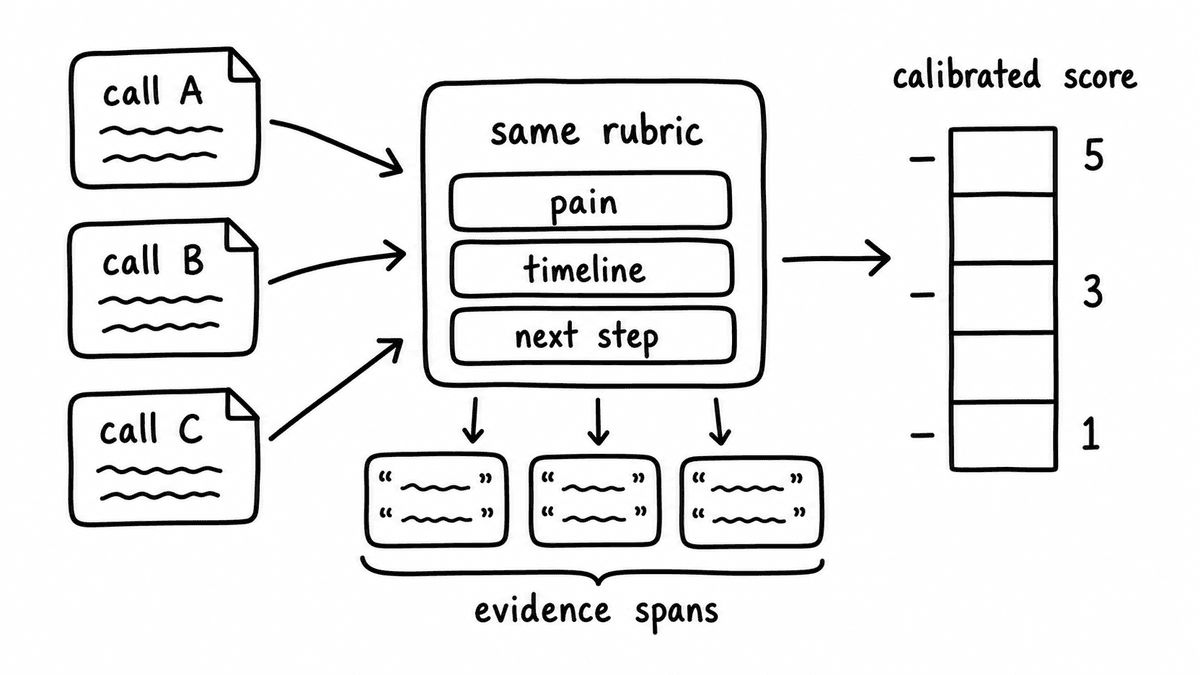
This is also the point where the choice of scoring engine matters. A baseline built by hand decays the moment the people scoring change their standards, so if you want the distribution to stay meaningful you need the scoring to be repeatable. Defining each criterion as a typed evaluation, a Brick that returns a boolean, a score, or a category with the transcript evidence attached, means the same call scored twice returns the same value, and the baseline you set today is still the baseline next month.
What makes a sales call score comparable over time
A benchmark is only worth setting if this month’s scores can be compared to last month’s, and that comparison holds only when the rubric behind the scores is fixed and versioned. Manual scoring drifts because reviewers recalibrate without noticing, and prompt-based scoring drifts because a reworded instruction quietly changes what counts as a 7. Either way, a rising average can mean the calls got better or it can mean the standard got softer, and you have no way to tell the two apart unless the scoring definition is pinned down and dated.
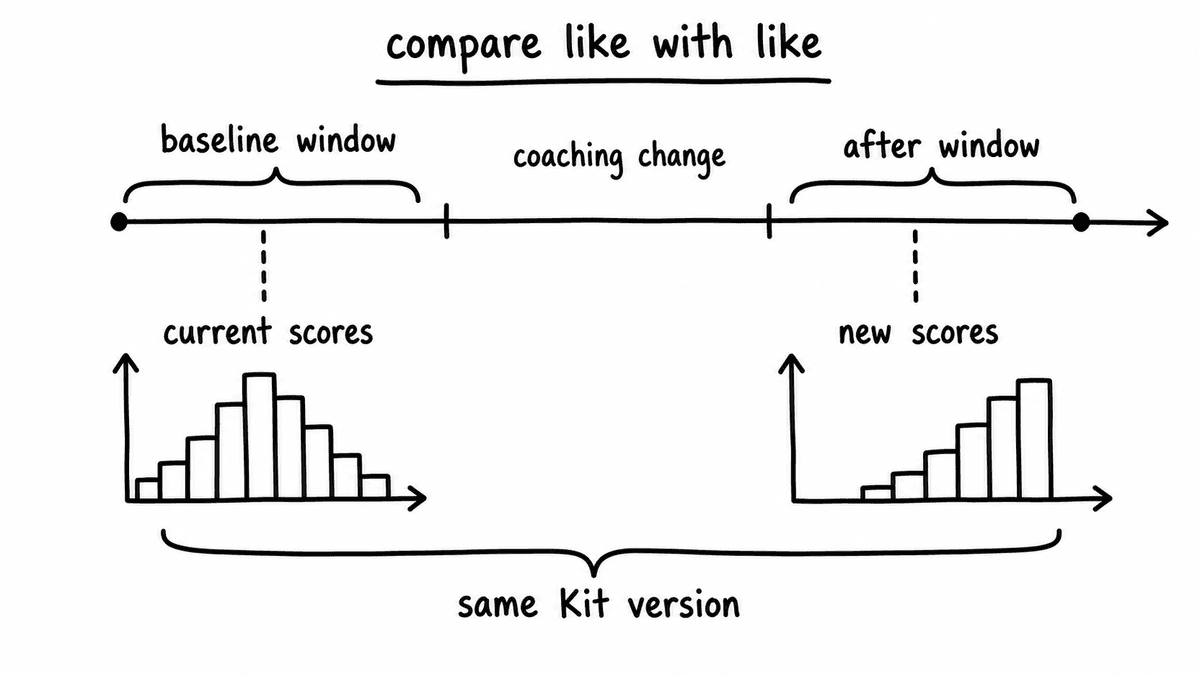
This is the specific problem that versioned evaluation schemas solve. When a group of criteria is bundled into a Kit and that Kit is versioned, the field names, the value types, and the criteria are frozen for as long as that version is live, so every call scored under Kit v3 is comparable to every other call scored under Kit v3. When you genuinely need to change the rubric, you publish a new version and keep the version stamped on each score, which means you can still read the old trend on its own terms and start a fresh trend on the new one. The same discipline that runs 100% QA scoring without manual review is what makes a call-score trend line trustworthy: deterministic rubrics produce comparable numbers, and comparable numbers are the only kind you can benchmark against yourself.
The signals worth scoring instead of one blended number
A single call score out of 10 is convenient to report and easy to game, and it hides the thing you actually want to know, which is what happened in the buyer’s head. The signals that predict whether a deal advances are buyer-side and specific: whether the buyer stated a consequence of not solving the problem, whether a real timeline was named rather than implied, whether the economic buyer was identified, and whether a next step was committed to with an owner and a date rather than left as a vague follow-up. Each of those is a discrete question with a verifiable answer in the transcript, and each is far more useful as a tracked field than as a sliver of a blended average.
Scoring buyer-side evidence rather than rep behaviour changes what the benchmark can tell you. A rep can hit every process checkbox while the buyer leaves without stating any consequence, and a blended score will happily call that a good call; a set of buyer-side signals will show the consequence field empty and the timeline field null, which is the honest picture. This is the same argument that runs through why AI scorecards become theatre when they only measure rep inputs: the number can look strong while the conversation did nothing, and only buyer-side evidence closes that gap. Keeping the individual signals alongside any composite score means you can always ask which signal moved, rather than trusting a figure that averages away the answer.
Using the baseline for coaching and pipeline health
Once you have a baseline distribution and a fixed rubric, the score becomes a routing signal rather than a verdict. For coaching, the useful move is to compare a rep’s calls against your own distribution and look at which specific signals sit low, so instead of telling a rep their calls score 5 out of 10 you can tell them their calls consistently miss the consequence and the committed next step, which is a coachable behaviour rather than an abstract grade. Tracking lift on those individual signals over time is a far better proof that coaching worked than watching a composite average creep up, because the composite can rise for reasons that have nothing to do with the conversations getting better.
For pipeline health, the baseline lets you read deals by the evidence underneath them rather than by the stage label a rep applied. A pipeline full of Proposal-stage deals whose discovery calls scored in your bottom quartile, with no economic buyer named and no committed next step, is a forecast risk that a stage-based view will never show you. The point is not to over-index on one figure and start managing to the number, which recreates the gaming problem in a new place; it is to use the score as one input that flags where to look, and then read the buyer-side signals to understand what’s actually true about the deal. That is the difference between a benchmark that improves decisions and a benchmark that just gives everyone a new metric to optimise, which is why the honest answer to “what is a good sales call score” is a distribution you own rather than a number someone else made up. The failure mode of coaching to a single score is covered in more depth in why AI scorecard coaching fails on buyer understanding.
Semarize turns each scoring criterion into a typed, versioned evaluation, so the baseline you set from your own calls stays comparable month over month instead of drifting under you.
Common questions
What is the average sales call score for SaaS teams?
There is no portable average, and any figure presented as one is noise. Call scores are outputs of the rubric that produced them, so a 7 scored against one set of criteria describes a different call from a 7 scored against another, and public averages have been blended across rubrics that were never reconciled. The useful number is not an industry average but the distribution of your own calls scored against one fixed rubric, which tells you where a given call sits relative to your own known-good and known-bad calls rather than relative to a figure nobody defined.
How do I set a baseline sales call score?
Pull a sample of recent calls where you already know the outcome, roughly twenty to fifty that became strong opportunities and a similar number that stalled, and score every one against a single written-down rubric without changing the criteria as you go. Then look at the distribution rather than the mean: the score below which almost every call was one you wouldn’t forecast, and the score above which calls were reliably worth advancing, are your thresholds. Those two percentiles, taken from your own calls, are the baseline, and a repeatable scoring engine keeps them stable.
What score means a discovery call was good?
No single number answers that on its own, because what makes a discovery call good is the buyer-side evidence rather than a blended figure. The signals worth checking are whether the buyer stated a consequence of not solving the problem, whether a real timeline was named, whether the economic buyer was identified, and whether a next step was committed to with an owner and a date. Calls that carry those signals sit in the top of your own distribution; a high score with the consequence and next-step fields empty is the kind of call a rep-behaviour rubric flatters and a buyer-side rubric flags.
How do I keep call scores comparable over time?
Fix the rubric and version it, so the criteria, field names, and value types are frozen for as long as that version is live and every call scored under it is comparable to every other. Manual scoring drifts as reviewers recalibrate, and prompt-based scoring drifts when instructions are reworded, so a rising average can mean better calls or a softer standard with no way to tell which. Versioned evaluation schemas, such as Semarize Kits, stamp each score with its version, which lets you read the old trend on its own terms and start a fresh one when the rubric genuinely changes.
Continue reading
Read more from Semarize
Automated Sales Call Scoring
Most automated call scoring measures whether reps followed a script. Script compliance isn't the same as buyer understanding, and the scorecard that improves while win rates stagnate is the clearest sign the rubric is measuring the wrong thing.
100% QA Scoring Without Manual Review: Deterministic Rubrics for Every Call
Manual QA sampling at 2–5% has two problems: coverage and consistency. Automated scoring with deterministic rubrics solves both - every call gets scored the same way, with no reviewer required to generate the result. The shift isn't just efficiency - it changes what coaching is built from and turns compliance verification from sampling into complete coverage.
Why Coaching From AI Scorecards Usually Fails (And What the Score Actually Needs to Measure)
Most AI scorecards measure rep activity, not buyer understanding. Coaching from activity scores improves script adherence, not deal quality. The score that changes coaching behaviour measures buyer-side evidence: what the buyer said, confirmed, and left unaddressed.